Guides / Star Charts
Contributions
If you like the website and want to contribute to the running costs then please do so below. All contributions are most welcome.
NGC 752 - Open Cluster
NGC 752 is a large sprawling open cluster in the constellation of Andromeda. With an apparent magnitude of +5.7 it's visible to the naked eye from a dark site, appearing as a large unresolved fuzzy patch of light. The cluster is one of the finest large open clusters in the sky and contains over 70 stars spread across a huge 1.25 degrees of apparent sky. Due to its size, NGC 752 is best observed with binoculars or wide field telescopes at low powers.
NGC 752 is located 5 degrees south and slightly west of outstanding double star Almach (γ And - mag. +2.1), the third brightest star in Andromeda. This cluster was discovered by Caroline Herschel on September 29, 1783 although it was probably observed sometime before 1654 by Italian astronomer Giovanni Battista Hodierna. Caroline's brother, William Herschel, subsequently added it to his catalogue a couple of years later.
NGC 752 is best seen from northern latitudes during the months of October, November and December. It's number 28 in the Caldwell catalogue.

Messier 23 - M23 - Open Cluster
M23 is a pretty open cluster that's located in the rich starfields of the Sagittarius Milky Way. With an apparent magnitude of +6.9, it's beyond naked eye visibility but a nice binocular object and a glorious sight through small telescopes. This vast cloud of about 150 stars is located 2,150 light-years from Earth and has an actual diameter of about 20 light-years. With an estimated age of at least 220 million years old, it's one of the galaxy's oldest open clusters.
M23 was discovered by Charles Messier on June 20, 1764. It can be easily found just northwest of the teapot asterism of Sagittarius. The three stars that form the top of the teapot are φ Sgr (mag. +3.2), Kaus Borealis (λ Sgr - mag. +2.8) and Kaus Media (δ Sgr - mag. +2.7). Positioned 6 degrees northwest of Kaus Borealis is μ Sgr (mag. +3.8). M23 can be found 4.5 degrees northwest of this star and approximately 2/5ths of the way along a line connecting μ Sgr with ξ Ser (mag. +3.5). Located 5 degrees east of M23 is M24, the very large Sagittarius Star Cloud.

NGC 2775 - Spiral Galaxy
NGC 2775 is a magnitude +10.5 spiral galaxy located in the constellation of Cancer, close to its border with Hydra. This galaxy is unusual in that it contains a very smooth nucleus with multiple spiral arms extending outwards from the central region. What makes the spiral arms interesting are their incredible complex detail, tightly wound structures and active star formation. Amateur astronomers should also keep their eye on this galaxy; it's been host to 5 supernovae explosions in the past 30 years and you never know when the next one will go off!
To find NGC 2775 look for the head of Hydra "the Sea Serpent". The asterism of stars that forms the head are ω Hyd (mag. +5.0), ζ Hyd (mag. +3.1), ρ Hyd (mag. +4.4), ε Hyd (mag. +3.4), δ Hyd (mag. +4.1), σ Hyd (mag. +4.5) and η Hyd (mag. +4.3). None of these stars are particularly bright, but all can be seen with the naked eye. The galaxy is positioned a few degrees east and slightly north of this grouping.
NGC 2775 was discovered by William Herschel in 1783 and is best seen during the months of February, March and April. The galaxy is located 55.5 million light-years from Earth and has an actual diameter of 70,000 light-years. It's estimated to contain 100 billion stars. NGC 2775 is number 48 in the Caldwell catalogue.
Messier 106 - M106 - Spiral Galaxy
M106, mag. +8.5, is a large spiral galaxy located in Canes Venatici that was discovered by Pierre Méchain in July 1781. He described it in little detail, referring to nothing more than a nebula close to star 3 Canum Venaticorum. It was rediscovered by William Herschel on March 9, 1788. Since Herschel was using a better telescope, he was able to see much more detail and noted it as "very brilliant with a bright nucleus and faint milky branches north preceding and south following." Although not one of Messier's final catalogue entries, this galaxy was included by Helen Sawyer Hogg in 1947 along with M105 and M107. It's reasonable to assume that all three were intended for addition by Méchain and Messier.
M106 is one of the brightest examples of a Seyfert type II galaxy and is therefore a strong X-ray emitter with unusual emission lines, which are believed to result from sections of the galaxy falling into the central supermassive black hole. American astronomer Carl Seyfert first identified this class of object in 1943.
This galaxy is located towards the northwestern corner of Canes Venatici, a faint constellation with only one reasonably bright star, Cor Caroli (α CVn - mag. +2.9). However, locating M106 is not difficult as the Plough or Big Dipper asterism of Ursa Major acts as a useful starting point. Focus on Megrez (δ UMa - mag. +3.2) the faintest star of the Plough and then move 5.5 degrees south and slightly east to reach 5 Canum Venaticorum (mag. +4.8). M106 is located just over 4 degrees south of 5 Canum Venaticorum with star 3 Canum Venaticorum (mag. +5.3) positioned halfway between them.
M106 is best seen from the Northern Hemisphere during the months of March, April and May. From southern temperate latitudes, it's a difficult object that never rises particularly high above the northern horizon.

Algol eclipse dates and times for June 2019
Algol (β Per) is a bright eclipsing binary system located in the northern constellation of Perseus and one of the best-known variable stars in the sky. Often referred to as the "Demon Star", most of the time it shines at mag. +2.1 but every two days, 20 hours and 49 minutes it suddenly dips in brightness to mag. +3.4, remaining dim for about 10 hours before returning to its original state.
Why the brightness change. The Algol system consists of at least three-stars (β Per A, β Per B and β Per C) with the orbital plane of Algol A and B directly in line with the Earth. The regular dips in brightness occur when the dimmer B star moves in front of and eclipses the brighter A star. There is also an extra dimension in that a secondary eclipse occurs when the brighter star occults the fainter secondary, resulting in a very small dip in brightness that can be detected with photo-electrical equipment.

Algol is located in Perseus among the stars of the northern Milky Way. It's positioned west of mag. +0.1 Capella (α Aur) and southeast of the well known "W" of Cassiopeia. The finder chart below shows the position of Algol along with magnitude data of some surrounding stars for comparative purposes.
NGC 2477 - Open Cluster
NGC 2477 is a stunning open cluster located in the Milky Way rich constellation of Puppis. It's arguably the constellation's finest cluster, which also contains other superb examples such as M46, M47 and M93. At magnitude +5.8, NGC 2477 is faintly visible to the naked eye, but easily seen with binoculars and a fantastic telescope object especially in medium to large scopes. It's listed as number 71 in the Caldwell catalogue.
The cluster was discovered by French astronomer Nicolas Louis de Lacaille during his tour of South Africa in 1751-52. In total it contains about 300 stars packed into an area 27 arc minutes in diameter with the brightest member star shining at magnitude +9.8. The four-magnitude difference between the combined cluster magnitude and the brightest component is an indication of how rich the cluster is.
NGC 2477 is too far south to have been included in Charles Messier's catalogue, but if he had observed from a more southerly latitude than Paris he almost certainly would have noticed this striking object. Twentieth century America astronomer Robert Burnham described NGC 2477 as "probably the finest of the galactic clusters in Puppis".
The cluster is easily found 2 degrees northwest of zeta Pup (ζ Pup - mag. +2.2) and just northwest of magnitude +4.5 star, b Pup. Located 1.5 degrees west of NGC 2477, and in the same binocular field of view, lies large loose open cluster NGC 2451. Another binocular open cluster, NGC 2546, is positioned 4 degrees east of NGC 2477. They are best seen from southern latitudes during the months of December, January and February.

Messier 20 - M20 - Trifid Nebula (Emission and Reflection Nebula)
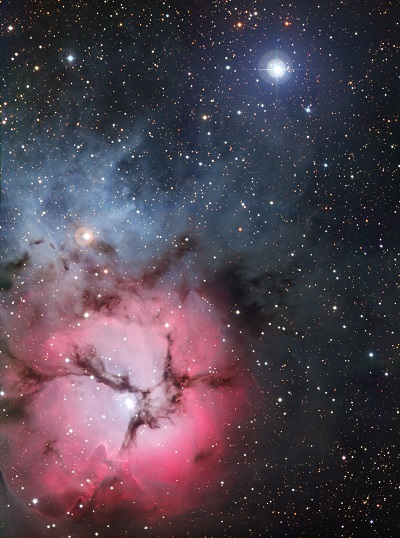
M20 is the famous Trifid Nebula, a bright colourful emission and reflection nebula that's located in the constellation of Sagittarius. At magnitude +6.3, it's visible with binoculars. This remarkable object not only contains an emission and reflection nebula but also a dark nebula and an embedded open cluster. When photographed or imaged it looks spectacular, with the emission nebula appearing red, the reflection nebula blue and numerous dark lanes mixed in between. The dark lanes appear to cut through the nebula splitting it into three prominent sections, hence the popular name Trifid, which means divided into three lobes.
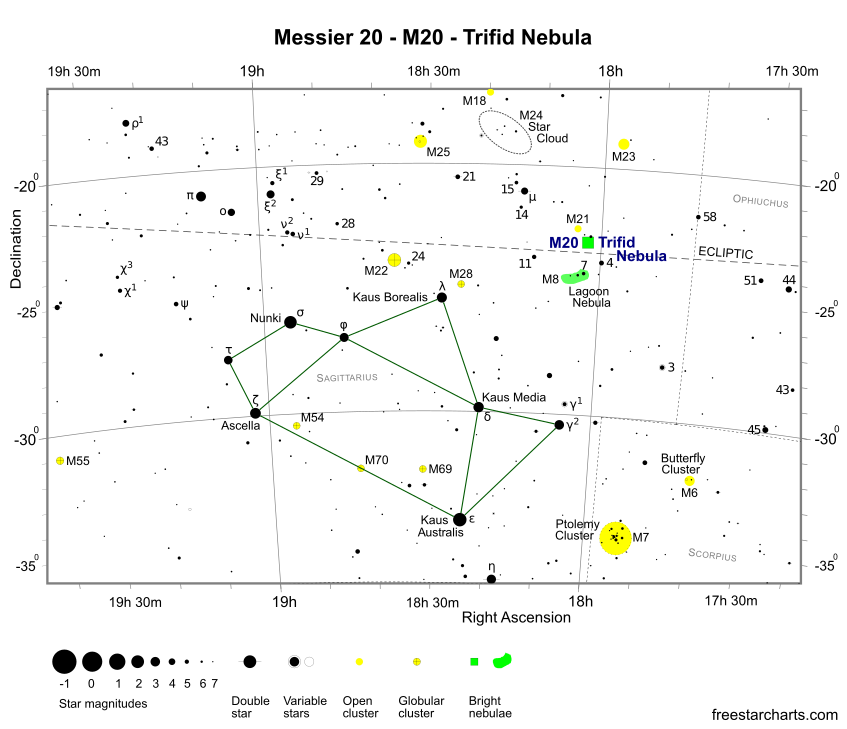
The much larger and brighter Lagoon Nebula (M8) is located two degrees south of M20, with tightly packed open cluster M21 positioned 0.75 degrees northeast of M20.
Charles Messier discovered both M20 and M21 on June 5, 1764. He referred to M20 as an envelope of nebulosity. The surrounding area of sky is the richest part of the Milky Way. Here you are looking towards the direction of the galactic centre, hence the abundance of stars, open clusters, globular clusters and nebulae. This wonderful region of sky is perfect to scan with binoculars or small telescopes, especially at low magnifications.
To locate the Trifid, first focus on the bright familiar teapot asterism of Sagittarius. The top three stars of the teapot are Kaus Borealis (λ Sgr - mag. +2.8), Kaus Media (δ Sgr - mag. +2.7) and φ Sgr (mag. +3.2). Imagine a line connecting φ Sgr to Kaus Borealis and then extending it for just over 6 degrees to arrive at M20.
The Trifid is best seen from southern and equatorial regions during the months of June, July and August.
The Planets this Month - May 2019
Mercury
Mercury is visible as an early morning object from southern and temperate locations during the first week of May. The innermost planet shines at about magnitude -0.5 and can be seen a few degrees above the eastern horizon with much brighter Venus just above. On May 3rd, the very thin crescent waning Moon will appear 3 degrees from Mercury. For the final three weeks of the month, the planet is no longer visible as it passes through superior conjunction on May 21st.
From northern temperate latitudes, Mercury is unsuitably placed for observation throughout May.
Venus
Venus is positioned too close to the Sun to be visible this month from northern latitudes. For observers located further south, the brightest planet remains a morning object, low down, in morning twilight. It shines at magnitude -3.8, and on May 2nd, the crescent Moon passes 4 degrees south of Venus.
Mars
Mars, mag. +1.7, is visible in the early evening skies throughout May. From northern latitudes, the red planet can be seen at the beginning of the month for about 3 hours after sunset, although the visibility period reduces by over an hour by months end. From southern and temperate locations, Mars sets about 2 hours after the Sun.
On May 7th, the thin waxing crescent moon will pass 3 degrees south of the planet.
NGC 40 - Bow Tie Nebula - Planetary Nebula
NGC 40, mag. +10.7, is a planetary nebula located in the northern constellation of Cepheus. It was discovered by William Herschel on November 25, 1788. He described it as "a 9th magnitude star, surrounded with milky nebulosity". Herschel used his 475mm (18.7-inch) telescope to make the discovery, but today's amateur astronomers don't require such a large instrument and it can be glimpsed with just a 100mm (4-inch) refractor. NGC 40 is also known as the Bow Tie nebula, a nickname it shares with another planetary nebula, NGC 2440 in Puppis. It's listed as number 2 in the Caldwell catalogue.
NGC 40 is located just over 17 degrees from the North Celestial Pole and is therefore circumpolar from most northern latitudes. It's one of the finest examples of its type in the far northern section of sky. The best time to look for the nebula is during October, November and December when it appears high in the sky during early evening. The Bow Tie nebula is also visible, although lower down, from most tropical latitudes. However, from southern temperate locations it never rises above the horizon.
Finding NGC 40 can be tricky as it's positioned in a star poor region of eastern Cepheus. One method is to imagine a line connecting Errai (γ Cep - mag. +3.21) with γ Cassiopeiae (mag. +2.15). The planetary lies approximately one-third of the way along this line.
Messier 54 - M54 - Globular cluster
M54 is a globular cluster in Sagittarius that’s a staggering 87,400 light-years from Earth. It was discovered by Charles Messier on July 24, 1778 and was for many years thought to be part of the Milky Way but is now believed to belong to the nearby Sagittarius Dwarf Elliptical Galaxy. It owns the distinction of being the first extragalactic globular cluster ever discovered, even though it wasn't recognised as such for over 200 years. Despite its vast distance, M54 is visible in binoculars albeit faintly at mag. +7.9. The fact that it can be seen in binoculars at all is incredible, which is a testament to its large intrinsic size and high absolute brightness. With a diameter of over 300 light-years, it's one of the largest globular's known.
Finding M54 is easy as it lies within the teapot asterism of Sagittarius. The starting point is to focus on the base of the teapot and image a line connecting Ascella (ζ Sgr - mag. +2.6) with Kaus Australis (ε Sgr - mag. +1.8). Positioned about 1.75 degrees along this line and slightly to the north is M54. With a declination of -30 degrees, the cluster is best seen from the Southern Hemisphere during the months of June, July and August. From northern temperate latitudes it’s a more difficult target that never rises high above the horizon.

NGC 188 - Open Cluster
NGC 188 is an open cluster located in the far northern constellation of Cepheus. John Herschel, the son of William Hershel, discovered it on November 3, 1831. He originally recorded it as h34 in his 1833 catalogue and then as GC92 in his General Catalogue of 1864. The cluster eventually became NGC 188 in John L.E. Dreyer's New General Catalogue of 1888.
NGC 188 is positioned 4.75 degrees from the North Celestial Pole and is the northernmost open cluster in the sky. It's effectively circumpolar from all Northern Hemisphere locations. However, it can never be seen from latitudes south of 5 degrees south.
Messier 110 - M110 - Dwarf Elliptical Galaxy
M110 is a dwarf elliptical galaxy located in the constellation of Andromeda. It's one of many satellite galaxies orbiting M31, the famous and spectacular Andromeda galaxy. Of these, at least 14 are dwarf galaxies with M110 being the second brightest (after M32). The galaxy is classified as Hubble type E5 and designated as peculiar, due to unusual dark structures that are probably caused by dust clouds.
At magnitude +8.7, M110 is a challenging binocular object. It covers 22 x 11 arc minutes but suffers from low surface brightness and therefore even a small amount of light pollution can render it invisible. Surprisingly, Charles Messier never included it in his famous list. However he depicted it, together with M32, on a drawing of the Andromeda galaxy that he made on August 10, 1773. Caroline Herschel independently rediscovered the galaxy on August 27, 1783. Much later in 1967, Kenneth Glyn Jones suggested assigning a Messier number. Although now commonly known as M110, it's still often referred to in many texts and charts by its New General Catalogue designation, NGC 205.
To find M110, first locate the Andromeda Galaxy, which is positioned northeast of the Great Square of Pegasus. Of the four stars of the square only three of them actually belong to Pegasus. The northeast corner star, Alpheratz (α And - mag. +2.1), is part of neighbouring Andromeda. Located 7 degrees northeast of Alpheratz is δ Andromedae (mag. +3.3) and a further 8 degrees to the northeast is Mirach (β And - mag. +2.1). The Andromeda galaxy is another 8 degrees northwest of Mirach at the end of a line connecting μ Andromedae with ν Andromedae. M110 is positioned 36 arc minutes northwest of the centre of M31.
The galaxies are best seen from the Northern Hemisphere locations during the months of September, October and November.
NGC 2392 - The Eskimo Nebula - Planetary Nebula
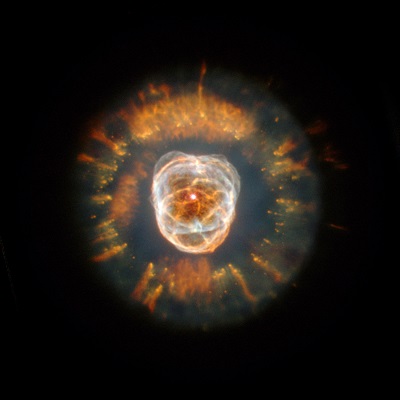
NGC 2392 is a 9th magnitude bipolar double shell planetary nebula located in the constellation of Gemini. Resembling a person's head surrounded by a parka hood, it's commonly known as the "Eskimo Nebula" or "Clown Face Nebula". William Herschel discovered this planetary nebula from his observatory in Slough on January 17, 1787, describing it as a 9th magnitude star with a bright centre surrounded by equally dispersed nebulosity.
Locating the Eskimo Nebula is relatively easy since it's positioned just east of constellation centre and close to Wasat (δ Gem - mag. +3.5). The easiest way to find Gemini is by identifying its two brightest stars Castor (α Gem - mag. +1.58) and Pollux (β Gem - mag. +1.16). They are positioned east of the Hyades open cluster in Taurus and northeast of the bright prominent constellation of Orion.
Imagine a line extending from Pollux - the brighter of the twins - in a southwesterly direction towards Orion's belt. Positioned just over 8 degrees along this line is Wasat and 2.3 degrees southeast of Wasat is NGC 2392. The planetary nebula is positioned next to a mag. +8.2 yellow-white star. Through a telescope the pair appears as a wide double star, separated by about 100 arc seconds.
Messier 66 - M66 - Intermediate Spiral Galaxy
M66 is a superb bright intermediate spiral galaxy located in the constellation of Leo. It's the brightest of a trio of galaxies that forms - along with M65 and NGC 3628 - the well known and popular Leo Triplet or M66 group. All three objects can be observed with small telescopes in the same low power field of view. After the M81/M82 pair in Ursa Major, the Leo Triplet is arguably the next most sought after galaxy grouping for amateur astronomers.
Charles Messier discovered both M66 (mag. +8.9) and M65 (mag. +9.6) on March 1, 1780. The apparent magnitude of the third member of the triplet, NGC 3628, is unclear. Some texts record it as the brightest group member, while others have it as the faintest. For our purposes we estimate NGC 3628 to be brighter than M65 and almost as bright as M66. However, what is clear is that it suffers from a low surface brightness and therefore is the most difficult member of the trio to spot. Messier missed it completely and it was not until April 8, 1784 when it was finally discovered by William Herschel.
To find the triplet, look to the eastern part of Leo. This zodiac constellation is relatively large and bright and somewhat looks like the Lion that it's supposed to represent. The brightest star in Leo and its only first magnitude star is Regulus (α Leo – mag +1.4). Positioned approximately 16 degrees northeast of Regulus is Chertan (θ Leo - mag. +3.3). Along with the Zosma (δ Leo - mag. +2.6) to the north and Denebola (β Leo - mag. +2.1) to the east, Chertan forms a prominent right-angled triangle. Located 2 degrees south of Chertan is 73 Leonis (mag. +5.3). M65 lies 0.75 degrees east of this star with M66 a further 0.33 degrees southeast of M65. NGC 3628 is positioned 0.5 degrees north of the Messier pair.
The galaxies are best seen during the months of March, April and May.


The Planets this Month - April 2019
Mercury
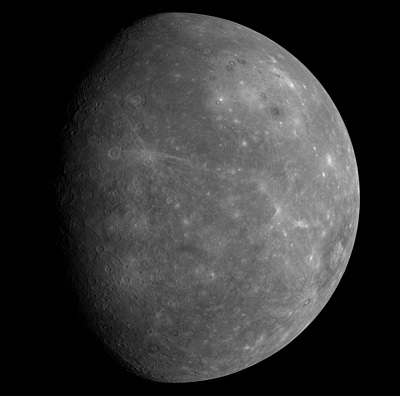
Mercury reaches greatest elongation west (GEW) on April 11th when it will be situated 27 degrees from the Sun in the morning sky. From northern temperate latitudes, the planet is not well placed for observation, and even at GEW it hugs the east-southeastern horizon just before sunrise, shining at magnitude +0.4. Much brighter Venus (mag. -3.9) lies a few degrees from Mercury. Both planets battle against the bright twilight sky.
From southern and equatorial latitudes, early morning observers are rewarded with great opportunities to spot Mercury as it shares the view with Venus. Much fainter Neptune, mag. +8.0, is also in same region of sky. On April 2nd, Neptune appears only 0.4 degrees south of Mercury (mag. +0.8) with the thin crescent Moon 4 degrees to the south. Mercury and Venus are at their closest on April 16th, when just over 4 degrees apart, with both planets visible throughout the month.
Venus
Venus shines at magnitude -3.9 throughout April. As the month progresses its angular size reduces from 13.1 to 11.6 arc seconds with its illuminated disk increasing from 81% to 86%. From northern locations, Venus hugs the horizon just before sunrise and by months end will be difficult to spot.
As previously mentioned, from southern and equatorial latitudes, Venus and Mercury are well placed in the morning sky this month with much fainter Neptune also nearby.
Mars
Mars remains visible after sunset throughout April. The red planet is now towards the lower end of its brightness scale and fades from magnitude +1.5 to +1.6 this month. From northern temperate locations, it still sets over 3 hours after the Sun by months end. However, those located further south don't have it quite so good with a visibility period of up to 2 hours less.
Mars is currently moving through Taurus and is between the Pleaides (M45) and Hyades open clusters during the first week of the month. On April 9th, the thin waxing crescent passes 5 degrees south of Mars. A week later Mars passes 7 degrees north of first magnitude star, Aldebaran (mag. +0.9).
Messier 7 - M7 - The Ptolemy Cluster (Open Cluster)
M7 is a large magnificent naked eye open cluster located in the constellation of Scorpius. It's one of the brightest open clusters and has been known since ancient times. It was first recorded in 130 AD by Greek-Roman astronomer Ptolemy and in recognition of this early observation, M7 is often referred to as the Ptolemy Cluster. Italian astronomer Giovanni Batista Hodierna observed 30 stars sometime before 1654 and Charles Messier adding it to his catalogue in 1764.
With a combined magnitude of +3.3, M7 is the brightest and most obvious deep sky object in Scorpius. It's a giant group of 80 stars with an apparent diameter of 80 arc minutes, almost 3x that of the full Moon. To the naked eye, M7 appears as a very large hazy patch with its brightest stars just about resolvable. It's so bright that it's even noticeable under suburban skies. With a declination of -34.8 degrees, the cluster is the southernmost Messier object and therefore best seen from the Southern Hemisphere particularly during the months of June, July and August. From most northern temperate locations it appears low down, at best climbing just a few degrees above the horizon. From northern latitudes above 56 degrees it never even rises.
M7 is located in eastern Scorpius, close to the Sagittarius border. It's positioned 4.75 degrees northeast of the constellations second brightest star, lambda Sco (λ Sco - mag. +1.6). Also known as Shaula, λ Sco marks the end of the Scorpions tail and part of the stinger. The Butterfly Cluster (M6) is located 4 degrees northwest of M7.


Finder Chart for M7 - pdf format (credit:- freestarcharts)
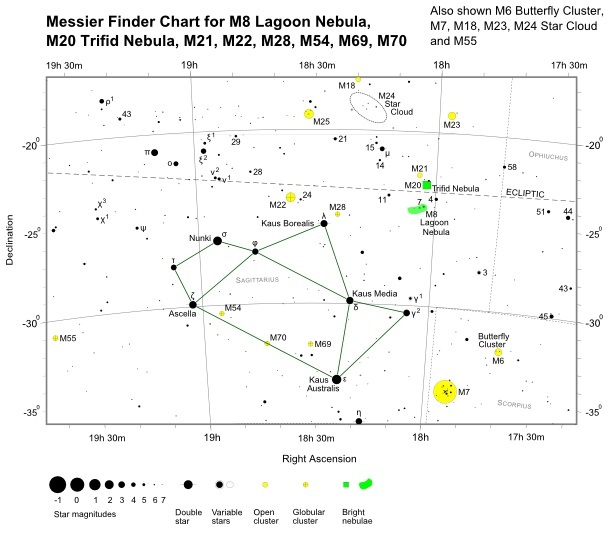
Finder Chart for M8 (also shown M6, M7, M18, M20->M24, M28, M54, M55, M69 and M70) - pdf format
Algol eclipse dates and times for May 2019
Algol (β Per) is a bright eclipsing binary system located in the northern constellation of Perseus and one of the best-known variable stars in the sky. Often referred to as the "Demon Star", most of the time it shines at mag. +2.1 but every two days, 20 hours and 49 minutes it suddenly dips in brightness to mag. +3.4, remaining dim for about 10 hours before returning to its original state.
Why the brightness change. The Algol system consists of at least three-stars (β Per A, β Per B and β Per C) with the orbital plane of Algol A and B directly in line with the Earth. The regular dips in brightness occur when the dimmer B star moves in front of and eclipses the brighter A star. There is also an extra dimension in that a secondary eclipse occurs when the brighter star occults the fainter secondary, resulting in a very small dip in brightness that can be detected with photo-electrical equipment.
Algol is located in Perseus among the stars of the northern Milky Way. It's positioned west of mag. +0.1 Capella (α Aur) and southeast of the well known "W" of Cassiopeia. The finder chart below shows the position of Algol along with magnitude data of some surrounding stars for comparative purposes.
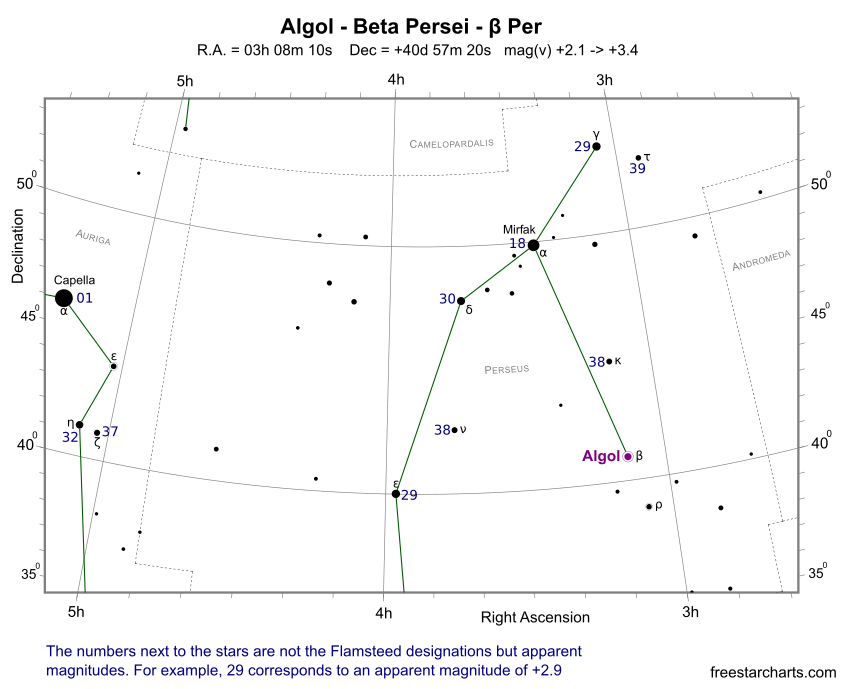
Finder Chart for Algol - pdf format (credit:- freestarcharts)
Messier 10 - M10 - Globular Cluster
M10 is a fine globular cluster that's located in the constellation of Ophiuchus. One of the largest constellations, Ophiuchus straddles the celestial equator and contains a host of globular clusters of which Messier catalogued seven of them. The brightest and best of them is M10 (mag. +6.6), which can be spotted with binoculars, appearing like an out of focus fuzzy star.
Charles Messier discovered M10 on May 29, 1764, describing it as a "nebula without stars". Ten years later, German astronomer Johann Elert Bode noted it as a "very pale nebulous patch without stars". Both Messier and Bode used telescopes that suffered in quality and hence were unable to resolve the cluster. It was not until William Herschel using better and larger instruments was able to spot individual member stars. He described it as a "beautiful cluster of extremely compressed stars". The best time of the year to observe M10 is during the months of May, June and July.
Locating M10 is not the easiest task as the surrounding area of sky is devoid of bright stars. Start by locating the brightest star in Ophiuchus, Rasalhague (α Oph - mag +2.1). Join the stars of the constellation in a curve heading westwards and southwards until arriving at two close 3rd magnitude stars, Yed Prior (δ Oph - mag. +2.7) and Yed Posterior (ε Oph - mag. +3.2). M10 is located about 12 degrees east of Yed Prior with star 30 Oph (mag. +4.8) one degree east of M10.


NGC 869 and NGC 884 - The Double Cluster - Open Clusters
NGC 869 and NGC 884 are two bright open clusters in the constellation of Perseus, that are separated by only half a degree of apparent sky. Together they are commonly known as the "Double Cluster" and form a famous showpiece object, that's easily visible to the naked eye and a wonderful sight in binoculars and telescopes. Both clusters have been known since antiquity and probably pre-historically. Greek astronomer Hipparchus first catalogued them around 130 B.C, with early celestial cartographers naming them as "h Persei" (NGC 869) and "χ Persei" (NGC 884).
The Double Cluster is located in the far northwestern part of Perseus, close to the border with Cassiopeia. With a declination of 57N, it's circumpolar from many northern locations and therefore never sets. To locate the object, draw an imaginary line from Mirfak (α Per - mag +1.8) in a northwesterly direction towards the centre of the "W" of Cassiopeia. The Double Cluster lies just over halfway along this line.
It's listed as number 14 in the Caldwell catalogue.
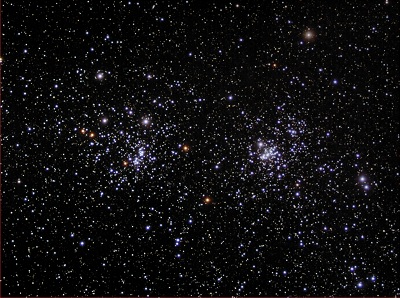

Finder Chart for NGC 869 and NGC 884 The Double Cluster - pdf format (credit:- freestarcharts)
47 Tucanae - NGC 104 - Globular Cluster
47 Tucanae or 47 Tuc is a spectacular globular cluster located in the southern constellation of Tucana. At magnitude +4.5, it appears to the naked eye as a slightly fuzzy star similar to the head of a tail-less comet. Always hidden from view for European and North American observers, 47 Tuc was discovered by French astronomer Nicolas Louis de Lacaille on September 14, 1751. Initially Lacaille though he had found a comet until further inspection revealed its true nature.
47 Tuc is the second brightest globular in the sky, only Omega Centauri is more brilliant. It has an extremely dense core and is one of the most massive globular clusters surrounding the Milky Way. The cluster is located 2.5 degrees west of the Small Magellanic Cloud (SMC) and from most of the Southern Hemisphere it's circumpolar and never sets. In contrast from latitudes of 18N or greater, the globular can never be seen as it fails to rise above the horizon.
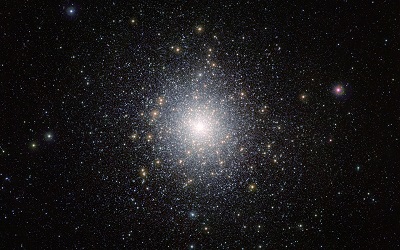
Through 7x50 or 10x50 binoculars, 47 Tuc appears as a bright starlight nucleus surrounding by a halo of soft pearly light. It's clearly non-stellar in nature. Telescopically the cluster is stunning and a showpiece object of the night sky. It total it spans 31 arc minutes of apparent sky, almost exactly the same diameter as the full Moon. For comparison, 47 Tuc is 50% larger and 3x brighter than M13 "the Great Hercules Globular Cluster" widely regarded as the finest globular in the northern section of the sky.
A small 100mm (4-inch) scope reveals a bright compact core surrounded by a large 15 arc minute sphere with the brightest members resolvable. Even through small telescopes it's a superb sight. A 200mm (8-inch) instrument shows a swarm of stars in a glittering 3D view. The dense centre remains unresolvable in stark contrast to the less dense outer regions. Overall it's a breathtaking object for all sizes and types of telescopes.