Mercury
Mercury is visible as an early evening object in western twilight during the first week of month for observers located at tropical and Northern Hemisphere latitudes. On March 1st, it sets some 90 minutes after the Sun, shining at magnitude -0.2. Mercury's altitude decreases each evening and after just a few days the fading planet will be lost to the bright twilight.
On March 14th, Mercury reaches inferior conjunction. However, it's not long before the fast-moving planet is visible again. At months end, it will rise some 90 minutes before the Sun from southern and equatorial locations with much fainter Neptune, mag. +8.0, located about a degree away. From northern temperate latitudes, the planet remains too close to the Sun to be safely observed.
Venus
Venus remains a brilliant morning object throughout March, although this apparition is now coming towards an end. The planet begins the month at magnitude -4.1 and rises some 3 hours before the Sun from southern and equatorial latitudes, slightly less for those located further north. At month's end, Venus will have faded to magnitude -3.9 with a shortened visibility period especially from northern locations. Its angular size reduces from 16 to 13 arc seconds as the month progresses with its illuminated disk increasing from 72% to 81%.
On March 2nd, the waning crescent Moon passes just over a degree south of Venus.
Mars
Mars fades from magnitude +1.2 to +1.4 this month but remains prominent in the western sky after sunset. The red planet is an early evening object that starts March in Aries before crossing into Taurus on the 23rd. For the next few days it moves slowly past the famous Pleiades open cluster, M45. The planet's angular size falls below 5 arc seconds this month, so it won't be possible to spot any details on its pink surface.
On March 11th, the waxing crescent Moon passes 6 degrees south of Mars.
Jupiter
Jupiter is now a prominent morning object moving direct in Ophiuchus. From northern locations, the giant planet rises early morning at start of the month, improving to an hour or so after midnight by months end. It remains visible until dawn. With a declination of 22 degrees south of the celestial equator, Jupiter is considerably better placed for observers at southern and tropical locations. By end of month from such locations, Jupiter is visible well before midnight and appears much higher in the sky.
As the month progresses, Jupiter increases from magnitude -2.0 to -2.2 with its apparent size improving from 36 to 39 arc seconds. Through a pair of binoculars the four large Galilean moons, Io, Europa, Ganymede and Callisto are readily visible. They change position as they orbit the planet and sometimes all four can be seen at once, but often some are obscured from view as they pass in front of, or behind, the Jovian disk. Occasionally none can be seen.
When viewed through a telescope, Jupiter is a stunning sight. Even a small 80mm (3.1 inch) refractor will show the main northern and southern equatorial cloud belts. Larger telescopes reveal subtle details. With time and patience features such as small belts, ovals, festoons, dark regions and of course the famous Great Red Spot can be seen.
On March 27th, the waning gibbous Moon passes a couple of degrees north of Jupiter.
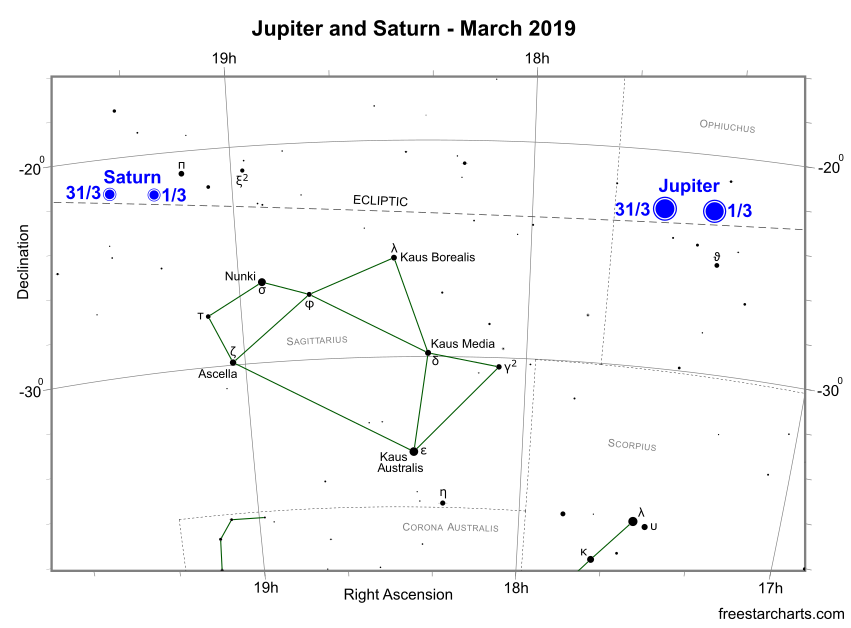
Jupiter and Saturn during March 2019 - pdf format (credit:- freestarcharts)
Saturn
Saturn, mag. +0.5, continues to move direct in Sagittarius, northeast of the "teapot" asterism. The beautiful "Ringed planet" remains a morning object, although by month's end it's visible from just after midnight from southern temperate locations. However, those located further north will have to wait up to 4 hours longer to spot the planet.
When seen through a telescope, Saturn is a wonderful sight. A small 80mm (3.1-inch) scope easily reveals the ring system, while 150mm (6-inch) or 200mm (8-inch) instruments show a wealth of details such as planetary cloud formations, ring divisions and up to half a dozen satellites. During the month, the apparent diameter of Saturn's disk increases slightly from 15.6 to 16.3 arc seconds.
On March 1st and 29th, the waning crescent Moon occults Saturn. The first event is visible from western USA, western Mexico and French Polynesia. The second from southern Africa, Madagascar and east South America.
Uranus
Uranus, mag. +5.9, remains an early evening binocular object during March. The seventh planet from the Sun, located in Aries, is visible towards the west as soon as it's dark enough. For those located at temperate northern latitudes it can be seen for about 3 hours on March 1st. However, it's not long before the bright twilight closes in and by months end, Uranus will be difficult to spot. From southern locations, the visibility period of Uranus is shorter still.
On March 10th, the thin waxing crescent Moon passes 5 degrees south of Uranus.
Neptune
Neptune reaches solar conjunction on March 7th. For observers at tropical and southern locations the distant planet reappears at month's end, low down above the eastern horizon just before sunrise. At mag. +8.0, it's beyond naked eye visibility but can be glimpsed with binoculars and small scopes. As previously mentioned, Mercury (mag. +0.9) is positioned about a degree from Neptune at month's end.
From northern temperate latitudes, Neptune remains inconveniently placed throughout March and is not readily observable.
Solar System Data Table - March 2019
| Date | Right Ascension | Declination | Mag. | App. Size | Illum. (%) | Dist. (AU) | Constellation | |
|---|---|---|---|---|---|---|---|---|
| Sun | Mar 01 | 22h 45m 33.2s | -07d 52m 37.5s | -26.8 | 32.3' | 100 | 0.991 | Aquarius |
| Sun | Mar 15 | 23h 37m 26.3s | -02d 26m 23.9s | -26.8 | 32.2' | 100 | 0.994 | Pisces |
| Sun | Mar 31 | 00h 35m 46.1s | 03d 51m 16.4s | -26.7 | 32.0' | 100 | 0.999 | Pisces |
| Mercury | Mar 01 | 23h 48m 12.2s | 00d 51m 52.9s | -0.2 | 7.7" | 39 | 0.876 | Pisces |
| Mercury | Mar 15 | 23h 32m 25.8s | 00d 50m 02.3s | 6.0 | 10.9" | 1 | 0.619 | Pisces |
| Mercury | Mar 31 | 23h 08m 52.5s | -05d 29m 23.3s | 0.9 | 9.5" | 27 | 0.705 | Aquarius |
| Venus | Mar 01 | 20h 03m 28.1s | -19d 33m 20.9s | -4.1 | 15.6" | 72 | 1.070 | Sagittarius |
| Venus | Mar 15 | 21h 12m 09.6s | -16d 12m 03.0s | -4.0 | 14.3" | 76 | 1.165 | Capricornus |
| Venus | Mar 31 | 22h 27m 45.6s | -10d 33m 55.8s | -3.9 | 13.2" | 81 | 1.268 | Aquarius |
| Mars | Mar 01 | 02h 27m 43.2s | 15d 17m 21.2s | 1.2 | 5.3" | 91 | 1.767 | Aries |
| Mars | Mar 15 | 03h 04m 59.0s | 18d 12m 25.8s | 1.3 | 5.0" | 92 | 1.884 | Aries |
| Mars | Mar 31 | 03h 48m 38.5s | 20d 56m 48.6s | 1.4 | 4.7" | 94 | 2.012 | Taurus |
| Jupiter | Mar 01 | 17h 23m 38.5s | -22d 32m 53.8s | -2.0 | 36.2" | 99 | 5.445 | Ophiuchus |
| Jupiter | Mar 15 | 17h 29m 37.0s | -22d 37m 26.7s | -2.1 | 37.8" | 99 | 5.219 | Ophiuchus |
| Jupiter | Mar 31 | 17h 33m 34.4s | -22d 39m 52.7s | -2.2 | 39.7" | 99 | 4.963 | Ophiuchus |
| Saturn | Mar 01 | 19h 15m 32.1s | -21d 52m 05.2s | 0.6 | 15.6" | 100 | 10.632 | Sagittarius |
| Saturn | Mar 15 | 19h 20m 14.2s | -21d 43m 53.0s | 0.5 | 15.9" | 100 | 10.432 | Sagittarius |
| Saturn | Mar 31 | 19h 24m 16.6s | -21d 36m 32.2s | 0.5 | 16.3" | 100 | 10.178 | Sagittarius |
| Uranus | Mar 01 | 01h 50m 29.7s | 10d 49m 41.2s | 5.9 | 3.4" | 100 | 20.482 | Aries |
| Uranus | Mar 15 | 01h 52m 54.4s | 11d 03m 22.1s | 5.9 | 3.4" | 100 | 20.646 | Aries |
| Uranus | Mar 31 | 01h 56m 04.0s | 11d 21m 00.5s | 5.9 | 3.4" | 100 | 20.779 | Aries |
| Neptune | Mar 01 | 23h 08m 45.2s | -06d 32m 02.0s | 8.0 | 2.2" | 100 | 30.923 | Aquarius |
| Neptune | Mar 15 | 23h 10m 43.5s | -06d 19m 47.6s | 8.0 | 2.2" | 100 | 30.922 | Aquarius |
| Neptune | Mar 31 | 23h 12m 54.7s | -06d 06m 18.8s | 8.0 | 2.2" | 100 | 30.854 | Aquarius |