Guides / Star Charts
Contributions
If you like the website and want to contribute to the running costs then please do so below. All contributions are most welcome.
The Planets this Month - May 2018
Mercury
Mercury reached greatest elongation east at the end of April, and from southern and equatorial latitudes the planet remains well placed for observation in morning twilight during the first half of May. On May 1st, it rises some 2 hours before the Sun. The period of visibility then decreases slightly each subsequent morning, until the planet is lost to the bright twilight sometime during the third week of the month. Between May 1st and 15th, Mercury's brightness increases from magnitude +0.3 to -0.3. On the morning of May 14th, the thin waning crescent Moon, Mercury and Uranus (mag. +5.9) will be within 5 degrees of each other. Keen eyed observers may be able to spot all three objects in the same binocular field of view, although Uranus will be challenging since it's over 250x fainter than Mercury. Of course, please take extreme care when using binoculars at this time of day, and always ensure that the Sun is below the horizon before looking.
From northern temperate locations, Mercury is not well placed for observation but may be glimpsed low down above the western horizon during the first few days of the month.
Venus
Venus, mag. -3.9, continues this month as a brilliant evening star, visible above the western horizon as soon as it's dark enough. From northern temperature latitudes, the planet sets about 2 hours after the Sun at start of month, improving to 2.5 hours by months end. For those further south the visibility period is slightly less. On May 3rd, Venus passes 7 degrees north of orange/red star Aldebaran (mag. +0.9) in Taurus, which is surrounded by the large sprawling Hyades open cluster. The planet reaches perihelion on May 15th, when it's approximately 0.718 AU (approx. 107 million kilometres or 66.7 million miles) from the Sun. On May 17th, the thin waxing crescent Moon passes 5 degrees south of Venus, providing pleasant early evening viewing. The planet then moves into Gemini on May 19th, and on the following day passes less than a degree from open cluster, M35. A small telescope should reveal the much dimmer open cluster alongside the brilliant planet.
Messier 44 - M44 - The Praesepe (Open Cluster)
M44, also known as the Praesepe or Beehive cluster, is a sprawling open cluster. It's the brightest and most prominent deep sky object in the constellation of Cancer. Visible to the naked eye under dark skies, the cluster appears like a large misty cloud covering over 1.5 degrees of sky. The brightness and size of M44 results from its close proximity to Earth; it lies a mere 577 light-years distant. Only the Hyades (at 153 light-years), Coma cluster (280 light-years), the Pleiades (M45) (425 light-years), Southern Pleiades (480 light-years) and IC 2391 (500 light-years) are nearer. Consequently, M44 is one of the brightest and largest objects of its type in the night sky.
The constellation of Cancer is a faint zodiac constellation that's bordered by much brighter Leo to the east and Gemini to the west. To the north is faint Lynx, with Canis Minor and Hydra located on the southern side. At the heart of Cancer is a grouping of four faint stars. They are Asellus Australis (δ Cnc - mag. +3.9), Asellus Borealis (γ Cnc - mag. +4.7), η Cnc (mag. +5.3) and θ Cnc (mag. +5.3). Of these, the brighter two are relatively easy naked eye objects, the fainter ones more difficult. Positioned at the centre of this grouping is M44. An alternative method of locating M44 is to imagine a line extending in a southeastern direction from Pollux (β Gem - mag. +1.1) for 37 degrees to Regulus (α Leo - mag. +1.4). M44 is positioned approximately at the mid-point of this line.
Messier 38 - M38 - Open Cluster
M38 is the third and faintest of the three Messier open clusters located in the constellation of Auriga (the other two been M36 and M37). With an apparent mag. of +7.0, it's almost a magnitude dimmer than both M36 and M37, but still an easy binocular target. The cluster covers over 20 arc minutes of sky and hence due to its large size, is best observed at low magnifications with small to medium size telescopes.
Finding M38 is relatively easy. Start by locating the brightest stars in the constellation of Auriga, the Charioteer. This medium size constellation is positioned to the northeast of Taurus and to the northwest of Gemini. The main stars of Auriga form an easy to find large polygon shape, that's marked at the northern point by brilliant Capella. To trace the polygon, start with Capella then move eastwards in a circular like shape to Menkalinan (β Aur - mag. +1.90), followed by θ Aur (mag. +2.65), El Nath (β Tau - mag. +1.68), Hassaleh (ι Aur - mag. +2.69), then η Aur (mag. +3.18), Almaaz (ε Aur. - mag +3.03) and finally back to Capella. Now focus on stars θ Aur and El Nath and imagine a line connecting them. Located just east of the mid-point of this line is M37 with M36 to the west. Move 2.3 degrees northwest of M36 and you will arrive at M38.
Algol eclipse dates and times for May 2018
Algol (β Per) is a bright eclipsing binary system located in the northern constellation of Perseus and one of the best-known variable stars in the sky. Often referred to as the "Demon Star", most of the time it shines at mag. +2.1 but every two days, 20 hours and 49 minutes it suddenly dips in brightness to mag. +3.4, remaining dim for about 10 hours before returning to its original state.
Why the brightness change. The Algol system consists of at least three-stars (β Per A, β Per B and β Per C) with the orbital plane of Algol A and B directly in line with the Earth. The regular dips in brightness occur when the dimmer B star moves in front of and eclipses the brighter A star. There is also an extra dimension in that a secondary eclipse occurs when the brighter star occults the fainter secondary, resulting in a very small dip in brightness that can be detected with photo-electrical equipment.

Messier 37 - M37 - Open Cluster
M37 is the brightest, largest and richest of the three Messier open clusters located in the constellation of Auriga (the other two are M36 and M38). It's an impressive cluster that shines at magnitude +6.0 and is visible to the naked eye from dark sites. M37 is often referred to as one of the finest open clusters in the northern section of the sky. It's best seen from the Northern Hemisphere during the months of December, January and February.
The Italian astronomer Giovanni Battista Hodierna discovered M37 sometime before 1654. French astronomer Guillaume Le Gentil rediscovered M36 and M38 in 1749, but surprisingly failed to spot the brighter M37. It was left to Charles Messier to independently rediscover M37, which he did so on September 2, 1764.
Lyrids meteor shower peaks on the night of April 21st / 22nd, 2018
The annual Lyrids meteor shower peaks during the night of April 21st / 22nd. This year's event promises to be reasonably good as the first quarter Moon sets a couple of hours after midnight and won't significantly interfere. Normally, you would expect to see up to 20 meteors per hour under ideal conditions. However, if you're lucky you might even spot a couple of fireballs. Occasionally the shower produces a few, that brilliantly streak through the sky, casting shadows as they disintegrate in the upper atmosphere.
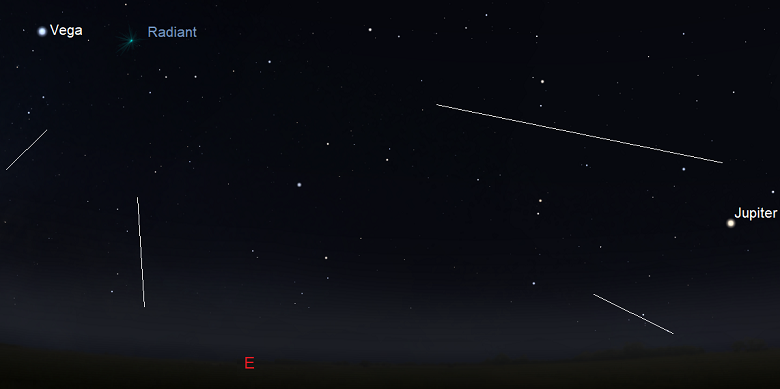
Unlike sporadic meteors that originate from anywhere, periodic meteors can always be traced back to the same part of the sky, known as the (radiant). Therefore, spotting this type of shooting star should be easy; just look directly at the radiant. The problem is although the meteors do originate from the radiant, they almost always streak many degrees from away in a different part of the sky. Therefore a good tip is to lie down on a reclining chair, look skywards and scan a large area of sky surrounding the radiant, without looking directly at it.
The Lyrids radiant is located inside Hercules. It's positioned close to the border with Lyra and only 6 degrees from Vega (mag. 0.0), the 5th brightest star in the sky. The best time to observe is around midnight and during the early hours of the morning.
Messier 36 - M36 - Open Cluster
M36 is the first of three bright Messier open clusters located in the southern part of the constellation of Auriga (the other two are M37 and M38). It was discovered by Italian astronomer Giovanni Batista Hodierna sometime before 1654 and catalogued by Charles Messier on September 2, 1764. At mag. +6.2, the cluster is at the limit of naked eye visibility and therefore easily visible in binoculars, appearing as a small fuzzy patch of light. M36 is concentrated, containing at least 60 known members and covers 12 arc minutes of apparent sky. This makes it a particularly nice object for owners of small / medium sized telescopes. The cluster is best seen from the Northern Hemisphere during the months of December, January and February.
The Planets this Month - April 2018
Mercury
Mercury passes inferior conjunction on April 1st, but it doesn't take long before the planet rises out of the Sun's glare. It should be visible, low down above the eastern horizon before sunrise from tropical and southern latitudes by about the middle of the month. The planet subsequently brightens and climbs higher in the sky each morning until it reaches a peak altitude on April 29th, the date of greatest elongation west (27 degrees from the Sun). On this day, from latitude 35S (approx. equal to Sydney, Cape Town and Santiago), Mercury shines at mag. +0.3 and appears 17 degrees above the horizon, 45 minutes before sunrise. The very thin waning crescent Moon passes 4 degrees south of the planet on April 14th. On the 23rd, Mercury reaches aphelion when it's 0.467 AU (approx. 69.9 million kilometres or 43.4 million miles) distant from the Sun.
From northern temperate latitudes, this is not a great apparition due to the shallow angle of the ecliptic to the horizon and even at greatest elongation the planet appears low down. Observers will struggle to easily spot it.
Messier 32 - M32 - Dwarf Elliptical Galaxy
M32 is a dwarf elliptical galaxy located in the constellation of Andromeda. It's a satellite of the famous and much larger Andromeda Galaxy (M31) and was the first elliptical galaxy ever observed. M32 was discovered by French astronomer Guillaume Joseph Hyacinthe Jean-Baptiste Le Gentil de la Galaisière (usually referred to as Guillaume Le Gentil) on October 29, 1749. Le Gentil, who was born in Coutances, Normandy, also discovered the Lagoon Nebula (M8) and was the first to catalogue the dark nebula Le Gentil 3 in Cygnus. He also independently found M36 and M38, objects that were discovered by Giovanni Batista Hodierna, around 100 years previously.
At a distance of about 2.65 million light-years, M32 is 110,000 light-years further from us than M31. Like most elliptical galaxies it contains mostly old red and yellow stars with practically no dust or gas, implying no current star formation. However, it has shown hints of star formation in the relatively recent past.
Locating M32 is as easy as locating the Andromeda Galaxy, which is positioned northeast of the Great Square of Pegasus. Of the four stars of the square, only three of them actually belong to Pegasus. The northeastern star and brightest of the four, Alpheratz (α And - mag. +2.1) is part of neighbouring Andromeda. Located 7 degrees northeast of Alpheratz is δ And (mag. +3.3) and a further 8 degrees northeast is Mirach (β And - mag. +2.1). The Andromeda galaxy is 8 degrees northwest of Mirach, at the end of a line connecting Mirach with μ And and ν And. M32 is located 22 arc minutes south of the central region of M31 and appears to be superimposed on a spiral arm.
The galaxy is best seen from Northern Hemisphere latitudes during the months of October, November and December.

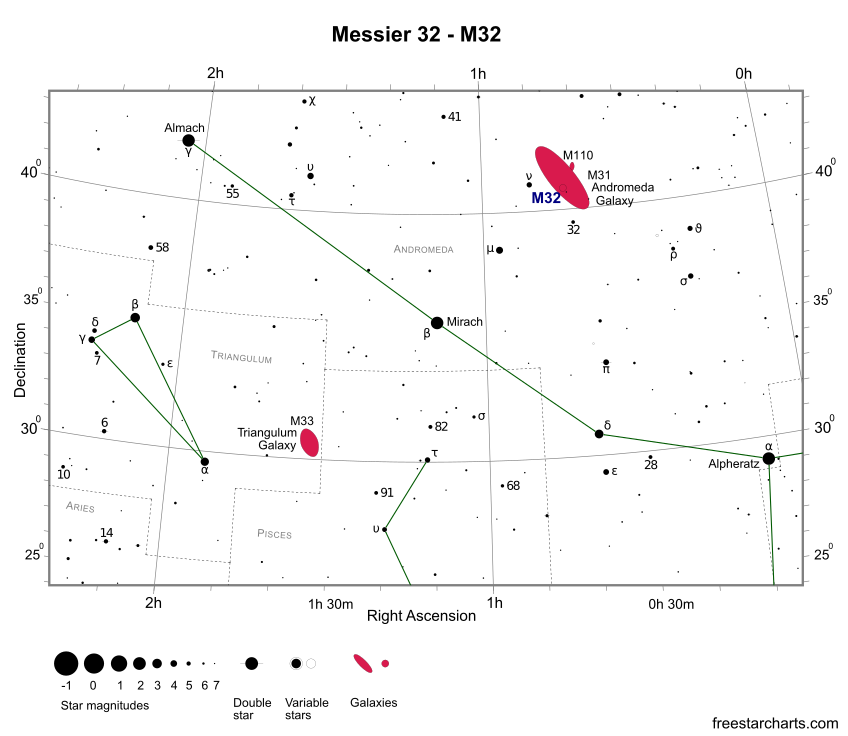
Finder Chart for M32 - pdf format (credit:- freestarcharts)
Despite been small (M32 measures only 8.5 x 6.5 arc minutes) it's relatively bright at mag. +8.1 and hence visible in binoculars, appearing non stellar like an out of focus star. The galaxy is an easy target for small telescopes. When viewed through an 80mm (3.1-inch) refractor, it appears as a small round diffuse ball with a distinctly bright central core. The galaxy is brighter and more oval shaped when seen through a larger 200mm (8-inch) scope. However for M32, that's about as good as it gets. Even the biggest amateur scopes don't bring out much more detail and like M110, the other Messier dwarf satellite of M31, it's dwarfed in size when compared to its parent.
Messier 31 - M31 - Andromeda Galaxy (Spiral Galaxy)
M31, the famous Andromeda Galaxy, is the largest member of the Local Group that also includes the Milky Way, the Triangulum Galaxy (M33) and about 50 other smaller galaxies. With an apparent mag. of +3.4, it's one of the brightest Messier objects and easily visible to the naked eye even from areas with a certain amount of light pollution. M31 is usually regarded as the most distant object that can be easily seen without optical aid.
The Andromeda Galaxy has been known for a long time. It was first recorded over 1000 years ago by Isfahan based Persian astronomer Abd-al-Rahman Al-Sufi. In 964 AD, he described it as the little cloud in his Book of Fixed Stars. This object was almost certainly known - for a number of years before this date - to other Persian astronomers. The first person to telescopically observe and describe M31, was German astronomer Simon Marius on December 15, 1612. Unaware of both Al Sufi's and Marius' discovery, Giovanni Batista Hodierna independently rediscovered the object sometime before 1654. Then on August 3, 1764, Charles Messier added the great spiral to his catalogue. Incidentally, Messier incorrectly credited Marius as the discoverer, apparently unaware of the earlier work of Al-Sufi.
Algol eclipse dates and times for April 2018
Algol (β Per) is a bright eclipsing binary system located in the northern constellation of Perseus and one of the best-known variable stars in the sky. Often referred to as the "Demon Star", most of the time it shines at mag. +2.1 but every two days, 20 hours and 49 minutes it suddenly dips in brightness to mag. +3.4, remaining dim for about 10 hours before returning to its original state.
Why the brightness change. The Algol system consists of at least three-stars (β Per A, β Per B and β Per C) with the orbital plane of Algol A and B directly in line with the Earth. The regular dips in brightness occur when the dimmer B star moves in front of and eclipses the brighter A star. There is also an extra dimension in that a secondary eclipse occurs when the brighter star occults the fainter secondary, resulting in a very small dip in brightness that can be detected with photo-electrical equipment.
Messier 46 - M46 - Open Cluster
M46 is a rich open cluster, easily visible with binoculars, that's located in the Milky Way star fields of the constellation of Puppis. The cluster is a relatively large object with an apparent diameter almost equal to that of the full Moon. It was discovered by Charles Messier on February 19, 1771 and is best seen from southern and equatorial latitudes during the months of December, January and February.
Puppis borders many constellations including Canis Major, the home of the brightest star in the sky, Sirius (mag. -1.46). To locate M46, imagine a line connecting Mirzam (mag. +1.98) with Sirius and extend it for 14 degrees in a north-easterly direction to arrive at the cluster. In addition to M46, there are two further Messier objects in Puppis, M47 and M93. All three are superb open clusters, with M47 positioned just over a degree northwest of M46. The third cluster M93 is located about 9 degrees south of the M46, M47 pair.

The Planets this Month - February 2018
Mercury
Mercury is currently located on the far side of the Sun. The innermost planet passes through superior conjunction on February 16th. Throughout the month it remains too close to the Sun to be safely observed.
Venus
Venus returns to the evening sky for the first time since March 2017. The brilliant planet shines at mag. -3.9 and can be seen during twilight from northern locations, very low above the western horizon towards the end of month. However, those living further south will struggle to spot the planet.

Messier 43 - M43 - De Mairan's Nebula (Emission/Reflection)
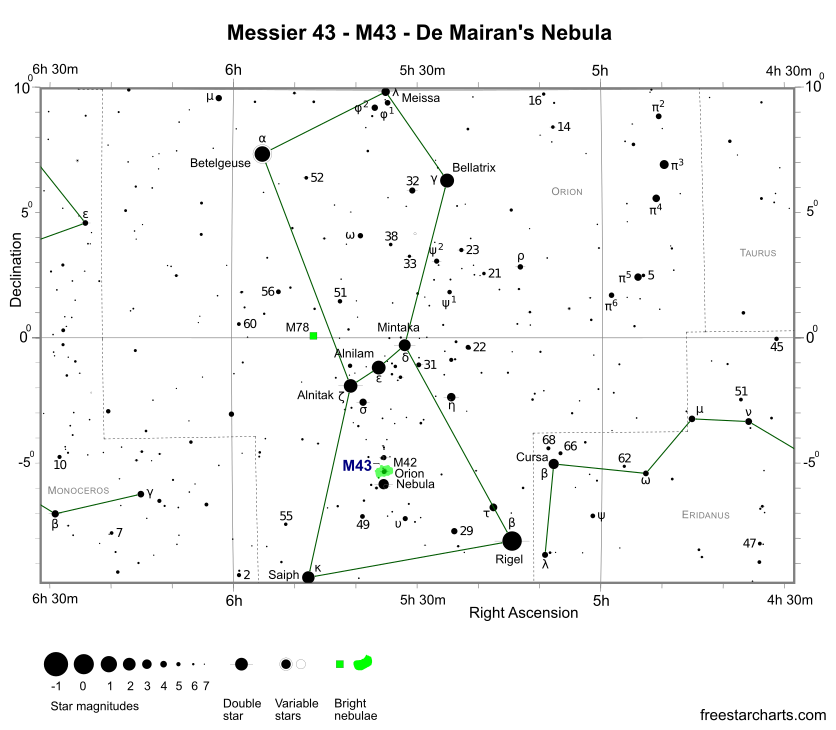
M43 is a HII region located in the constellation of Orion that was discovered by Jean-Jacques Dortous de Mairan sometime before 1731. As part of the famous Orion Nebula (M42), it's positioned just north of the main nebula and separated from it by a narrow dust lane. With an apparent mag. of +9.0, M43 is about 100 times fainter than M42, but still bright enough to be seen with binoculars.
Occasionally, ninth mag. nebulae like M43 can be difficult to find - especially if located in barren parts of the sky - but not this one. Firstly, it's located in majestic Orion, perhaps the most recognizable of all constellations, secondly it's part of the Orion Nebula and therefore positioned right next to the great showpiece object and finally it has a relatively high surface brightness. Of course, finding M42 is easy, it's positioned 5 degrees south of the three bright stars that form Orion's belt (Mintaka, Alnilam and Alnitak). M43 is located just 8 arc minutes north of M42 surrounding a 7th magnitude star. M43 (and M42) are best seen during the months of December, January and February.

Algol eclipse dates and times for March 2018
Algol (β Per) is a bright eclipsing binary system located in the northern constellation of Perseus and one of the best-known variable stars in the sky. Often referred to as the "Demon Star", most of the time it shines at mag. +2.1 but every two days, 20 hours and 49 minutes it suddenly dips in brightness to mag. +3.4, remaining dim for about 10 hours before returning to its original state.
Why the brightness change. The Algol system consists of at least three-stars (β Per A, β Per B and β Per C) with the orbital plane of Algol A and B directly in line with the Earth. The regular dips in brightness occur when the dimmer B star moves in front of and eclipses the brighter A star. There is also an extra dimension in that a secondary eclipse occurs when the brighter star occults the fainter secondary, resulting in a very small dip in brightness that can be detected with photo-electrical equipment.
Algol is located in Perseus among the stars of the northern Milky Way. It's positioned west of mag. +0.1 Capella (α Aur) and southeast of the well known "W" of Cassiopeia. The finder chart below shows the position of Algol along with magnitude data of some surrounding stars for comparative purposes.
Messier 41 - M41 - Open Cluster
M41 is a stunning, large bright open cluster located in the constellation of Canis Major. Of the many clusters in Canis Major, it's the stand out object and the constellation's only
M41 was discovered by Giovanni Batista Hodierna sometime before 1654, although it was probably known to Aristotle as far back as 325 BC. If true, this would make it the faintest object recorded in classical antiquity, but caution prevails as Aristotle may have described a nearby part of the Milky Way instead. The cluster was catalogued by Charles Messier on January 16, 1765 and is best seen during the months of December, January and February from the tropics and Southern Hemisphere.
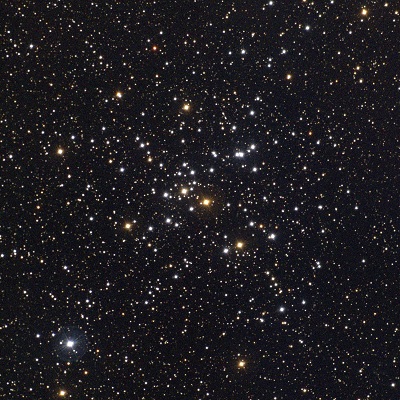

Finder Chart for M41 - pdf format (credit:- freestarcharts)
The Planets this Month - March 2018
Mercury
Mercury, the innermost planet, is now heading towards greatest eastern elongation (GEE), which it reaches on March 15th. Observers at northern-based locations should be able to spot the elusive planet just after sunset during the first 3 weeks of the month, when it appears low down above the western horizon. Each subsequent evening, from March 1st, it gradually improves in altitude with a longer visibility until GEE is reached. The planet will then be positioned 18 degrees from the Sun and shine at magnitude -0.4. After that, Mercury gradually sinks back towards the horizon until about 10 days later when it's finally lost to the bright twilight sky. From northern locations this also happens to be the best evening apparition of the year.
During the first few days of the month, Venus and Mercury appear close together. Venus is 12x brighter than its inner neighbour and on March 5th the two planets are separated by 1.4 degrees. Binoculars will assist locating Mercury, especially in the bright twilight, but don't use them until after the Sun has set. From southern latitudes, Mercury is not so well placed at this time. At GEE it sets only forty minutes after the Sun and will be difficult to spot in twilight. However, much brighter Venus is situated four degrees to the south and acts as a good marker.
Venus
Venus, mag. -3.9, can be seen low towards the west after sunset. As the month progresses the brilliant planet rises a little higher in the sky each subsequent evening and by months end, from northern temperature latitudes, sets about 90 minutes after the Sun. For those further south, the planet sets an hour after the Sun on the last day of the month.
As mentioned above, Mercury and Venus are positioned close together during the start of the month. On March 19th, the thin waxing crescent Moon passes 4 degrees south of Venus and on March 29th, Venus passes only 0.1 degrees south of Uranus. At mag. +5.9, Uranus is almost 10,000x fainter than Venus. Binoculars or a small telescope will be required to spot distant Uranus, although both planets will easily fit in the same field of view.

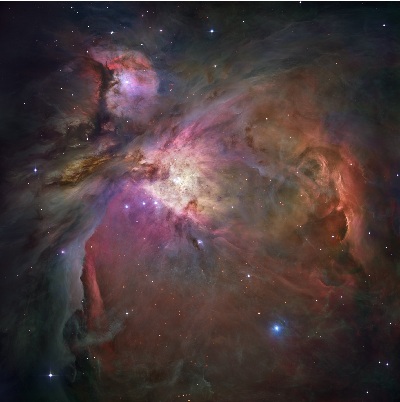
Messier 42 - M42 - The Great Orion Nebula (Emission/Reflection)
M42, also known as the Great Orion Nebula or Orion Nebula, is the prime deep sky attraction in the constellation of Orion and a showpiece deep sky object. With an apparent magnitude of +4.0, it's easily visible to the naked eye. This emission / reflection nebula and star forming region spans more than a degree of sky and is therefore one of the largest and brightest objects of its type.
Orion is a prominent constellation and one of the most recognizable and familiar sights. Located on the celestial equator, it's visible throughout the World and best seen during the months of December, January and February. The constellation is filled with bright stars, including first magnitude Rigel and Betelgeuse plus a further five second magnitude stars. Three of the second magnitude stars (Mintaka, Alnilam and Alnitak) form the famous belt of Orion. Positioned just 5 degrees south of the belt is the Orion Nebula itself, which is part of the Hunters Sword.

Messier 35 - M35 - Open Cluster
M35 is a fantastic open cluster located in the constellation of Gemini. At magnitude +5.2, it's visible to the naked eye under good conditions. Curiously, despite being a naked eye object, it wasn't discovered until 1745-46 by Philippe Loys de Chéseaux and then independently "re-discovered" by John Bevis sometime before 1750. Since the cluster is reasonable close at 2,800 light-years it presents a large apparent diameter of some 28 arc minutes - almost exactly the same as that of the full Moon. Without a doubt, M35 is a magnificent sight in all types of optical instruments.
The constellation Gemini covers a reasonable 514 sq. degrees and is partially located in the rich star fields of the Milky Way. During the winter months, it's positioned high in the sky for Northern Hemisphere observers although less well placed for those located further south. Surprisingly, despite such a prime Milky Way location, M35 is the only Messier object in Gemini. It's located at the western edge of the constellation in a corner of the sky close to the Taurus, Orion and Auriga borders. Finding M35 is quite easy as it's 3.5 degrees northwest of mag. +2.9 star, Mu (μ) Gem.


Messier 47 - M47 - Open Cluster
M47 is a bright, loose naked eye, open cluster located in the Milky Way star fields of the constellation of Puppis. It was discovered by Giovanni Batista Hodierna before 1654 and independently by Charles Messier on February 19, 1771. The cluster is best seen from southern and equatorial latitudes during the months of December, January and February.
Finding M47 is quite easy, since Sirius (mag. -1.46), the brightest star in the night-time sky is near by. To do this, imagine a line connecting Mirzam (mag. +1.98) with Sirius and extend it for 14 degrees in a north-easterly direction to arrive at the cluster. Just over a degree to the southeast of M47, and in the same binocular field of view, is another Messier open cluster, M46. Both clusters have about the same apparent size (approx. 0.5 degrees) although M47 is noticeably brighter. A third Messier cluster in Puppis, M93, is located about 9 degrees south of the M46, M47 pair.
