Guides / Star Charts
Contributions
If you like the website and want to contribute to the running costs then please do so below. All contributions are most welcome.
Algol eclipse dates and times for March 2019
Algol (β Per) is a bright eclipsing binary system located in the northern constellation of Perseus and one of the best-known variable stars in the sky. Often referred to as the "Demon Star", most of the time it shines at mag. +2.1 but every two days, 20 hours and 49 minutes it suddenly dips in brightness to mag. +3.4, remaining dim for about 10 hours before returning to its original state.
Why the brightness change. The Algol system consists of at least three-stars (β Per A, β Per B and β Per C) with the orbital plane of Algol A and B directly in line with the Earth. The regular dips in brightness occur when the dimmer B star moves in front of and eclipses the brighter A star. There is also an extra dimension in that a secondary eclipse occurs when the brighter star occults the fainter secondary, resulting in a very small dip in brightness that can be detected with photo-electrical equipment.

Algol is located in Perseus among the stars of the northern Milky Way. It's positioned west of mag. +0.1 Capella (α Aur) and southeast of the well known "W" of Cassiopeia. The finder chart below shows the position of Algol along with magnitude data of some surrounding stars for comparative purposes.
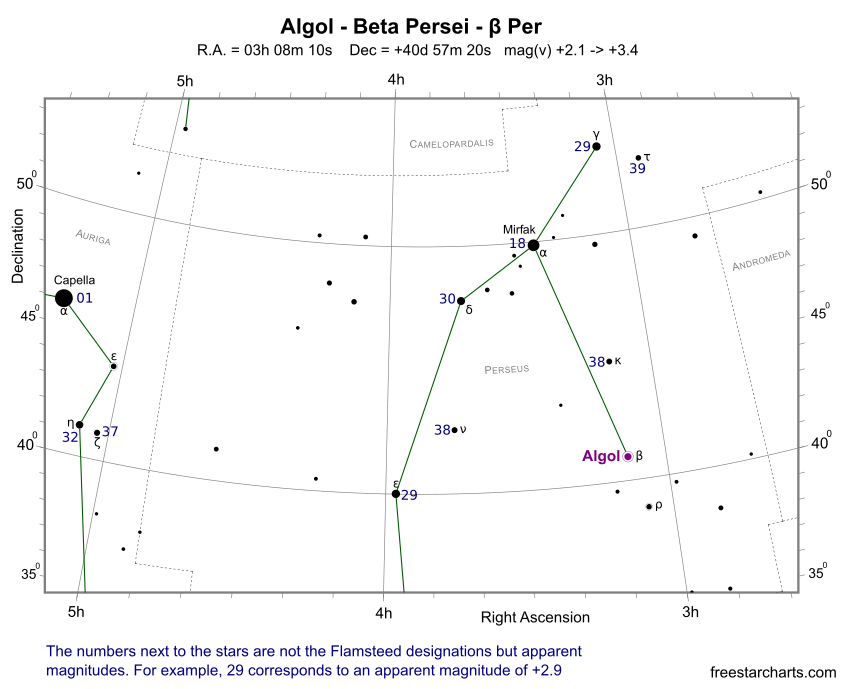
Finder Chart for Algol - pdf format (credit:- freestarcharts.com)
For those new to variable star observing, Algol is an excellent first choice target. It dims quite dramatically and the regular brightness changes are obvious to the naked eye. The table below contains date and time information of Algol's minima for March 2019 for various world time zones that cover most regions of Europe, America, China and Australia. For time zones not listed, local eclipse times can be calculated by adjusting the table to fit to the observer's local time.
The Planets this Month - March 2019
Mercury
Mercury is visible as an early evening object in western twilight during the first week of month for observers located at tropical and Northern Hemisphere latitudes. On March 1st, it sets some 90 minutes after the Sun, shining at magnitude -0.2. Mercury's altitude decreases each evening and after just a few days the fading planet will be lost to the bright twilight.
On March 14th, Mercury reaches inferior conjunction. However, it's not long before the fast-moving planet is visible again. At months end, it will rise some 90 minutes before the Sun from southern and equatorial locations with much fainter Neptune, mag. +8.0, located about a degree away. From northern temperate latitudes, the planet remains too close to the Sun to be safely observed.
NGC 4236 - Barred Spiral Galaxy
NGC 4236 is a tenth magnitude barred spiral galaxy in Draco that's visible through small telescopes although best seen with larger instruments. This galaxy was discovered by German born British astronomer William Herschel on April 6, 1793 and is a member of the Ursa Major or M81 group of galaxies that contains at least 34 galaxies, including spectacular M81 (Bode's galaxy) and M82 (Cigar galaxy).
NGC 4236 is located in the far northern constellation of Draco about 15 degrees north of the seven stars that form the famous "Plough" or "Big Dipper" asterism of Ursa Major. The galaxy is positioned two-thirds of the way along an imaginary line connecting stars lambda Dra (λ Dra - mag. +3.8) and kappa Dra (κ Dra - mag. +3.9). Star HD 106574 (mag +5.7) is 0.75 degrees directly north of NGC 4236.
Due to its high northerly declination, NGC 4236 is a Northern Hemisphere object. The best months to look for it are March, April or May, although from most northern locations it's visible all year round and never sets. It can be seen from the Southern Hemisphere, but only from latitudes north of 20 degrees south and even then appears low down above the northern horizon at best.

Messier 84 - M84 - Lenticular Galaxy (or Elliptical Galaxy)
M84 is a magnitude +9.4 lenticular or elliptical galaxy that belongs to the Virgo cluster of galaxies. Although one of the brighter members of this famous cluster, it's challenging to spot with popular 7x50 or 10x50 binoculars. Larger models or small telescopes make this task easier but as with most galaxies, dark skies are essential. It's currently not certain what type of galaxy M84 is; it could be a type S0 lenticular galaxy seen face-on or an elliptical galaxy of type E1.
Charles Messier discovered M84 on March 18, 1781 during one of his regular nightly patrols. He also discovered and catalogued another eight objects on the same day, including M86 just east of M84. The apparent size of M84 is 6.5 x 5.6 arc minutes and it's about 60 Million light-years distant. This corresponds to a spatial diameter of 110,000 light-years.
M84 lies at the heart of the Virgo Cluster, close to the Virgo-Coma Berenices constellation border. It can be found by imagining a line connecting Denebola (β Leo - mag. +2.1) to Vindemiatrix (ε Vir - mag. +2.8). At the centre point of this line is M84, with M86 positioned 17 arc minutes to the east.
The Virgo cluster galaxies are best seen during the months of March, April and May.

Messier 49 - M49 - Elliptical Galaxy
M49 is an elliptical galaxy located in the constellation of Virgo. It belongs to the Virgo cluster of galaxies, a large group of galaxies centered about 54 Million light-years from Earth. With an apparent magnitude of +8.4, M49 is the brightest member of this famous cluster. It's best seen during the months of March, April and May.
This galaxy was discovered by Charles Messier on February 19, 1771. He also discovered M46 and M48 on the same night and re-discovered M47, which was originally found by Giovanni Batista Hodierna sometime before 1654. After M83, M49 was the second galaxy discovered beyond the Local Group and the first member of the Virgo cluster to be found.
To locate M49, first imagine a line connecting Denebola (β Leo - mag. +2.1) with Vindemiatrix (ε Vir - mag. +2.8). The centre of the Virgo cluster is positioned about halfway along this line and M49 is located about 5 degrees south of this point.
NGC 4244 - Spiral Galaxy
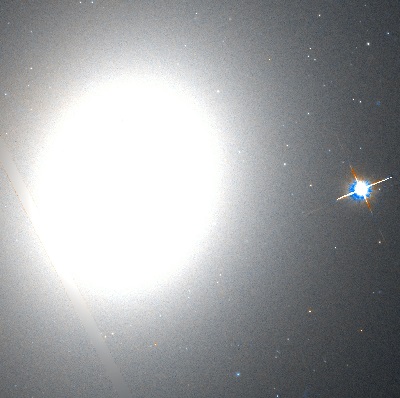
NGC 4244, also known as Caldwell 26, is an edge-on spiral galaxy located in the constellation of Canes Venatici. With an apparent magnitude of +10.0 it can be spotted with small telescopes under dark skies, but much easier with larger instruments. The galaxy appears highly flattened, spanning 16 x 2 arc minutes, and as a result is often referred to as the Silver Needle galaxy. It's a superb example of an edge-on needle spiral that's bettered only by NGC 4565 in Coma Berenices.
NGC 4244 was discovered by William Herschel on March 17, 1787. It's part of the M94 Group or Canes Venatici I group of galaxies, which contains at least 24 members. The galaxy is best seen from Northern Hemisphere locations during the months of March, April and May.

NGC 2775 - Spiral Galaxy
NGC 2775 is a magnitude +10.5 spiral galaxy located in the constellation of Cancer, close to its border with Hydra. This galaxy is unusual in that it contains a very smooth nucleus with multiple spiral arms extending outwards from the central region. What makes the spiral arms interesting are their incredible complex detail, tightly wound structures and active star formation. Amateur astronomers should also keep their eye on this galaxy; it's been host to 5 supernovae explosions in the past 30 years and you never know when the next one will go off!
To find NGC 2775 look for the head of Hydra "the Sea Serpent". The asterism of stars that forms the head are ω Hyd (mag. +5.0), ζ Hyd (mag. +3.1), ρ Hyd (mag. +4.4), ε Hyd (mag. +3.4), δ Hyd (mag. +4.1), σ Hyd (mag. +4.5) and η Hyd (mag. +4.3). None of these stars are particularly bright, but all can be seen with the naked eye. The galaxy is positioned a few degrees east and slightly north of this grouping.
NGC 2775 was discovered by William Herschel in 1783 and is best seen during the months of February, March and April. The galaxy is located 55.5 million light-years from Earth and has an actual diameter of 70,000 light-years. It's estimated to contain 100 billion stars. NGC 2775 is number 48 in the Caldwell catalogue.
Messier 95 - M95 - Barred Spiral Galaxy
M95 is a barred spiral galaxy about 36 million light-years away in the constellation of Leo. It was discovered by Pierre Méchain on March 20, 1781, which was the same night he discovered M96. Four days later, Charles Messier including both items in his catalogue. With an apparent magnitude of +10.3, it's visible in small telescopes. Together with M96 and M105 they form a close group of galaxies that are gravitationally bound. Of these, M96 is the brightest and the largest. The group is known as the Leo I or M96 group of galaxies and contains at least another 21 fainter galaxies. It's one of many groups that lie within the Virgo Supercluster. M105 was not included in the original Messier catalogue but added much later by Helen B. Sawyer Hogg in 1947.
The galaxies are best seen during the months of March, April and May.

Messier 104 - M104 - Sombrero Galaxy (Spiral Galaxy)
M104, more commonly known as the Sombrero Galaxy, is a spectacular almost edge-on spiral galaxy in Virgo. At magnitude +8.4, it appears in binoculars as a small patch of nebulosity. Its most striking feature, which is visible in medium/large size amateur scopes, is a ring of thick dust encapsulating the galaxy bulge that gives it the appearance of a Sombrero hat. Many astronomers regard M104 as the finest of all the Virgo galaxies.
Pierre Méchain discovered M104 on May 11, 1781. A couple of years later he described it in a letter to Johann Bernoulli and later it was published in the Berliner Astronomisches Jahrbuch (Berlin Astronomy Year Book). Charles Messier made some hand-written notes about the galaxy and five other objects, but none were included in his final published catalogue. It was finally added to the "official" catalogue in 1921 and the remaining "missing" items, (M105 to M109), were included a few years later.
In 1912, M104 was one of the first galaxies to have its spectra and velocity measured by Vesto Slipher. He noted that the object was redshifted and therefore receding from us. The current accepted rate is 900 km/s. Slipher's calculations along with measurements from other galaxies pointed towards an expanding Universe, providing a key piece of evidence for the Big Bang Theory.