Guides / Star Charts
Contributions
If you like the website and want to contribute to the running costs then please do so below. All contributions are most welcome.
M48 is a large conspicuous open cluster covering almost a degree of sky in the constellation of Hydra. It's located close to the border with Monoceros. At magnitude +5.5, the cluster is visible to the naked eye under reasonably dark skies, and a superb binocular or small telescope object. It's best seen during the months of December, January and February.
Charles Messier discovered and cataloged M48 on February 19, 1771. However, he made a positioning mistake and hence the object was missing for over 150 years, until it was identified by Oswald Thomas in 1934, and independently by T.F. Morris in 1959. Since M48 was lost, two subsequent independent re-discoveries occurred. The first was by Johann Elert Bode who found it before 1782 and then Caroline Herschel located it on March 8, 1783.
Hydra is the largest constellation in the sky, but finding M48 is relatively easy as it's positioned just 14 degrees southeast of Procyon (α CMi) in Canis Minor. At magnitude +0.34, Procyon is the seventh brightest star in the night sky. Also visible to the naked eye, but better seen with binoculars is a triangle of 4th and 5th magnitude stars located about 5 degrees northwest of M48. The stars in question are Zeta Mon (ζ Mon - mag. +4.4), 28 Mon (mag. + 4.7) and 27 Mon (mag. +4.9).

M65 is a magnitude +9.6 edge-on spiral galaxy located 35 million light-years distant. It was discovered by Charles Messier on March 1, 1780, the night he also discovered M66. Messier described the galaxy as "a very faint nebula without stars." Apart from M81 and M82 in Ursa Major, M65 and M66 are probably the most sought after galaxy pair for amateur astronomers. With a third galaxy, NGC 3628, lying nearby the trio forms the heart of a small celebrated group, known as the Leo Triplet or M66 group. All can be observed or photographed in the same field of view and are a popular target for observers and astrophotographers alike.
M65 is located in the eastern section of the relatively large and bright zodiac constellation of Leo, the Lion. In western skylore, the Lion's heart is marked by the constellation's brightest and only first magnitude star, Regulus (α Leo - mag +1.4). Positioned approximately 16 degrees northeast of Regulus is Chertan (θ Leo - mag. +3.3). Along with the Zosma (δ Leo - mag. +2.6) and Denebola (β Leo - mag. +2.1), Chertan forms a prominent right-angled triangle. Located 2 degrees south of Chertan is 73 Leonis (mag. +5.3). M65 lies 0.75 degrees east of this star, with M66 a further 0.33 degrees to the southeast of M65. Positioned 0.5 degrees north of the Messier pair is the third member of the triplet, NGC 3628.
The galaxies are best seen during the months of March, April and May.
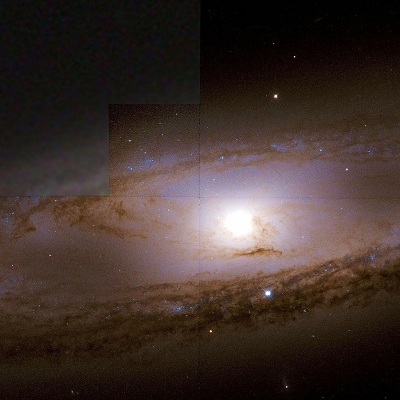
M66 is a superb bright intermediate spiral galaxy located in the constellation of Leo. It's the brightest of a trio of galaxies that forms - along with M65 and NGC 3628 - the well known and popular Leo Triplet or M66 group. All three objects can be observed with small telescopes in the same low power field of view. After the M81/M82 pair in Ursa Major, the Leo Triplet is arguably the next most sought after galaxy grouping for amateur astronomers.
Charles Messier discovered both M66 (mag. +8.9) and M65 (mag. +9.6) on March 1, 1780. The apparent magnitude of the third member of the triplet, NGC 3628, is unclear. Some texts record it as the brightest group member, while others have it as the faintest. For our purposes we estimate NGC 3628 to be brighter than M65 and almost as bright as M66. However, what is clear is that it suffers from a low surface brightness and therefore is the most difficult member of the trio to spot. Messier missed it completely and it was not until April 8, 1784 when it was finally discovered by William Herschel.
To find the triplet, look to the eastern part of Leo. This zodiac constellation is relatively large and bright and somewhat looks like the Lion that it's supposed to represent. The brightest star in Leo and its only first magnitude star is Regulus (α Leo – mag +1.4). Positioned approximately 16 degrees northeast of Regulus is Chertan (θ Leo - mag. +3.3). Along with the Zosma (δ Leo - mag. +2.6) to the north and Denebola (β Leo - mag. +2.1) to the east, Chertan forms a prominent right-angled triangle. Located 2 degrees south of Chertan is 73 Leonis (mag. +5.3). M65 lies 0.75 degrees east of this star with M66 a further 0.33 degrees southeast of M65. NGC 3628 is positioned 0.5 degrees north of the Messier pair.
The galaxies are best seen during the months of March, April and May.


M32 is a dwarf elliptical galaxy located in the constellation of Andromeda. It's a satellite of the famous and much larger Andromeda Galaxy (M31) and was the first elliptical galaxy ever observed. M32 was discovered by French astronomer Guillaume Joseph Hyacinthe Jean-Baptiste Le Gentil de la Galaisière (usually referred to as Guillaume Le Gentil) on October 29, 1749. Le Gentil, who was born in Coutances, Normandy, also discovered the Lagoon Nebula (M8) and was the first to catalogue the dark nebula Le Gentil 3 in Cygnus. He also independently found M36 and M38, objects that were discovered by Giovanni Batista Hodierna, around 100 years previously.
At a distance of about 2.65 million light-years, M32 is 110,000 light-years further from us than M31. Like most elliptical galaxies it contains mostly old red and yellow stars with practically no dust or gas, implying no current star formation. However, it has shown hints of star formation in the relatively recent past.
Locating M32 is as easy as locating the Andromeda Galaxy, which is positioned northeast of the Great Square of Pegasus. Of the four stars of the square, only three of them actually belong to Pegasus. The northeastern star and brightest of the four, Alpheratz (α And - mag. +2.1) is part of neighbouring Andromeda. Located 7 degrees northeast of Alpheratz is δ And (mag. +3.3) and a further 8 degrees northeast is Mirach (β And - mag. +2.1). The Andromeda galaxy is 8 degrees northwest of Mirach, at the end of a line connecting Mirach with μ And and ν And. M32 is located 22 arc minutes south of the central region of M31 and appears to be superimposed on a spiral arm.
The galaxy is best seen from Northern Hemisphere latitudes during the months of October, November and December.

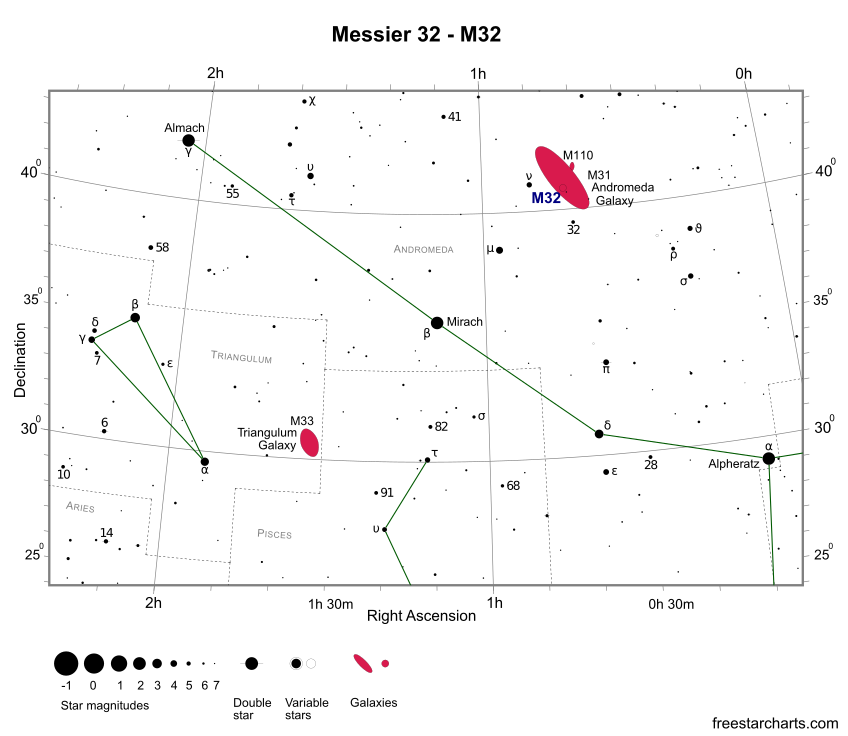
Finder Chart for M32 - pdf format (credit:- freestarcharts)
Despite been small (M32 measures only 8.5 x 6.5 arc minutes) it's relatively bright at mag. +8.1 and hence visible in binoculars, appearing non stellar like an out of focus star. The galaxy is an easy target for small telescopes. When viewed through an 80mm (3.1-inch) refractor, it appears as a small round diffuse ball with a distinctly bright central core. The galaxy is brighter and more oval shaped when seen through a larger 200mm (8-inch) scope. However for M32, that's about as good as it gets. Even the biggest amateur scopes don't bring out much more detail and like M110, the other Messier dwarf satellite of M31, it's dwarfed in size when compared to its parent.
M31, the famous Andromeda Galaxy, is the largest member of the Local Group that also includes the Milky Way, the Triangulum Galaxy (M33) and about 50 other smaller galaxies. With an apparent mag. of +3.4, it's one of the brightest Messier objects and easily visible to the naked eye even from areas with a certain amount of light pollution. M31 is usually regarded as the most distant object that can be easily seen without optical aid.
The Andromeda Galaxy has been known for a long time. It was first recorded over 1000 years ago by Isfahan based Persian astronomer Abd-al-Rahman Al-Sufi. In 964 AD, he described it as the little cloud in his Book of Fixed Stars. This object was almost certainly known - for a number of years before this date - to other Persian astronomers. The first person to telescopically observe and describe M31, was German astronomer Simon Marius on December 15, 1612. Unaware of both Al Sufi's and Marius' discovery, Giovanni Batista Hodierna independently rediscovered the object sometime before 1654. Then on August 3, 1764, Charles Messier added the great spiral to his catalogue. Incidentally, Messier incorrectly credited Marius as the discoverer, apparently unaware of the earlier work of Al-Sufi.
M101 is a large face-on spiral galaxy located 22 million light-years away in the constellation of Ursa Major. At magnitude +7.9, it can be glimpsed in binoculars or small telescopes from dark sites. However, this galaxy suffers from low surface brightness and in bad seeing conditions or light polluted areas is sometimes difficult to spot even with 200mm (8-inch) scopes. M101 is best seen from the Northern Hemisphere during the months of March, April and May.
M101 is also known as the Pinwheel galaxy and was discovered by Pierre Méchain on March 27, 1781. He described it as "nebula without star, very obscure and pretty large, 6' to 7' in diameter, between the left hand of Boötes and the tail of the great Bear." He communicated this to Charles Messier, who verified its position and then included it in his catalogue as one of the final entries.
Locating the part of sky where M101 is positioned is easy, since it's close to the handle of the bowl that forms the Plough or Big Dipper asterism of Ursa Major. The Pinwheel galaxy is located at one corner of an equatorial triangle formed with second magnitude stars Mizar (ζ UMa - mag. +2.2) and Alkaid (η UMa - mag. +1.8). M101 is 5.5 degrees east of Mizar (the celebrated naked eye double star) and 5.5 degrees northeast of Alkaid.

M41 is a stunning, large bright open cluster located in the constellation of Canis Major. Of the many clusters in Canis Major, it's the stand out object and the constellation's only
M41 was discovered by Giovanni Batista Hodierna sometime before 1654, although it was probably known to Aristotle as far back as 325 BC. If true, this would make it the faintest object recorded in classical antiquity, but caution prevails as Aristotle may have described a nearby part of the Milky Way instead. The cluster was catalogued by Charles Messier on January 16, 1765 and is best seen during the months of December, January and February from the tropics and Southern Hemisphere.
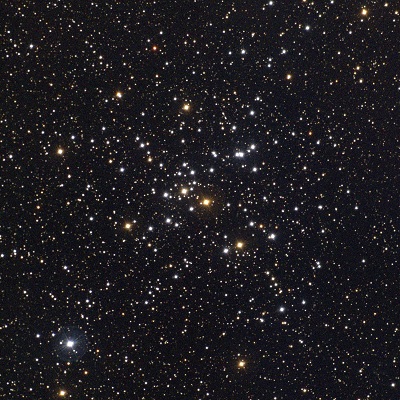

Finder Chart for M41 - pdf format (credit:- freestarcharts)
M43 is a HII region located in the constellation of Orion that was discovered by Jean-Jacques Dortous de Mairan sometime before 1731. As part of the famous Orion Nebula (M42), it's positioned just north of the main nebula and separated from it by a narrow dust lane. With an apparent mag. of +9.0, M43 is about 100 times fainter than M42, but still bright enough to be seen with binoculars.
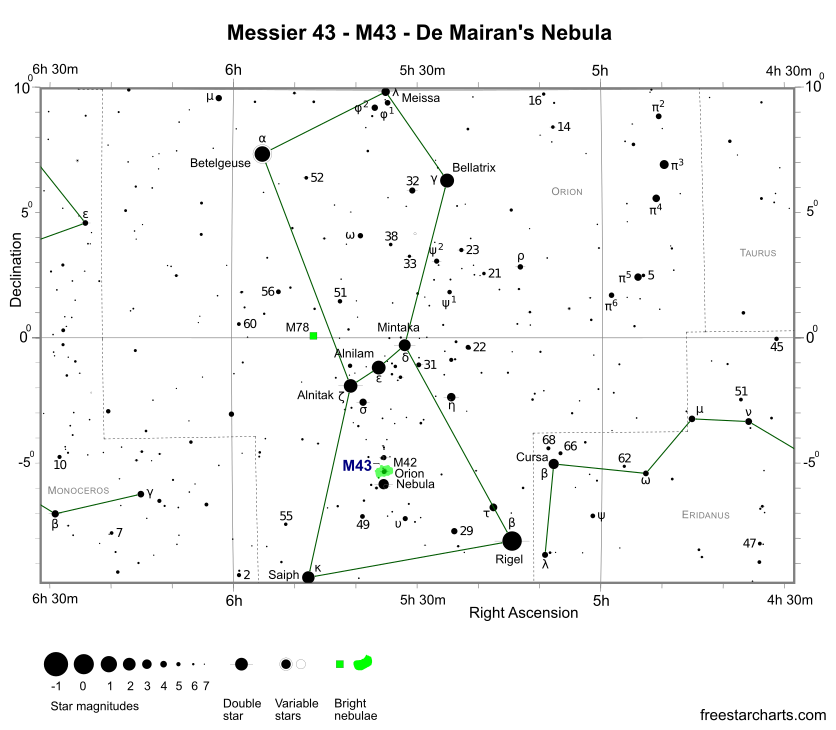
Occasionally, ninth mag. nebulae like M43 can be difficult to find - especially if located in barren parts of the sky - but not this one. Firstly, it's located in majestic Orion, perhaps the most recognizable of all constellations, secondly it's part of the Orion Nebula and therefore positioned right next to the great showpiece object and finally it has a relatively high surface brightness. Of course, finding M42 is easy, it's positioned 5 degrees south of the three bright stars that form Orion's belt (Mintaka, Alnilam and Alnitak). M43 is located just 8 arc minutes north of M42 surrounding a 7th magnitude star. M43 (and M42) are best seen during the months of December, January and February.

M102 is a galaxy catalogued by Charles Messier that hasn't yet been explicitly identified. It was Pierre Méchain who made the original observation in March 1781, before passing the information onto Messier who catalogued it without verification. However, Méchain believed M102 was an error and even wrote a letter on May 6, 1783 expressing his view that the object was in fact a duplicate of M101. Historical, evidence based on Messier's description of the galaxy, combined with its co-ordinates, suggest that M102 could well be lenticular galaxy NGC 5866, also known as the Spindle galaxy. A number of other possible candidates have emerged, but it seems likely that Messier and Méchain both at some time observed NGC 5866, and therefore we include it as the missing item.
The Spindle galaxy (mag. +9.9) is located at the southern edge of the far northern constellation of Draco. It's positioned four degrees southwest of Iota Draconis (ι Dra - mag. +3.3). Directly west of NGC 5866 are the seven stars that form the famous "Plough" or "Big Dipper" asterism of Ursa Major.
NGC 5866 is a challenging binocular object, but much easier to spot with small scopes. It's best seen from Northern Hemisphere locations during the months of April, May and June. From latitudes of 35N or greater, this galaxy is circumpolar and therefore never sets.