Guides / Star Charts
Contributions
If you like the website and want to contribute to the running costs then please do so below. All contributions are most welcome.
Caldwell 2 - C2 - NGC 40 - Bow Tie Nebula - Planetary Nebula
NGC 40 is a planetary nebula located in the northern constellation of Cepheus. It was discovered by William Herschel on November 25, 1788 who described it as "a 9th magnitude star, surrounded with milky nebulosity". Herschel used his 475mm (18.7) inch telescope to make the discovery but for today's amateur astronomers such a large scope isn't required, it can be glimpsed with just a 100mm (4-inch) instrument. NGC 40 is also known as the Bow Tie nebula, a nickname it shares with another planetary nebula, NGC 2440 in Puppis.
NGC 40 is located just over 17 degrees from the North Celestial Pole and therefore circumpolar from most northern latitudes. It's one of the finest examples of its type in the far northern part of the sky. The best time to look for the nebula is during October, November and December when it appears highest in the sky during early evening. The Bow Tie nebula is also visible from most tropical locations although lower down. However, from southern temperate latitudes it's not visible at all.
Locating NGC 40 can be precarious as it's positioned in a star poor region of eastern Cepheus. One method to find it is by imagining a line connecting Errai (γ Cep - mag. +3.21) and γ Cas (mag. +2.15). The planetary lies approximately one-third of the way along this line.
Messier 89 - M89 - Elliptical Galaxy
M89 is another member of the Virgo Cluster of galaxies. It's a small magnitude +10.0 elliptical galaxy (type - E0) discovered by Charles Messier on March 18, 1781. On this bumper night for Messier he also discovered seven other Virgo galaxies and re-discovered globular cluster M92 in Hercules. Recent observations indicate that M89 may be nearly perfectly spherical in shape. This is unusual because all other known ellipticals are elongated. However, it's possible that the spherical nature of M89 is purely a visual affect resulting from its orientation from our perspective.
The galaxy is not as bright as some other group members and therefore a challenging small telescope object. Messier's original discovery observation acknowledges this: "extremely faint and pale and it's not without difficulty that one can distinguish it". The galaxy is best seen with large telescopes but generally featureless and rather unexciting through most amateur instruments.
M89 is located in Virgo just south of the Virgo-Coma Berenices constellation boundary. It's positioned roughly 60% along an imaginary line connecting stars, Denebola (β Leo - mag. +2.1) and Vindemiatrix (ε Vir - mag. +2.8). Slightly brighter spiral galaxy M90 is 0.75 degrees northeast of M89. One degree southeast of M89 is fine barred spiral galaxy M58 with supergiant elliptical galaxy M87 located about a degree west of M89.
The Virgo galaxies are best seen during the months of March, April and May.
About
Our aim is to promote Astronomy for all by providing information, articles, charts for anyone who wants to learn more about the stars, galaxies, the Sun, the planets, moon, asteroids, comets and whatever may be out there.
FAQ
1. How are the charts produced?
All charts are computer generated with finishing touches applied using vector graphics program Inkscape. The star data for the charts comes from the Hipparcos and Tycho-2 Catalogues of the Hipparcos satellite, which was launched by the European Space Agency in 1989 and operational until 1993.
The Hipparcos Catalogue is a high-precision data-set of more than 100,000 stars and was published in 1997 along with the lower precision Tycho Catalogue of more than a million stars. An enhanced catalogue Tycho-2 with 2.5 million stars was published in 2000. Double stars were checked using the Washington double star catalogue. Data for deep sky objects such as nebula, galaxies, open clusters, globular clusters etc are checked against various sources.
2. Will the charts always be free?
Absolutely. All charts will be free to download and we will try to make them available in as many different formats as possible.
Algol eclipse dates and times for January 2023
Algol (β Per) is a bright eclipsing binary system located in the northern constellation of Perseus and one of the best-known variable stars in the sky. Often referred to as the "Demon Star", most of the time it shines at mag. +2.1 but every two days, 20 hours and 49 minutes it suddenly dips in brightness to mag. +3.4, remaining dim for about 10 hours before returning to its original state.
Why the brightness change. The Algol system consists of at least three-stars (β Per A, β Per B and β Per C) with the orbital plane of Algol A and B directly in line with the Earth. The regular dips in brightness occur when the dimmer B star moves in front of and eclipses the brighter A star. There is also an extra dimension in that a secondary eclipse occurs when the brighter star occults the fainter secondary, resulting in a very small dip in brightness that can be detected with photo-electrical equipment.

NGC 7000 - The North American Nebula - Emission Nebula
NGC 7000 is a giant emission nebula in the constellation of Cygnus that spans 120 x 100 arc minutes of apparent sky. It's one of a number of low surface brightness nebulae surrounding first magnitude star, Deneb (α Cyg - mag. +1.25). Under dark skies this object can be spotted with the naked eye, appearing as a faint hazy patch of light although even the smallest amount of light pollution renders it invisible.
The integrated magnitude of NGC 7000 is probably about +4.5. However, this is misleading due its large size and some parts of the nebula shine no brighter than 12th magnitude. When photographed or imaged, NGC 7000 bears a striking resemblance to the North American continent, hence it's nickname "the North America Nebula".
NGC 7000 was discovered by William Herschel on October 24, 1786 and first photographed by Max Wolf on December 12, 1890. It is 1,600 light-years away and best seen from northern latitudes during the months of July, August and September.
IC 2602 - The Southern Pleiades - Open Cluster
IC 2602 is a prominent open cluster in the southern constellation of Carina that was discovered by Abbe Lacaille in 1751 from South Africa. It contains about 60 stars spread across 50 arc minutes and is easily visible to the naked eye. The brightest member is blue-white Theta Carinae (θ Car), which shines at magnitude +2.74. Of the remaining constituents all are of fifth magnitude or fainter. When seen through binoculars and small scopes, IC 2602 is a stunning object and a superb example of its type.
IC 2602 is one of the brightest and closest open clusters to the Solar System. It's known as the "Theta Carinae Cluster" or "Southern Pleiades" and has a combined magnitude of +1.9. For comparison, IC 2602 is 70% fainter and about half the apparent size of its northern namesake, the Pleiades (M45).


Finder Chart for IC 2602 - pdf format (credit:- freestarcharts)
Almach - Gamma Andromedae - γ And - Double Star
Almach (γ And) is one of the finest double stars in the sky. To the naked eye, it appears as a single bright star of magnitude +2.10, but small scopes reveal an outstanding double, made up of a bright yellow or slightly orange primary and a fainter deep blue secondary. It's widely regarded as the second best colour contrast double in the sky, surpassed only by Albireo in Cygnus.

Almach is positioned in the eastern part of Andromeda. It's the third brightest star in the constellation and is comparable in brightness to Polaris and the main stars of Ursa Major. To locate Almach, a useful starting point is the Great Square of Pegasus and in particular its north-eastern star, Alpheratz (α And). With a mag. of +2.07, Alpheratz is marginally brighter than Almach. From Alpheratz, imagine a line moving north-easterly towards Perseus. This line passes through delta Andromedae (δ And - mag. +3.3) then Mirach (β And - mag. +2.1) followed by Almach.
Any small scope will split Almach. For example, an 80mm (3.1 inch) refractor at 75x magnification will easily transform it into two colourful stars, separated by 9.4 arc seconds. The colour contrast is stark, the brighter member is a type K3 orange yellow giant, while its companion is a type B9 hot blue main-sequence star. Depending on your eyes, and seeing conditions, you may perceive slightly different colours than described. This star was first identified as a double by German physicist and astronomer Johann Tobias Mayer in 1778.
The blue secondary is actually a triple star and with large amateur scopes on good nights, can be split into components of magnitudes +5.1 and +6.3. However, the separation is a measly 0.3 arc seconds, therefore difficult and a reflector of at least 250mm (10-inch) aperture is recommended. German astronomer Wilhelm Struve first resolved this pair in October 1842. In addition, the brighter member is also a spectroscopic double, making this a four star system in total.
Orion - Constellation Guide
Orion
Orionis
Ori
The Hunter
Introduction
Orion is a prominent constellation that's one of the brightest and most familiar sights in the night sky. Straddling the celestial equator it can be seen from all locations on Earth. Named after a great hunter in Greek mythology, it contains two first magnitude stars, many other bright stars, a famous belt, spectacular nebulae, some impressive multiple stars and fine open clusters. Its most famous inhabitant, the Orion Nebula, is one of the most spectacular deep sky objects in the sky.
The distinctive pattern of Orion has been used historically and in the modern World extensively. The earliest linking is an ivory carving found in a cave in the Ach valley in Germany, which is estimated to be at least 32,000 years old. In Greek mythology, Orion was a handsome strong hunter, born to Euryale the daughter of King Minos of Crete and Poseidon, the god of the sea. Many myths surround the character particularly involving his death. Various versions exist, but generally Orion brought the wrath of goddess Artemis who sent the scorpion to kill him. The resulting outcome is that the hunter and the scorpion are placed on opposite sides of the sky. When Scorpius rises in the east, Orion is setting in the west.
In medieval Muslim astronomy, Orion was known as al-jabbar, the giant. In old Hungarian tradition, Orion was a magic Archer or Reaper and in China the constellation was one of the 28 lunar mansions that reflect the movement of the Moon. The Egyptians associated Orion with Osiris, the god of death, afterlife, resurrection, regeneration and rebirth. They also aligned part of the Great Pyramid of Giza with Alnitak, one of the stars of the belt. For the Aztecs, Orion rising in the east signaled the time to perform the "New Fire" ceremony, a ritual designed to postpone the end of the World. More recently, the film company Orion Pictures used the constellation's main shape as its logo.
Orion is best seen during the months of December, January and February.

Capella - Alpha Aurigae - α Aur
Capella is a bright yellow star located in the northern section of sky. With an apparent magnitude of +0.08, it's marginally fainter than another bright northern star, Vega. Capella is the standout star of the relatively large constellation of Auriga, the Charioteer. The Milky Way passes through the heart of Auriga and as a result it contains numerous bright open clusters, nebulae and interesting stars.
Capella is the northernmost first magnitude star and is circumpolar from latitudes greater than +44 degrees. The star can still be spotted from most southerly regions including Australia, New Zealand and Argentina. However, it's not visible from the Falkland Islands or Antarctica.

Caldwell 63 - C63 - NGC 7293 - The Helix Nebula - Planetary Nebula
The Helix Nebula (NGC 7293) is a large and famous planetary nebula located in the faint zodiac constellation of Aquarius. Also known as Caldwell 63 it's one of the nearest objects of its type; a beautiful remnant of a dying star containing a double ring structure not unlike two coils of a spring, hence the popular name "The Helix Nebula".
Although the immediate area surrounding the Helix Nebula is devoid of any particular bright stars, the region can be easily located by star-hoping. NGC 7293 lies roughly halfway along an imaginary line connecting Fomalhaut (α PsA - mag. +1.2) the brightest star in the southerly constellation of Piscis Austrinus and ι Aqr (mag. +4.3). Just over one degree to the east of the Helix Nebula is υ Aqr. At magnitude +5.2 this star is visible to the naked eye under dark skies, simplifying the search for the Helix Nebula.
Sirius - Alpha Canis Majoris - α CMa
There are at least 6,000 stars bright enough to be visible with the naked eye. Under dark skies, up to about 3,000 can be seen at any one time (since one half of the Earth is in daylight). However, none can rival the brilliance of Sirius, the brightest night time star.
Located in the constellation of Canis Major, Sirius shines with an apparent magnitude of -1.46. It's noticeably brighter than its nearest rival Canopus (α Car mag. -0.72) and four times more brilliant than Arcturus, the brightest star in the northern section of sky. Sirius is also known as the "Dog Star". When close to the horizon it twinkles. Of course, the colour variations are only a result of the Earth's unsteady atmosphere. In practice, all stars do twinkle and to a lesser extent the planets as well.

To the naked eye Sirius appears as a single star, but it's actually a binary system. The primary component is a white main sequence star of spectral type, A1V, named Sirius A. This star is the one visible to the naked eye. It has a radius of 1.7 times that of the Sun and is 25 times more luminous.
IC 2497 and Hanny's Voorwerp
IC 2497 is a spiral galaxy located about 650 million light-years distant in the small northern constellation of Leo Minor. Although similar in size to our Milky Way, it appears very small and faint due to its vast distance from us. At magnitude +15.8, this galaxy is beyond the reach of most amateur backyard scopes and seemingly just one of the many thousands of faint galaxies populating the night sky. However, a few years ago IC 2497 made international news not because of the galaxy itself, but due to a new strangle object that was discovered next to it - Hanny's Voorwerp.
Hanny's Voorwerp
In 2007, Dutch school teacher Hanny van Arkel signed up to the newly created on-line citizen science project Galaxy Zoo. The project enlisted help from the public to classify vast numbers of galaxies based on their physical appearance. The original dataset used was obtained from the Sloan Digital Sky Survey and contained almost 1 million galaxies. With so many galaxies it was thought that the analysis would take years, but the organisers were in for a pleasant surprise - within 24 hours the website was receiving almost 70,000 classifications an hour and the site even crashed temporarily due to intense traffic.
Messier 100 - M100 - Spiral Galaxy
M100, mag. +9.5, is a spiral galaxy located in the southern part of the constellation of Coma Berenices. It's one of the brightest members of the Virgo cluster of galaxies and appears almost face-on from our perspective. It exhibits prominent well-defined spiral arms and is therefore regarded as a grand design spiral. Other notable galaxies that fall into this category are M51, M74, M81 and M101.
M100 was discovered, along with M98 and M99, by Pierre Méchain on March 15, 1781. Charles Messier subsequently observed all three objects and added them to his catalogue on April 13, 1781. He described the galaxy as faint without stars. It was not until 1850 that its spiral nature was first detected by Ango-Irish astronomer William Parsons, the 3rd Earl of Rosse. He included it in his list of 14 spiral nebulae.
Finding the area of sky where M100 is positioned is not difficult once familiar with the location of the Virgo cluster. The cluster centre is positioned close to supergiant elliptical galaxy M87 and about halfway along a line connecting Denebola (β Leo - mag. +2.1) with Vindemiatrix (ε Vir - mag. +2.8). M100 is towards the northern section of the group, 2 degrees southeast of star 11 Comae Berenices (mag. +4.7).
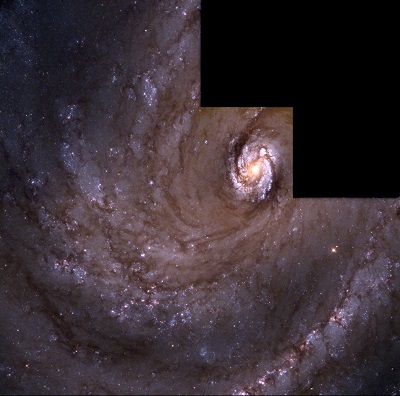

Finder Chart for M100 - pdf format (credit:- freestarcharts)
Cassiopeia - Constellation Guide
Cassiopeia
Cassiopeiae
Cas
The Seated Queen
Introduction
Cassiopeia is a prominent northern constellation named after Queen Cassiopeia, the wife of King Cepheus of Ethiopia. In Greek mythology, the Queen was arrogant and extremely boastful about her beauty. Legend has it she claimed both her and her daughter, Andromeda, were more beautiful than all the Nereids the nymph-daughters of the sea god Nereus. This brought the wrath of the ruling god of the sea Poseidon who decided to destroy the kingdom.
After consulting a wise oracle, the only way the King and Queen could stop Poseidon from carrying out his threat was to scarify Andromeda. The princess was left helplessly chained to a rock at the sea edge, awaiting her fate at the hands of Cetus, the sea monster. However, just in time, the hero Perseus arrived to save Andromeda and in the process killed the sea monster. Although Andromeda lived to marry Perseus, Poseidon deemed that Cassiopeia should not escape punishment and banished her to the sky forever, tied to the chair of torture!
The constellation is one of the original 48 plotted by second century astronomer Ptolemy and remains as one of the 88 modern constellations. It's one of the most recognisable constellations due to the distinctive W shape of its five brightest stars. This asterism forms part of the chair and consists of γ Cas (mag.(v) +1.6 -> +3.0), Schedar (α Cas - mag. +2.24), Caph (β Cas - mag. +2.28), Ruchbah (δ Cas - mag. +2.66) and ε Cas (mag. +3.35). Variable star γ Cas can peak at magnitude +1.6 and when it does it's easily the brightest member but currently it hovers around magnitude +2.15.
Since located right bang at the centre of the rich northern Milky Way, Cassiopeia is full of wonderful deep-sky objects. It contains over a dozen bright open clusters visible in small scopes. In addition, there are some beautiful double stars and interesting variable stars. At Cassiopeia's southern end there are three faint galaxies, two of which are dwarfs and members of the M31 Group. For larger scopes there are four faint nebulae within range.
Messier 90 - M90 - Spiral Galaxy
M90 is a spiral galaxy located in Virgo that's a member of the Virgo Cluster and one of the group's largest and brightest spirals. With an apparent magnitude of +9.6, it's visible with small scopes, appearing as an oval shaped patch of light. M90 shines relatively bright in medium size reflectors, but spotting the spiral structure is difficult and larger scopes are recommended.
This galaxy was one of eight galaxies, all Virgo members, discovered by Charles Messier on March 18, 1781. It's located about 60 Million light-years away and is intrinsically large, with an actual diameter of 165,000 light-years. This equates to about 20% more than the diameter of the Andromeda Galaxy (M31). M90 is estimated to contain a trillion stars.
The galaxy is positioned close to the centre of the Virgo cluster and right at the Virgo-Coma Berenices constellation border. The centre of the Virgo cluster is located roughly halfway along a line connecting stars, Denebola (β Leo - mag. +2.1) and Vindemiatrix (ε Vir - mag. +2.8). In the same area of sky are M84, M86 and M87. M90 is positioned 1.5 degrees northeast of M87. The small elliptical galaxy, M89, is 0.75 degrees southwest of M90 with M91 about a degree north-northwest of M90. Tenth magnitude spiral galaxy M88 is located 1.5 degrees northwest of M90.
The Virgo galaxies are best seen during the months of March, April and May.
Algol eclipse dates and times for December 2022
Algol (β Per) is a bright eclipsing binary system located in the northern constellation of Perseus and one of the best-known variable stars in the sky. Often referred to as the "Demon Star", most of the time it shines at mag. +2.1 but every two days, 20 hours and 49 minutes it suddenly dips in brightness to mag. +3.4, remaining dim for about 10 hours before returning to its original state.
Why the brightness change. The Algol system consists of at least three-stars (β Per A, β Per B and β Per C) with the orbital plane of Algol A and B directly in line with the Earth. The regular dips in brightness occur when the dimmer B star moves in front of and eclipses the brighter A star. There is also an extra dimension in that a secondary eclipse occurs when the brighter star occults the fainter secondary, resulting in a very small dip in brightness that can be detected with photo-electrical equipment.
Caldwell 39 - C39 - NGC 2392 - Eskimo Nebula - Planetary Nebula
NGC 2392 is a 9th magnitude bipolar double shell planetary nebula located in the constellation of Gemini. Resembling a person's head surrounded by a parka hood, it's commonly known as the "Eskimo Nebula" or "Clown Face Nebula". William Herschel discovered it from his observatory in Slough on January 17, 1787, describing the planetary nebula as a 9th magnitude star with a bright centre surrounded by equally dispersed nebulosity.
Locating the Eskimo Nebula is relatively easy; it's positioned just east of centre of the bright zodiacal constellation of Gemini, "the Twins" and close to Wasat (δ Gem - mag. +3.5). The easiest way to find Gemini is by identifying its two brightest stars Castor (α Gem - mag. +1.58) and Pollux (β Gem - mag. +1.16). They are positioned east of the familiar "V" shaped asterism of Taurus and to the northeast of the bright prominent constellation of Orion.
Imagine a line extending from Pollux - the brighter of the twins - towards the southwest in the direction of Orions belt. Positioned just over 8 degrees along this line is Wasat and 2.3 degrees southeast of Wasat is NGC 2392. The planetary nebula is positioned next to a mag. +8.2 yellow white star. At first glance through a telescope the pair appears like a wide double star, separated by about 100 arc seconds.
Algol eclipse dates and times for November 2022
Algol (β Per) is a bright eclipsing binary system located in the northern constellation of Perseus and one of the best-known variable stars in the sky. Often referred to as the "Demon Star", most of the time it shines at mag. +2.1 but every two days, 20 hours and 49 minutes it suddenly dips in brightness to mag. +3.4, remaining dim for about 10 hours before returning to its original state.
Why the brightness change. The Algol system consists of at least three-stars (β Per A, β Per B and β Per C) with the orbital plane of Algol A and B directly in line with the Earth. The regular dips in brightness occur when the dimmer B star moves in front of and eclipses the brighter A star. There is also an extra dimension in that a secondary eclipse occurs when the brighter star occults the fainter secondary, resulting in a very small dip in brightness that can be detected with photo-electrical equipment.
NGC 6302 - Bug Nebula - Planetary Nebula
NGC 6302, also known as the Bug Nebula or Butterfly Nebula, is a bipolar planetary nebula in the constellation of Scorpius. It's an unusual object, complex in structure with an incredibly hot star at its core. At a temperature of 250,000 degrees Celsius, this dying star is one of the hottest known in the galaxy. However, since it radiates predominantly in UV and is shrouded by dust, it's visually challenging to observe.
The discoverer of the Bug Nebula is debatable. Edward E. Barnard observed the planetary in 1880, although some references suggest that James Dunlop may have found it in 1826. The nebula itself shines at mag. of +9.6 and therefore well within the reach of medium size backyard scopes.
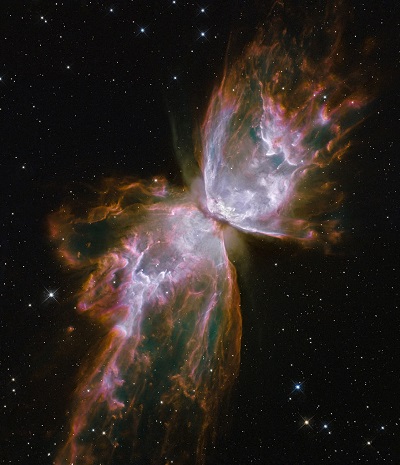

Finder Chart for NGC 6302 - pdf format (credit:- freestarcharts)