Guides / Star Charts
Contributions
If you like the website and want to contribute to the running costs then please do so below. All contributions are most welcome.
Ursa Minor
Ursa Minoris
UMi
The Little Bear
Introduction
Ursa Minor is a medium size constellation located in the far northern reaches of the sky. Also known as the Little Bear, its main group of stars resemble a smaller version of the Great Bear of Ursa Major. Greek astronomer Thales first mentioned the constellation, around 600 BC, after realising it could be used as a better guide to finding true north than Ursa Major. Over the years it has been visualised as many things, including a dog's tail revolving its tip and a bunch of jewels.
Ursa Minor has been important for navigation since it contains the North Celestial Pole (NCP). Currently, the constellation's brightest star Polaris (mag. +1.97) is only three quarters of a degree from the NCP, thereby providing a convenient marker. Polaris is slowly edging nearer and on March 24, 2100 it will be less than half a degree removed. After that it gradually moves away.
Like Ursa Major, the main seven stars of Ursa Minor form the handle of a ladle. The bowl contains second magnitude Kochab (β UMi) and third magnitude Pherkad (γ UMi), which are collectively known as the guardians of the pole. The remaining members of the group are fainter, down to fifth magnitude, but do provide a useful sky darkness check scale. On good nights all seven stars can be seen with the naked eye.
In terms of size, Ursa Minor covers 256 square degrees and is the 56th largest constellation in the sky. It's devoid of bright deep sky objects but contains a few interesting galaxies within amateur range, including the Ursa Minor Dwarf galaxy, a satellite of the Milky Way. Ursa Minor also contains some variable stars and a few double stars of interest.
From locations north of latitude 25N, the constellation is circumpolar and therefore never sets. For those living south of 25S, it always remains below the horizon and can never be seen.
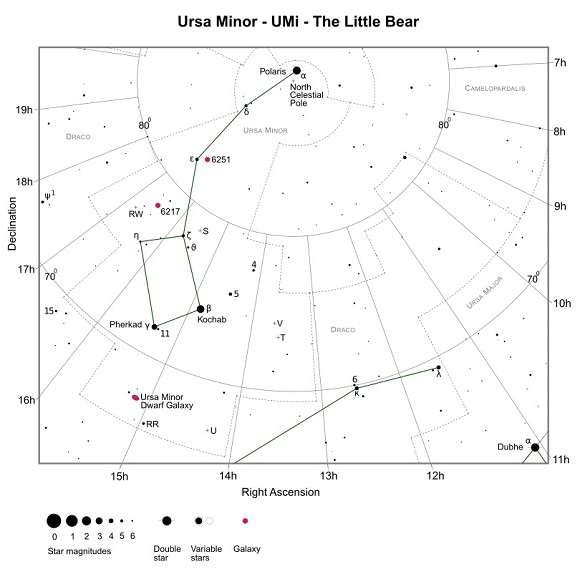
Ursa Minor Star Chart - pdf format (credit:- freestarcharts)
Gemini
Geminorum
Gem
The Twins
Introduction
Gemini is a northern zodiac constellation and one of the 48 constellations described by second century astronomer Ptolemy. Its name is Latin for the twins and it's one of the few constellations in the sky that actually looks like what it suppose to represent. This bright grouping contains two-standout stars, Castor (α Gem) and Pollux (β Gem). At mag. +1.16, Pollux is the brighter while multiple system Castor shines at mag. +1.58. Surprisingly, Pollux was assigned beta Geminorum by Johann Bayer - the German astronomer who labelled the stars with Greek letters in 1603 - even though it easily outshines Castor. Some astronomers have suggested that maybe Pollux has since brightened or Castor faded, but both possibilities seem extremely improbable. The likelihood is that Bayer simply made a mistake and didn't carefully distinguish which was the brighter star.
In Greek mythology, Castor and Pollux were twin brothers whose mother was Queen Leda although Castor was the mortal son of King Tyndareus and Pollux the divine son of Zeus. Together the twins were known as the Dioscuri, which means the sons of Zeus. However, in most versions of the myth only Pollux was Zeus's child. The twins were the patron saints of mariners, appearing in ships rigging as the St Elmo's fire phenomena. When Castor died, Pollux begged Zeus to give Castor immortality, which he did, thereby reuniting the twins together in the heavens forever.
Ursa Major
Ursa Majoris
UMa
The Great Bear
Introduction
Ursa Major or the Great Bear is a prominent constellation in the northern celestial hemisphere. It's the third largest constellation in the sky and contains a central feature of seven stars, known as the Plough or Big Dipper, which is one of the most recognisable patterns. It's made up of stars, Dubhe, Merak, Phecda, Megrez, Alioth, Mizar and Alkaid. Ursa Major was listed by Ptolemy as one his 48 constellations in his second century Almagest and remains today as one of the modern 88 constellations.
Orion
Orionis
Ori
The Hunter
Introduction
Orion is a prominent constellation that's one of the brightest and most familiar sights in the night sky. Straddling the celestial equator it can be seen from all locations on Earth. Named after a great hunter in Greek mythology, it contains two first magnitude stars, many other bright stars, a famous belt, spectacular nebulae, some impressive multiple stars and fine open clusters. Its most famous inhabitant, the Orion Nebula, is one of the most spectacular deep sky objects in the sky.
The distinctive pattern of Orion has been used historically and in the modern World extensively. The earliest linking is an ivory carving found in a cave in the Ach valley in Germany, which is estimated to be at least 32,000 years old. In Greek mythology, Orion was a handsome strong hunter, born to Euryale the daughter of King Minos of Crete and Poseidon, the god of the sea. Many myths surround the character particularly involving his death. Various versions exist, but generally Orion brought the wrath of goddess Artemis who sent the scorpion to kill him. The resulting outcome is that the hunter and the scorpion are placed on opposite sides of the sky. When Scorpius rises in the east, Orion is setting in the west.
In medieval Muslim astronomy, Orion was known as al-jabbar, the giant. In old Hungarian tradition, Orion was a magic Archer or Reaper and in China the constellation was one of the 28 lunar mansions that reflect the movement of the Moon. The Egyptians associated Orion with Osiris, the god of death, afterlife, resurrection, regeneration and rebirth. They also aligned part of the Great Pyramid of Giza with Alnitak, one of the stars of the belt. For the Aztecs, Orion rising in the east signaled the time to perform the "New Fire" ceremony, a ritual designed to postpone the end of the World. More recently, the film company Orion Pictures used the constellation's main shape as its logo.
Orion is best seen during the months of December, January and February.

Cassiopeia
Cassiopeiae
Cas
The Seated Queen
Introduction
Cassiopeia is a prominent northern constellation named after Queen Cassiopeia, the wife of King Cepheus of Ethiopia. In Greek mythology, the Queen was arrogant and extremely boastful about her beauty. Legend has it she claimed both her and her daughter, Andromeda, were more beautiful than all the Nereids the nymph-daughters of the sea god Nereus. This brought the wrath of the ruling god of the sea Poseidon who decided to destroy the kingdom.
After consulting a wise oracle, the only way the King and Queen could stop Poseidon from carrying out his threat was to scarify Andromeda. The princess was left helplessly chained to a rock at the sea edge, awaiting her fate at the hands of Cetus, the sea monster. However, just in time, the hero Perseus arrived to save Andromeda and in the process killed the sea monster. Although Andromeda lived to marry Perseus, Poseidon deemed that Cassiopeia should not escape punishment and banished her to the sky forever, tied to the chair of torture!
The constellation is one of the original 48 plotted by second century astronomer Ptolemy and remains as one of the 88 modern constellations. It's one of the most recognisable constellations due to the distinctive W shape of its five brightest stars. This asterism forms part of the chair and consists of γ Cas (mag.(v) +1.6 -> +3.0), Schedar (α Cas - mag. +2.24), Caph (β Cas - mag. +2.28), Ruchbah (δ Cas - mag. +2.66) and ε Cas (mag. +3.35). Variable star γ Cas can peak at magnitude +1.6 and when it does it's easily the brightest member but currently it hovers around magnitude +2.15.
Since located right bang at the centre of the rich northern Milky Way, Cassiopeia is full of wonderful deep-sky objects. It contains over a dozen bright open clusters visible in small scopes. In addition, there are some beautiful double stars and interesting variable stars. At Cassiopeia's southern end there are three faint galaxies, two of which are dwarfs and members of the M31 Group. For larger scopes there are four faint nebulae within range.
Aries
Arietis
Ari
The Ram
Introduction
Aries is a medium-sized northern constellation of the zodiac that lies in a rather barren part of the sky. It contains mostly inconspicuous faint stars and is bordered by Taurus to the east, Perseus and Triangulum to the north, Pisces to west and Cetus to the south. The constellation was one of the original 48 constellations plotted by second century astronomer Ptolemy and remains today as one of the modern 88 constellations defined by the IAU (International Astronomical Union).
In Greek mythology, Aries represents the golden ram that was sent to rescue Phrixos and Helle, the children of King Athamus of Boeotia and his first wife Nephele. The King's second wife, Ino, was resentful and wanted the children, in particular, Phrixos killed. She induced a famine in the Kingdom and then falsified a message to the King, indicating Phrixos must be sacrificed in order to save the land. Athamus was about to sacrifice his son, when Aries - sent by Nephele - arrived. The ram managed to rescue Phrixos, but Helle didn't survive. Phrixus then sacrificed the ram to Zeus with its Golden Fleece presented to King Aeëtes of Colchis. In a later myth, Jason and the Argonauts who actively sought the fleece eventually managed to steal it. In ancient Egyptian astronomy, Aries was associated with the god Amon-Ra, who was depicted as a man with a ram's head and represented fertility and creativity. The Arabs knew Aries as a sheep and the Chinese as a dog.
The constellation contains a single second magnitude star, one third magnitude star, three fourth magnitude stars and over a dozen fifth magnitude stars. It contains no Messier objects and no bright deep sky objects. However, its boundaries contain numerous faint galaxies within the range of medium / large size amateur scopes. For small scopes, there are a handful of nice double stars, including some bright ones.
Two thousand or so years ago Aries contained the vernal equinox, the point where the Sun annually passes from south to north across the celestial equator. This occurs on or about March 20th and signals the start of spring in the Northern Hemisphere and autumn in the Southern Hemisphere. Due to precession the vernal equinox has now moved into neighbouring Pisces.
Aries covers 441 square degrees of sky, ranking it 39th in overall size. It's best seen from Northern Hemisphere locations during the months of October, November and December. There are several meteor showers that radiate from Aries, including the Daytime Arietids and the Delta Arietids.

Andromeda
Andromedae
And
The Chained Woman
Introduction
Andromeda is located in the northern part of the sky away from the plane of the Milky Way. It was one of the original 48 constellations plotted by second century astronomer Ptolemy and remains today as one of the modern 88 constellations defined by the IAU (International Astronomical Union). Andromeda is named after the princess in Greek Mythology who was the daughter of King Cepheus and Queen Cassiopeia. Legend has it, she was chained to a rock on the coast to be sacrificed in order to save the land from the large sea monster, Cetus. Returning Perseus came across the shackled princess and lay in waiting for the monster, before killing it and then marrying the princess.
For amateurs, Andromeda contains one famous galaxy, many faint galaxies, a selection of nice double stars, a couple of bright open clusters, a few variable stars and a beautiful planetary nebula. The deep sky object that dominates the constellation is the spectacular Andromeda galaxy (M31), which is the largest member of our Local Group. At 2.54 Million light-years, it's the most distant object in the night sky that's easily visible with the naked eye.
Vulpecula
Vulpeculae
Vul
The Fox / The Little Fox
Introduction
Vulpecula is a small, faint constellation located in the northern section of the sky. Strangely, it was not one of the original 48 constellations created by 2nd century astronomer Ptolemy, even though the pattern of stars were clearly visible to him and other ancient Greeks and Romans.
The constellation we know today was created by Johannes Hevelius. He included it in his influential 56 page star atlas, Firmamentum Sobiescianum, which was published posthumously in 1690. Originally it was known by two names, Vulpecula cum anser and Vulpecula et Anser. The first means the little fox with the goose and the second the little fox and the goose. In his original illustration, Hevelius depicted an unfortunate goose carried in the jaws of a fox. Later the constellation was divided into two separate parts, Vulpecula and Anser. It was then re-merged into a single entity - simply named Vulpecula - by the International Astronomical Union (IAU) in the 20th century. The only remains of the goose is the constellation's brightest star, Anser (α Vul).
Locating the area of the sky where Vulpecula lies is easy; it's wedged between Cygnus and Sagitta with the western half located roughly in the middle of the well observed Summer triangle (an asterism consisting of the bright stars Deneb, Vega and Altair). For deep sky observers, Vulpecula contains the superb Dumbbell Nebula, a famous coathanger shaped open cluster and a few other open clusters. At 288 square degrees, it's the 55th largest constellation in the sky.
Crux
Crucis
Cru
The Southern Cross
Introduction
Despite having the smallest size of all constellations - a mere 68 square degrees - Crux is the most celebrated of all southern constellations. Its name is Latin for cross, which refers to the main asterism of the four relatively bright stars at its centre. To some the cross shape is more resembling of a kite, but whatever you think it looks like it's superb and unmistakable.
Positioned in the sky at a declination of about -60 degrees, Crux is visible from all parts of the Southern Hemisphere and for many of these observers it's circumpolar. For residents just north of the equator the cross can be spotted during late spring, low down above the southern horizon. Unfortunately, for most Northern Hemisphere observers this superb constellation never manages to climb above the horizon and can never be seen.

Hercules
Herculis
Her
The Strongman
Introduction
The constellation of Hercules is one of the original 48 constellations plotted by 2nd century astronomer Ptolemy and remains today as one of the modern 88 constellations. Hercules is the 5th largest constellation and spans an impressive 1,225 square degrees of sky. However, despite its large apparent size it's rather faint. Although easily traceable under dark skies, the constellation can become elusive with just a hint of light pollution or when viewed under a moonlit sky.
The centrepiece of Hercules is a trapezoid shaped asterism commonly known as the Keystone. The four stars of the Keystone are Eta Herculis, Zeta Herculis, Epsilon Herculis and Pi Herculis. They are all between magnitudes 3 and 4 in brightness. The brightest of the four, Zeta Herculis, shines at magnitude + 2.81 and is the second brightest star in the constellation. Along with marginally brighter Kornephoros (Beta Herculis) these are the only two stars in Hercules above magnitude +3.0.
For deep sky enthusiasts Hercules contains a sprinkle of globular clusters, challenging planetary nebulae and a host of faint galaxies.