Guides / Star Charts
Contributions
If you like the website and want to contribute to the running costs then please do so below. All contributions are most welcome.
NGC 4889 - Elliptical Galaxy
NGC 4889 is a supergiant elliptical galaxy in the constellation of Coma Berenices. It's one of the principal members of the Coma Cluster, a large cluster of a least 1,000 galaxies located 335 million light-years distant. This group of galaxies is comparable to the Virgo Cluster but six times further away.
NGC 4889 lies at the centre of the Coma Cluster, a region it dominates along with another supergiant elliptical, NGC 4874. The Coma Cluster is also known as Abell 1656 and together with the Leo Cluster (Abell 1367) they are the major constituents of the Coma Supercluster. With an apparent mag. of +11.5, NGC 4889 is the brightest Coma cluster member and can be glimpsed with just a 100mm (4-inch) refractor, which is remarkable considering how far away it is.
Many amateur astronomers like to push telescopes to test their deep space distance records. The obvious starting point is the Messier catalogue and the most distant Messier galaxy is M109, at 83.5 Million light-years. To go deeper still you need to search elsewhere and the Caldwell catalogue has a few good examples. One of them is NGC 4889 and it's one of the most distant galaxies easily visible with backyard scopes. The current estimate has it at 308 Million light-years.
Caldwell 28 - C28 - NGC 752 - Open Cluster
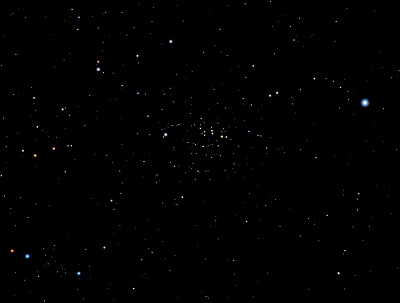
NGC 752 is a large spawling open cluster in the constellation of Andromeda. With an apparent magnitude of +5.7, it's visible to the naked eye from a dark site appearing as a large unresolved fuzzy patch of light. The cluster is one of the finest large open clusters in the sky and contains over 70 stars spread across a huge 1.25 degrees of apparent sky. Due to its size, NGC 752 is best observed with binoculars or through wide field telescopes at low powers.
NGC 752 is located 5 degrees south and slightly west of outstanding double star Almach (γ And - mag. +2.1) the third brightest star in the constellation. It was discovered by Caroline Herschel on September 29, 1783 although it was probably observed sometime before 1654 by Italian astronomer Giovanni Battista Hodierna. Caroline's brother William Herschel subsequently added it to his catalogue a couple of years later. It's best seen from northern latitudes during the months of October, November and December.

Messier 60 - M60 - Elliptical galaxy
M60 is an elliptical galaxy and a member of the Virgo cluster of galaxies. With an apparent magnitude of +9.2, it's the third brightest of the giant elliptical galaxies in the cluster. Only M49 (mag. +8.4) and M87 (mag. +8.7) appear more luminous. M60 is visible with small scopes or large binoculars, but as with most galaxies it's better seen with greater aperture.
On April 11, 1779 while comet chasing, Johann Gottfried Koehler discovered M60 together with its slightly smaller and fainter neighbour M59. Also searching around the same time and in the same part of the sky was Charles Messier, who independently found both M59 and M60 four days later. During his search, Messier discovered another Virgo cluster galaxy (M58) that was missed by Koehler. Of the three galaxies, Messier described M60 as the brightest with M59 and M58 fainter but of similar magnitude.
Locating M60 is relatively easy. Start by imagining a line from Vindemiatrix (ε Vir - mag. +2.8) heading in the direction of Denebola (β Leo - mag. +2.1). M60 is about 4.5 degrees along this line, with M59 positioned 0.4 degrees west of M60. Move another degree further west to arrive at M58.
M60 is estimated to lie 55 million light-years from Earth. It spans 7.6 x 6.2 arc minutes of apparent sky, which corresponds to a spatial diameter of 120,000 light-years. The galaxy contains about 400 billion stars and is best seen during the months of March, April and May.

Mu Cephei - Herschel's Garnet Star
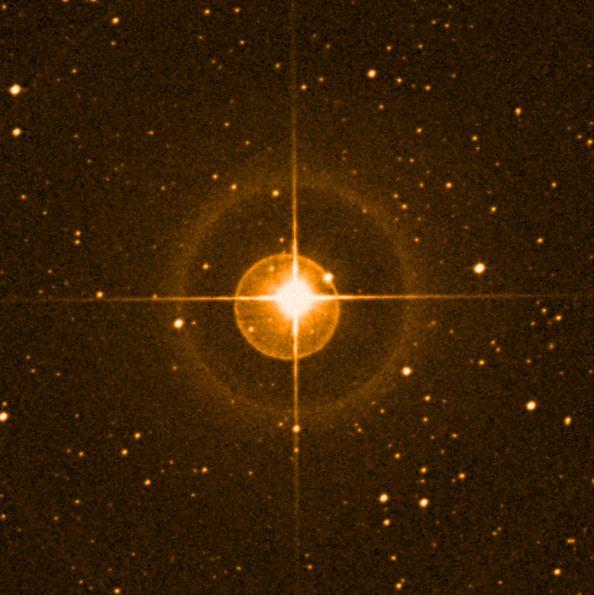
When Sir William Herschel observed Mu Cephei in 1783 he described it as a most beautiful object of a very fine deep garnet colour, that's exceptionally striking when compared to nearby white stars. In fact, Mu Cephei is an extremely luminous red supergiant and one of the reddest known stars of all. It may be the largest star visible to the naked eye with an estimated radius of 1.15 billion kilometres (710 million miles) or 1,650 times that of the Sun.
Algol eclipse dates and times for April 2022
Algol (β Per) is a bright eclipsing binary system located in the northern constellation of Perseus and one of the best-known variable stars in the sky. Often referred to as the "Demon Star", most of the time it shines at mag. +2.1 but every two days, 20 hours and 49 minutes it suddenly dips in brightness to mag. +3.4, remaining dim for about 10 hours before returning to its original state.
Why the brightness change. The Algol system consists of at least three-stars (β Per A, β Per B and β Per C) with the orbital plane of Algol A and B directly in line with the Earth. The regular dips in brightness occur when the dimmer B star moves in front of and eclipses the brighter A star. There is also an extra dimension in that a secondary eclipse occurs when the brighter star occults the fainter secondary, resulting in a very small dip in brightness that can be detected with photo-electrical equipment.

NGC 1275 - Perseus A - Seyfert Galaxy
NGC 1275, also known as Perseus A, is a Seyfert galaxy in the constellation Perseus. It's lies at the centre of the Perseus cluster of galaxies (Abell 426) and is the group's dominant member. At 230 million light-years distant, it's way beyond the Local Group but can be spotted in medium size backyard scopes under dark skies and good seeing conditions. This galaxy shines at apparent mag. +11.7.
NGC 1275 is a strong radio and X-ray source that produces peculiar emission lines in its nucleus. It's listed as entry 3C 84 in the 3rd Cambridge Catalogue of Radio Sources and Carl Seyfert include it in his original list of active galaxies. NGC 1275 is actually a complex system consisting of a main galaxy and a high velocity system (HVS). Tidal interactions between the two objects result in large amounts of dust disruption, gas stripping and star formation. In addition, tidal forces send existing gas and dust swirling into the supermassive black hole at centre of the main galaxy, resulting in the powerful X-ray and radio wave emissions.
NGC 1275 was discovered by William Herschel on October 17, 1786.

Caldwell 58 - C58 - NGC 2360 - Open Cluster
NGC 2360 is an open cluster visible with binoculars in the constellation of Canis Major. It was the first deep sky discovery made by Caroline Herschel - the younger sister of William Herschel - on February 26, 1783. She described it as "a beautiful cluster of pretty compressed stars near 1/2 degree in diameter." It's also known as Caroline's Cluster, Caldwell 58 and Melotte 64.
William included the cluster in his 1786 catalogue of 1000 clusters, crediting his sister as the discoverer. At magnitude +7.2, NGC 2360 is not visible to the naked eye but it's an easy binocular object and a fine sight through small telescopes. The cluster is positioned 8 degrees east-northeast of the brightest star in the night sky Sirius (α CMa - mag. -1.47) and lies 3.5 degrees directly east of gamma CMa (γ CMa - mag. +4.1). At the western edge of NGC 2360 is an unrelated star, HD 56405 (mag. +5.5).
Messier 17 - M17 - The Omega Nebula (Emission Nebula with Open Cluster)
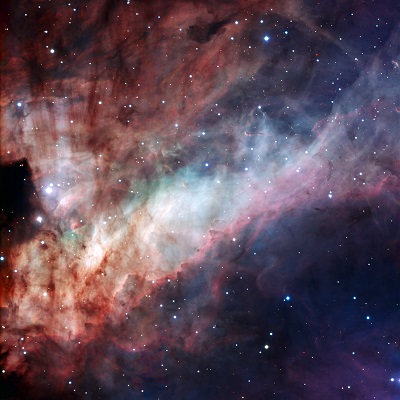
M17, also known as the Omega Nebula, is an emission nebula located in the rich Milky Way star fields of Sagittarius. It's a HII star formation region that shines at magnitude +6.0, placing it at the limit of naked eye visibility. Through binoculars, M17 appears as a diffuse patch of light that's oval shaped. In the same field of view to the south are open cluster M18 (mag. +7.5) and M24, the very large Sagittarius Star Cloud (mag. +4.6).
The Omega Nebula is located 5,500 light-years from Earth. Embedded within it is an open cluster of at least 35 stars that provides the source of the glowing gas. In many similar nebulae such stars are easily visible, but not so in the case of M17. They are hidden deep within the structure and therefore not obvious. In total, there are many hundreds of stars contained inside.
M17 was discovered by Philippe Loys de Chéseaux sometime between 1745-46. Charles Messier independently rediscovered it on June 3, 1764. The nebula covers 20 x 15 arc minutes of apparent sky, which corresponds to an actual diameter of 32 light-years. It's also sometimes referred to as the Swan Nebula, Horseshoe Nebula, Checkmark Nebula or Lobster Nebula.
The object is best seen from southern and equatorial regions during the months of June, July and August.
How dark are your night skies?
Astronomers dream of nights where thousands of stars dazzle in pitch-black skies with the band of the Milky Way flowing like a great river from one side to another. Alas for most of us this is often just a dream. We live in towns and cities polluted by artificial lighting from streets, building and factories that significantly diminish our view of the night sky.
However, it's not all that bleak as things do seem to be improving. Recently more efficient street lights have been installed in many areas, significantly reducing the amount of light beamed up to the heavens rather than down on the ground. Of course there are always out of town regions, especially forests and mountainous areas, away from the bulk of civilisation where the beauty of the night sky still rules. But have you ever wondered, how dark are your night skies? One way to check is by looking towards the constellation of Pegasus.
Pegasus is the 7th largest constellation in the sky covering an impressive 1,121 square degrees. For Northern Hemisphere observers, it's easily recognisable during the autumn months. The prominent asterism known as "Great Square of Pegasus" dominates the constellation. It's made up of reasonably bright stars between 2nd and 3rd magnitude:
Scheat (β Peg) - mag. 2.44
Markab (α Peg) - mag. 2.49
Algenib (γ Peg) - mag. 2.83
Alpheratz (α And) - mag. 2.07
Algol eclipse dates and times for March 2022
Algol (β Per) is a bright eclipsing binary system located in the northern constellation of Perseus and one of the best-known variable stars in the sky. Often referred to as the "Demon Star", most of the time it shines at mag. +2.1 but every two days, 20 hours and 49 minutes it suddenly dips in brightness to mag. +3.4, remaining dim for about 10 hours before returning to its original state.
Why the brightness change. The Algol system consists of at least three-stars (β Per A, β Per B and β Per C) with the orbital plane of Algol A and B directly in line with the Earth. The regular dips in brightness occur when the dimmer B star moves in front of and eclipses the brighter A star. There is also an extra dimension in that a secondary eclipse occurs when the brighter star occults the fainter secondary, resulting in a very small dip in brightness that can be detected with photo-electrical equipment.
NGC 3766 - Pearl Cluster - Open Cluster
NGC 3766, also known as the Pearl Cluster, is a superb open cluster in Centaurus. At magnitude +5.3, it's faintly visible to the naked eye but challenging to spot against the numerous stars of the background Milky Way. The cluster was born in the Carina molecular cloud, a vast star-forming region that lies at approximately between 6,500 and 10,000 light-years distant. It includes the barely-stable star eta Carinae (η Car), which one-day will explode as a spectacular supernova.
NGC 3766 is a nice binocular target, a wonderful sight through telescopes and one of the jewels of the southern sky. With a declination of 61S, it's best seen from southern latitudes during the months of March, April and May. From many southern towns and cities, the cluster is circumpolar and therefore never sets. However, from northern locations above 29N it never rises above the horizon.
Nicholas Louis de Lacaille discovered NGC 3766 on March 5, 1752.
Algol eclipse dates and times for February 2022
Algol (β Per) is a bright eclipsing binary system located in the northern constellation of Perseus and one of the best-known variable stars in the sky. Often referred to as the "Demon Star", most of the time it shines at mag. +2.1 but every two days, 20 hours and 49 minutes it suddenly dips in brightness to mag. +3.4, remaining dim for about 10 hours before returning to its original state.
Why the brightness change. The Algol system consists of at least three-stars (β Per A, β Per B and β Per C) with the orbital plane of Algol A and B directly in line with the Earth. The regular dips in brightness occur when the dimmer B star moves in front of and eclipses the brighter A star. There is also an extra dimension in that a secondary eclipse occurs when the brighter star occults the fainter secondary, resulting in a very small dip in brightness that can be detected with photo-electrical equipment.
Messier 24 - M24 - Small Sagittarius Star Cloud
M24, also known as the Small Sagittarius Star Cloud, is a large naked eye expanse of stars, clusters, nebulosity and other objects located in Sagittarius. At mag. +2.5 and covering 1.5 degrees of sky, it's visible to the naked eye as a large detached part of the Milky Way. The object is a fantastic sight in binoculars and small telescopes. It's claimed that M24 has the densest concentration of individual stars visible, around a thousand, in a single binocular field of view. It should not be confused with the nearby Large Sagittarius Star Cloud which lies about ten degrees to the south.
The Small Sagittarius Star Cloud is not a true deep sky object but results from a rare alignment between the Earth and the centre of our galaxy. We would expect this region to be packed with interstellar dust, however by chance we are looking through a gap in the dust. As a result, many thousands of distant stars, clusters and nebulae are visible that would otherwise be obscured. Spatially, M24 covers a volume up to 16,000 light-years deep.
M24 can be found 7 degrees north and a little west of the top star of the bright teapot asterism, Kaus Borealis (λ Sgr - mag. +2.8). Positioned north of M24 is open cluster M18 and the Omega Nebula (M17). All three objects are visible in the same binocular field of view. Open clusters M23 and M25 are located a few degrees west and east of M24 respectively.
M24 was discovered by Charles Messier on June 20, 1764. It's best seen from southern or equatorial latitudes during the months of June, July and August.


Caldwell 13 - C13 - NGC 457 - Owl Cluster - Open Cluster
NGC 457 is the brightest open cluster in Cassiopeia and one of the finest objects of its type in the northern sky. At magnitude +6.4, it's just beyond naked-eye visibility but easily seen with binoculars and a beautiful sight through telescopes. The brightest cluster stars are arranged in prominent lines and curves lines appearing to resemble an Owl shape, hence the popular name "the Owl Cluster". It's located 7,900 light-years distant.
NGC 457 was discovered by William Herschel in 1787. Finding the Owl Cluster is easy; it's positioned two degrees south-southeast of eclipsing binary star system Ruchbah (δ Cas - mag. +2.7). This star is one component of the characteristic "W" asterism of Cassiopeia. The brightest star inside NGC 457 is Phi Cas (φ Cas - mag. +5.0). Despite not being a member of the cluster, this foreground star is visible to the naked eye. Together with another non-cluster star - seventh magnitude HD 7902 (HIP 6229) - they form the bright eyes of the Owl greatly adding to the splendour of the view through backyard scopes.
NGC 457 is best seen from Northern Hemisphere latitudes during August, September and October. It appears high in the sky and even overhead from many locations. From latitudes greater than 32N, the Owl is circumpolar and never sets.
NGC 1851 - Globular Cluster
NGC 1851 is a globular cluster in the southern constellation of Columba that's easily visible with binoculars. It's an unusual cluster since it was probably a former member of the Canis Major Dwarf galaxy. This dwarf galaxy and Local Group member was discovered in 2003.
James Dunlop, a Scottish astronomer based in Australia, discovered NGC 1851 on May 29, 1826. It shines at mag. +7.3 and spans 11 arc minutes of sky, making it the brightest and largest deep sky object in Columba.
This globular is best seen during the months of December, January and February. From northern temperate locations it appears low down, apart from latitudes above 50N where it's not even visible at all. The object is number 73 in the Caldwell catalogue.


Finder Chart for NGC 1851 - pdf format (credit:- freestarcharts)
Stars
On a clear night, from a dark site with exceptional seeing there are about 2,500 stars visible to the naked eye at any one time and in total there are about 6,000 stars, maybe a few more, visible to the naked eye from Earth. However this represents a very tiny fraction of the number of stars in our Milky Way galaxy. Conservative estimates put the total number at 100 billion with probably many more.
With at least 100 billion galaxies in the Universe the total number of stars in the Universe is enormous, almost unimaginable. In this section we list some of the more famous, unusual and historical significant stars / star groupings of interest to amateur astronomers.
Messier 85 - M85 - Lenticular Galaxy (or Elliptical Galaxy)
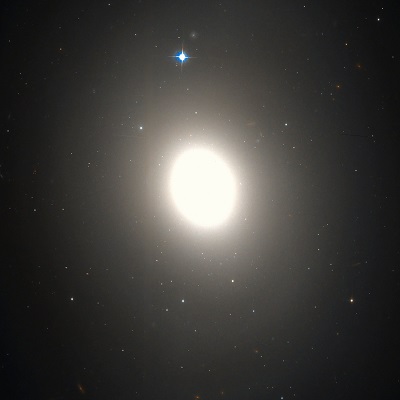
M85 is a lenticular or elliptical galaxy located in Coma Berenices that's a member of the Virgo cluster of galaxies. At magnitude +9.5 and covering 7.1 x 5.5 arc minutes, it's similar in brightness and size to another Virgo cluster galaxy, M84. Spotting M85 with 7x50 or 10x50 binoculars is challenging and dark skies and good seeing conditions are a must. Small 80mm (3.1-inch) refractors, reveal a featureless ball of fuzz with a slightly brighter core. The view through amateur scopes in no way reflects the true nature of this distant object. It's a large galaxy that's located 60 million light-years away, making it one of the most remote objects in the Messier catalogue. Its actual diameter is 125,000 light-years and it's estimated to contain 400 billion stars. Long classified as a lenticular galaxy of type S0, recent observations have suggested M85 could be an elliptical galaxy of type E1.
Pierre Méchain discovered M85 on March 4, 1781. He reported the discovery to his friend Charles Messier, who subsequently catalogued it on March 18, 1781. On that night, Messier was very active. He discovered another seven galaxies, all of them Virgo Cluster members and also re-discovered bright globular cluster M92.
The main crux of the Virgo cluster lies about halfway along an imaginary line connecting Denebola (β Leo - mag. +2.1) with Vindemiatrix (ε Vir - mag. +2.8). Most of the group members can be found in this region of sky. However, M85 is located at the very northern edge of the cluster, some 6 degrees northwest of the group centre and one degree northeast of star 11 Comae Berenices (mag. +4.7).
It's best seen during the months of March, April and May.
Caldwell 41 - C41 - The Hyades - Open Cluster
The Hyades is a very large loose naked eye open cluster located in the constellation of Taurus. It spans 5.5 degrees of sky, which is equivalent to 11 times the diameter of the full Moon. At a distance of 153 light-years this is the nearest open cluster - the Ursa Major Moving Group is closer, but's extremely scattered and more of a cluster like object than a true cluster. Consequently, the Hyades is one of the top studied open clusters of all.
The Hyades is easily found as it circles the brightest star in Taurus, first magnitude orange giant star Aldebaran (α Tau - mag. +0.87). It's not unreasonable to assume that Aldebaran is also a member of the Hyades. However, it's purely a foreground star, an interloper located only 65 light-years distant that happens to be in the same line of sight. As a naked-eye object, the Hyades have been known since prehistoric times.
The cluster is best seen from northern latitudes during the months of November, December and January.

Algol eclipse dates and times for January 2022
Algol (β Per) is a bright eclipsing binary system located in the northern constellation of Perseus and one of the best-known variable stars in the sky. Often referred to as the "Demon Star", most of the time it shines at mag. +2.1 but every two days, 20 hours and 49 minutes it suddenly dips in brightness to mag. +3.4, remaining dim for about 10 hours before returning to its original state.
Why the brightness change. The Algol system consists of at least three-stars (β Per A, β Per B and β Per C) with the orbital plane of Algol A and B directly in line with the Earth. The regular dips in brightness occur when the dimmer B star moves in front of and eclipses the brighter A star. There is also an extra dimension in that a secondary eclipse occurs when the brighter star occults the fainter secondary, resulting in a very small dip in brightness that can be detected with photo-electrical equipment.
18 Scorpii - The nearest Solar twin
Most of the stars visible to the naked eye in the night sky are much larger, more luminous and brilliant than the Sun. However, despite often labelled as an average star the Sun actually outshines most stars in the galaxy. It's believed up to 80% of all stars in the Milky Way are red dwarfs. This type of star is so dim that not one is bright enough to be seen from Earth with the naked eye. Even Proxima Centauri, the closest star to the Earth after the Sun, requires optical aid to be seen. When it comes to solar twins or stars that are incredibly similar to the Sun across all parameters, not many exist. One of the best examples is 18 Scorpii.