Guides / Star Charts
Contributions
If you like the website and want to contribute to the running costs then please do so below. All contributions are most welcome.
Algol eclipse dates and times for June 2023
Algol (β Per) is a bright eclipsing binary system located in the northern constellation of Perseus and one of the best-known variable stars in the sky. Often referred to as the "Demon Star", most of the time it shines at mag. +2.1 but every two days, 20 hours and 49 minutes it suddenly dips in brightness to mag. +3.4, remaining dim for about 10 hours before returning to its original state.
Why the brightness change. The Algol system consists of at least three-stars (β Per A, β Per B and β Per C) with the orbital plane of Algol A and B directly in line with the Earth. The regular dips in brightness occur when the dimmer B star moves in front of and eclipses the brighter A star. There is also an extra dimension in that a secondary eclipse occurs when the brighter star occults the fainter secondary, resulting in a very small dip in brightness that can be detected with photo-electrical equipment.

NGC 3626 - Spiral Galaxy
NGC 3626, mag. +10.9, is a spiral galaxy in Leo that was discovered by William Herschel on March 14, 1784. It's one of many galaxies in the constellation within the range of small scopes.
NGC 3626 is located 70 million light-years away. It covers 2.7 x 1.9 arc minutes of apparent sky, which corresponds to a spatial diameter of 55,000 light-years and is estimated to contain 40 billion stars.
Patrick Moore listed, NGC 3626, as number 40 in his Caldwell catalogue. It belongs to the NGC 3607 group of galaxies.


Finder Chart for NGC 3626 - pdf format (credit:- freestarcharts)
NGC 3626 is positioned 2.5 degrees southeast of Zosma (δ Leo - mag. +2.6). A trio of elliptical galaxies, consisting of NGC 3607, NGC 3608 and NGC 3605, are located 50 arc seconds west-southwest of NGC 3626. Of these, NGC 3607 is the brightest at magnitude +9.9. NGC 3608 is similar in brightness to NGC 3626. At 12th magnitude the third member, NGC 3605, is by far the faintest.
IC 59 and IC 63 - Reflection and Emission Nebulae
IC 59 and IC 63 are faint reflection and emission nebula located in the northern constellation of Cassiopeia. They are challenging objects to spot with telescopes for a number of reasons. Both nebulae are faint at apparent mag. +10, they have extremely low surface brightness and surround bright variable star gamma Cas (γ Cas). This remarkable star is partly unstable and is known as a "shell star". It currently shines at mag. +2.15, making it the brightest star in Cassiopeia.
IC 59 and IC 63 are 610 light-years distant. From our perspective, IC 59 is located on the northern side of gamma Cas and IC 63 to the northeast. Spatially the nebulae are roughly 3 light-years from gamma Cas, although IC 63 is slightly closer to the star. As a result, it's appears mostly red due to a dominance of H-alpha emission, whereas IC 59 exhibits much less H-alpha emission and appears mostly blue due to dust reflected starlight.
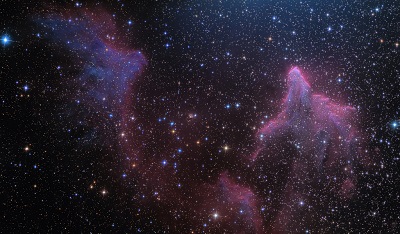

Finder Chart for IC 59 and IC 63 - pdf format (credit:- freestarcharts)
Ursa Minor - Constellation Guide
Ursa Minor
Ursa Minoris
UMi
The Little Bear
Introduction
Ursa Minor is a medium size constellation located in the far northern reaches of the sky. Also known as the Little Bear, its main group of stars resemble a smaller version of the Great Bear of Ursa Major. Greek astronomer Thales first mentioned the constellation, around 600 BC, after realising it could be used as a better guide to finding true north than Ursa Major. Over the years it has been visualised as many things, including a dog's tail revolving its tip and a bunch of jewels.
Ursa Minor has been important for navigation since it contains the North Celestial Pole (NCP). Currently, the constellation's brightest star Polaris (mag. +1.97) is only three quarters of a degree from the NCP, thereby providing a convenient marker. Polaris is slowly edging nearer and on March 24, 2100 it will be less than half a degree removed. After that it gradually moves away.
Like Ursa Major, the main seven stars of Ursa Minor form the handle of a ladle. The bowl contains second magnitude Kochab (β UMi) and third magnitude Pherkad (γ UMi), which are collectively known as the guardians of the pole. The remaining members of the group are fainter, down to fifth magnitude, but do provide a useful sky darkness check scale. On good nights all seven stars can be seen with the naked eye.
In terms of size, Ursa Minor covers 256 square degrees and is the 56th largest constellation in the sky. It's devoid of bright deep sky objects but contains a few interesting galaxies within amateur range, including the Ursa Minor Dwarf galaxy, a satellite of the Milky Way. Ursa Minor also contains some variable stars and a few double stars of interest.
From locations north of latitude 25N, the constellation is circumpolar and therefore never sets. For those living south of 25S, it always remains below the horizon and can never be seen.
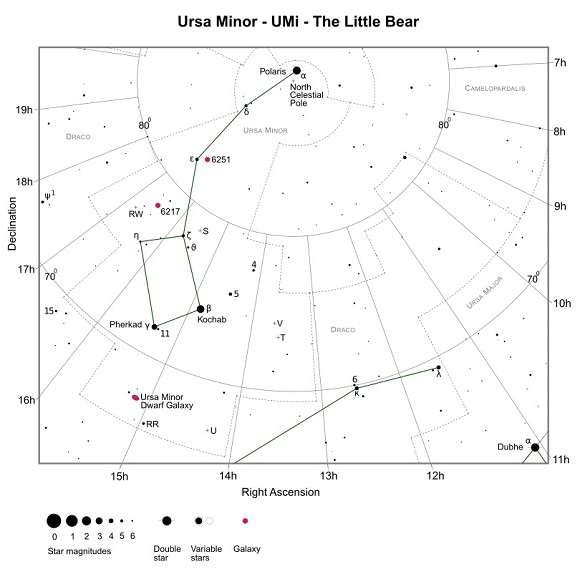
Ursa Minor Star Chart - pdf format (credit:- freestarcharts)
Winter Circle or Winter Hexagon asterism
The "Winter Circle" or "Winter Hexagon" is a bright asterism that's best seen during the months from December to March. The group consists of a large circle of stars or more actually a hexagon shape loosely centred on red supergiant Betelgeuse (mag. +0.42). All stars are bright. Starting from the most northerly point and moving in a clockwise direction they are as follows: Capella (mag. +0.1), Aldebaran (mag. +0.9), Rigel (mag. +0.1), Sirius (mag. -1.4), Procyon (mag. +0.3), and Pollux (mag. +1.1). It's possibly the largest of the well-known asterisms.
What is an asterism?
An asterism is a recognised pattern of stars in the night sky. It may be part of one of the 88 official constellations or it may be composed of stars from many constellations. Anyone can make his or her own asterism and if many people use it often enough it can find its way into Astronomy vocabulary. In the case of the Winter Circle it's no accident it's so large, the six stars come from six different constellations (Auriga, Taurus, Orion, Canis Major, Canis Minor and Gemini).
Five superb Northern Hemisphere naked eye and binocular open clusters visible during Winter
The long cold nights of the Northern Hemisphere winter months are populated with some of the finest constellations in the sky. During the months of December, January and February many celestial gems are visible in the evening sky. They include spectacular open clusters, stunning nebulae as well as numerous bright stars. Below is a list of five of the best open clusters visible at this time of year; all of which can be spotted with the naked eye and each one a superb binocular object.
5. M35
We start the countdown with the faintest and smallest cluster on our list, M35 in Gemini. At mag. +5.2 it appears to the naked eye as a somewhat misty patch of light. Surprisingly it wasn't discovered until 1745-46. When seen through binoculars M35 is a fantastic sight with the brightest dozen or so stars resolvable. Enhancing the view is a hazy glow surrounding the stars. Telescopes reveal many more stars but the glow effect disappears. M35 is 2,800 light years distant and spans 28 arc minutes which is similar to the full Moon diameter. It's estimated to contain up to 200 stars.
Located about 15 arc minutes southwest of M35 is open cluster NGC 2158, which at mag. +8.6 is faintly visible with binoculars.
Melotte 111 - Mel 111 - The Coma Star Cluster (Open Cluster)
Although Coma Berenices is a small constellation it does contain one of the densest concentrations of galaxies in the sky. However, its most outstanding feature is not a galaxy but an extremely large and loose naked eye open cluster, called Melotte 111 or the Coma Star Cluster. In total, Melotte 111 contains about 50 stars spread over 6 degrees of apparent sky. It's located 280 light-years from Earth.
Although conspicuous and easily visible to the naked eye, the cluster was not included in either the Messier or NGC / IC catalogues. This was due to its loose nature, large apparent size and unproven status as a genuine open cluster. It was in 1938 when Swiss-American astronomer Robert J. Trumpler first identified 37 stars as members and therefore established its true nature. Before that in 1915, British astronomer Philibert J. Melotte included the object as number 111 in his catalogue of star clusters, hence the name Melotte 111 or Mel 111.
Canopus - Alpha Carinae - α Car
Canopus is a brilliant star in the southern constellation of Carina and the second brightest in the night sky. At magnitude -0.72, it's about half as bright as Sirius but appearances can be deceptive; Canopus is far the more powerful star and Sirius only appears brighter because it's much closer to us. With a declination of -52 degrees, Canopus is best seen from southern latitudes. It can appear high in the sky from Australia, New Zealand, South Africa and much of South America. Indeed from such locations, the star is either circumpolar or only sets briefly.
Canopus can't be seen from most of Europe and many parts of the United States. For observers north of 38 degrees latitude, it never rises above the horizon. However, those living in southern Spain, southern Portugal, southern Florida, southern Texas and Hawaii can glimpse the star during the winter months. It's also visible from India, Pakistan and much of China and Japan.
From a historical perspective, Canopus can be seen from Alexandria but not from Athens. This provided early proof that the Earth is a globe and not a flat disk.
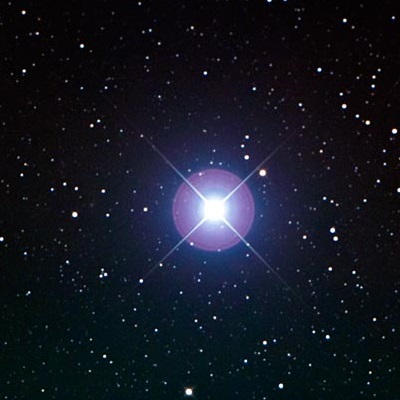
Caldwell 71 - C71 - NGC 2477 - Open Cluster
NGC 2477 is a stunning open cluster located in the Milky Way rich constellation of Puppis. It's arguably the constellations finest cluster which also contains other superb examples such as M46, M47 and M93. At magnitude +5.8, NGC 2477 is faintly visible to the naked eye but easily seen with binoculars and a fantastic telescope object, especially in medium to large scopes.
The cluster was discovered by French astronomer Nicolas Louis de Lacaille during his tour of South Africa in 1751-52. In total it contains about 300 stars packed into an area 27 arc minutes in diameter with the brightest member star shining at magnitude +9.8. The four-magnitude difference between the combined cluster magnitude and the brightest component is an indication of how rich the cluster is.
NGC 2477 is too far south to have been included in Charles Messier's catalogue, but if he had observed from a more southerly latitude than Paris he almost certainly would have noticed this striking object. Twentieth century America astronomer Robert Burnham described NGC 2477 as "probably the finest of the galactic clusters in Puppis".
Messier 87 - M87 - Elliptical Galaxy
M87 is a supergiant elliptical galaxy that's a prominent member of the Virgo cluster of galaxies. It's one of the largest and most luminous galaxies known and a strong source of electromagnetic radiation, particularly radio and X-ray emissions. At the centre of M87 is a supermassive black hole from which a jet of extremely energetic plasma extends outwards for at least 5,000 light-years. The galaxy is therefore an interesting object for both professional and amateur astronomers alike.
With an apparent magnitude of +8.6, M87 is the second brightest of the Virgo cluster galaxies. Only M49, at mag. +8.4, is marginally brighter. On dark moonless nights, M87 is visible with 7x50 or 10x50 binoculars, appearing as a faint hazy patch of light. This galaxy was one of eight discovered by Charles Messier on March 18, 1781. He also re-discovered fine globular cluster, M92, on the same day.
M87 lies at the heart of the Virgo cluster. It can be found by imagining a line connecting Denebola (β Leo - mag. +2.1) with Vindemiatrix (ε Vir - mag. +2.8). Just over half way along this line is M87. Faint elliptical galaxy M89 is positioned just over a degree east of M87 with the galaxy pair M84/M86 located 1.5 degrees to the northwest.
The Virgo galaxies are best seen during the months of March, April and May. On April 10, 2019, Astronomers released the first ever image of a black hole, which is at the centre of M87. It measures 40 billion km across - three million times the size of the Earth - and has been described by scientists as "a monster".


NGC / IC Catalogues
The New General Catalogue of Nebulae and Clusters of Stars (NGC) is an extensive catalogue of astronomical deep sky objects that was compiled by John Louis Emil Dreyer in 1888. Danish born Dreyer spent much of his life in Ireland where he compiled the catalogue, which was based on Sir William Herschel's Catalogue of Nebulae and Clusters of Stars.
Herschel first published his catalogue containing 1,000 entries in 1786 with assistance from his sister Caroline. He then added another 1,000 entries in 1789 and a final 500 in 1802, bringing the total number of entries to 2,500. In 1864, Sir John Herschel the son of William then expanded the catalogue into the General Catalogue of Nebulae and Clusters and Clusters of Stars (GC), which contained 5,079 entries.
Dreyer build on the early work of the Herschel's to produce the renowned NGC, which is still used by astronomers all over the World today. In total he listed 7,840 objects that are referred to as NGC objects. The catalogue contains all types of deep sky objects including galaxies, nebulae, globular clusters, open clusters, supernova remnants and planetary nebulae. Compiling the catalogue was a massive task for Dreyer, he had to deal with many observation reports from a host of different scopes that contained numerous amounts of contradictory information. The sheer volume of information and number of objects meant Dreyer couldn't validate all of them himself and as a result, he had to accept some data as recorded. Although Dreyer himself was very accurate in his transcripts, it's perhaps not surprising that the catalogue contains several, mostly position and description errors.
In addition to the NGC, Dreyer also published two supplements, known as the Index Catalogues (IC). The first containing 1,520 objects was published in 1895. The second published in 1908 listed an extra 3,866 objects. In total, the two IC's catalogues contain 5,386 objects.
Various attempts have been made to correct the original NGC errors. These include the Revised New General Catalogue by Jack Sulentic and William Tifft in 1973 and NGC 2000.0 by Roger Sinnott in 1989 using J2000.0 coordinates. More recently, the Revised New General Catalogue and Index Catalogue (Revised NGC/IC) published by Wolfgang Steinicke in 1996.
NGC 4631 - The Whale Galaxy - Barred Spiral Galaxy
NGC 4631, also known as the Whale Galaxy, is a magnitude +9.3 edge-on barred spiral galaxy in the constellation of Canes Venatici. It has a high surface brightness and therefore is a good target for small scopes. Larger instruments reveal numerous dust clumps and mottling. The central region of NGC 4631 is a starburst region, where intensive star formation is currently taking place.
William Herschel discovered the Whale Galaxy on March 20, 1787. It's located 28 million light-years away and is best seen from northern latitudes during the months of March, April or May.
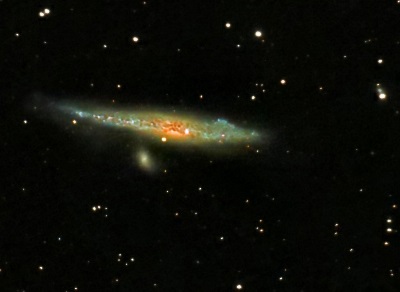

Finder Chart for NGC 4631 - pdf format (credit:- freestarcharts)
Polaris - Alpha Ursae Minoris - α UMi
Polaris is only the 46th brightest star in the night sky, but it's an important one that's been of immense value to navigators. This star is the current Northern Pole Star since it's positioned only three quarters of a degree from the North Celestial Pole. Polaris is edging closer still and on March 24, 2100 it will be less than half a degree away, before starting to slowly drift away.

Polaris is a multiple system located 434 light-years away that shines with a combined magnitude of +1.97. The dominant main component, α UMi Aa, is usually referred to as simply "Polaris" and is a type F7Ib yellow-white supergiant. It's a classical Cepheid variable with a period of slightly more than 4 days. There is evidence that the brightness variation has changed over recent times. Before 1960, it was about 0.15 magnitudes but a few years later it was down to 0.05 magnitudes. Now it appears to be back on the rise and with modern imaging and measuring techniques, it will be interesting to see how it changes in the coming years. Since one of the nearest Cepheid's, Polaris has been heavily studied by astronomers. The main star is 2,300 more luminous than the Sun and 46 times larger.
Messier Catalogue
The Messier Catalogue is a famous catalogue in Astronomy. It consists of 110 deep sky objects, including open and globular star clusters, galaxies, nebulae, an asterism, a double star and even a supernova remnant. It was compiled in the 18th century by Charles Messier.
Messier was a comet hunter who was born in Badonviller, France on June 26, 1730. When searching for comets he was frustrated by fixed objects that looked like comets in the night sky but actually weren't. These fuzzy "comet" like objects hindered his searches so he catalogued them in order to avoid them in future.
The first version of his catalogue contained 45 objects and was published in 1774 in the journal of the French Academy of Sciences in Paris. Over the next 7 years he updated the catalogue and published the final version in 1781, containing 103 objects. Many of these objects he actually discovered himself.
On several different occasions between 1921 and 1966, astronomers and historians discovered evidence of another 7 deep-sky objects that were observed either by Messier or his friend and assistant, Pierre Mechain, shortly after the final version was published. These objects, numbered M104 to M110, are now accepted by astronomers as "official" Messier objects.
IC 342 - Intermediate Spiral Galaxy
IC 342 is an 8th magnitude face-on intermediate spiral galaxy that's located in the faint northern constellation of Camelopardalis. Since positioned only 10 degrees from the galactic equator it's obscured heavily by Milky Way dust. As a result, this galaxy wasn't even discovered until famed British amateur astronomer William Frederick Denning found it in 1895. At the time it was originally thought to be a galactic nebula, but in 1934 Edwin Hubble and Milton Humason discovered its spiral nature and identified it as a galaxy. Visually IC 342 is less impressive than its magnitude suggests, but on very good nights when high overhead it's a fine sight in medium and large size amateur scopes.
The galaxy is best seen from the Northern Hemisphere during the months of November, December and January. It's circumpolar from all latitudes greater than 22N, but not well situated for southern observers where it never climbs very high above the northern horizon.
IC 342 is listed as number 5 in the Caldwell catalogue.
Caldwell 54 - C54 - NGC 2506 - Open Cluster
NGC 2506 is a magnitude +7.6 rich open cluster located in the constellation of Monoceros. Although its member stars are faint the cluster itself appears quite bright and can be seen with a pair of binoculars. Through telescopes it's an impressive object and of all the Monoceros open clusters it's probably the finest. With an age of 1.1 billion years old this is an old cluster. For comparison, M45 (The Pleiades) in Taurus is a youthful 115 million years old with the Hyades cluster 625 million years old. However, NGC 2506 is not nearly as old as the 4 billion years of M67 in Cancer.
William Herschel discovered NGC 2506 on February 23, 1791. Locating the cluster can sometimes be a bit tricky as it's positioned in an area of sky devoid of bright stars. It can be found 5 degrees east-southeast of alpha Mon (α Mon - mag. +3.94) the brightest star in Monoceros. Located 19 degrees southwest of NGC 2506 is the brightest star in the sky, Sirius (α CMa - mag. -1.46). Although α Mon and Sirius are the brightest stars in their respective constellations the difference in apparent brightness between them is enormous, more than 100x.
Large open cluster M48 lies 6 degrees northeast of NGC 2506 with open cluster pair M46 and M47 positioned 6 degrees southwest of NGC 2506. They are best seen during the months of December, January and February.
Help us
Every effort is made by the freestarcharts.com team to ensure that all-star charts and articles displayed on our website are of the highest quality and accuracy. Of course, there is always a chance of mistakes and here is where we would like your help. If you do notice any errors, however significant or insignificant then please do contact us at This email address is being protected from spambots. You need JavaScript enabled to view it..
But it not just error correcting that we are after; we are continuously trying to improve the quality, accuracy, presentation and usefulness of the charts. Any ideas, comments or suggestions that you may have in these areas would also be very welcome.
As always, we are truly grateful for all comments that we receive and hope that you enjoy using the star charts.
Thank you.
Here's to dark stars!
Your freestarcharts.com team.
Gemini - Constellation Guide
Gemini
Geminorum
Gem
The Twins
Introduction
Gemini is a northern zodiac constellation and one of the 48 constellations described by second century astronomer Ptolemy. Its name is Latin for the twins and it's one of the few constellations in the sky that actually looks like what it suppose to represent. This bright grouping contains two-standout stars, Castor (α Gem) and Pollux (β Gem). At mag. +1.16, Pollux is the brighter while multiple system Castor shines at mag. +1.58. Surprisingly, Pollux was assigned beta Geminorum by Johann Bayer - the German astronomer who labelled the stars with Greek letters in 1603 - even though it easily outshines Castor. Some astronomers have suggested that maybe Pollux has since brightened or Castor faded, but both possibilities seem extremely improbable. The likelihood is that Bayer simply made a mistake and didn't carefully distinguish which was the brighter star.
In Greek mythology, Castor and Pollux were twin brothers whose mother was Queen Leda although Castor was the mortal son of King Tyndareus and Pollux the divine son of Zeus. Together the twins were known as the Dioscuri, which means the sons of Zeus. However, in most versions of the myth only Pollux was Zeus's child. The twins were the patron saints of mariners, appearing in ships rigging as the St Elmo's fire phenomena. When Castor died, Pollux begged Zeus to give Castor immortality, which he did, thereby reuniting the twins together in the heavens forever.
Messier 88 - M88 - Spiral Galaxy
M88, mag. +9.6, is a fine spiral galaxy located in Coma Berenices that's a member of the Virgo cluster of galaxies. It has a reasonably high surface brightness, which is partly due to its favourable inclination of 30 degrees. As a result, it's a nice small telescope object that appears somewhat like a much smaller and fainter version of M31, the spectacular Andromeda Galaxy.
M88 is one of the brightest Seyfert galaxies in the sky. These types of galaxies have very active quasar like nuclei and are strong emitters of electromagnetic radiation with highly ionised spectral emission lines present. They are named after 20th century American astronomer Carl Seyfert who first identified them. Galaxies M51, M66, M77, M81, M87 and M106 also belong to this class of object.
M88 was one of the eight Virgo cluster galaxies discovered by Messier on March 18, 1781, his most productive night. Messier's description of M88 was of a "nebula without star between two small stars and one star of the sixth magnitude, which appear at the same time as the nebula in the field of the telescope". He also remarked that it was similar in appearance to M58. William Parsons the 3rd Earl of Rosse was the first to recognise the spiral shape and listed it as one of 14 "spiral nebulae" discovered to 1850.
Algol eclipse dates and times for May 2023
Algol (β Per) is a bright eclipsing binary system located in the northern constellation of Perseus and one of the best-known variable stars in the sky. Often referred to as the "Demon Star", most of the time it shines at mag. +2.1 but every two days, 20 hours and 49 minutes it suddenly dips in brightness to mag. +3.4, remaining dim for about 10 hours before returning to its original state.
Why the brightness change. The Algol system consists of at least three-stars (β Per A, β Per B and β Per C) with the orbital plane of Algol A and B directly in line with the Earth. The regular dips in brightness occur when the dimmer B star moves in front of and eclipses the brighter A star. There is also an extra dimension in that a secondary eclipse occurs when the brighter star occults the fainter secondary, resulting in a very small dip in brightness that can be detected with photo-electrical equipment.