Guides / Star Charts
Contributions
If you like the website and want to contribute to the running costs then please do so below. All contributions are most welcome.
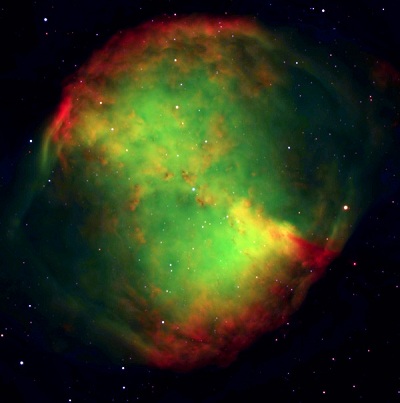
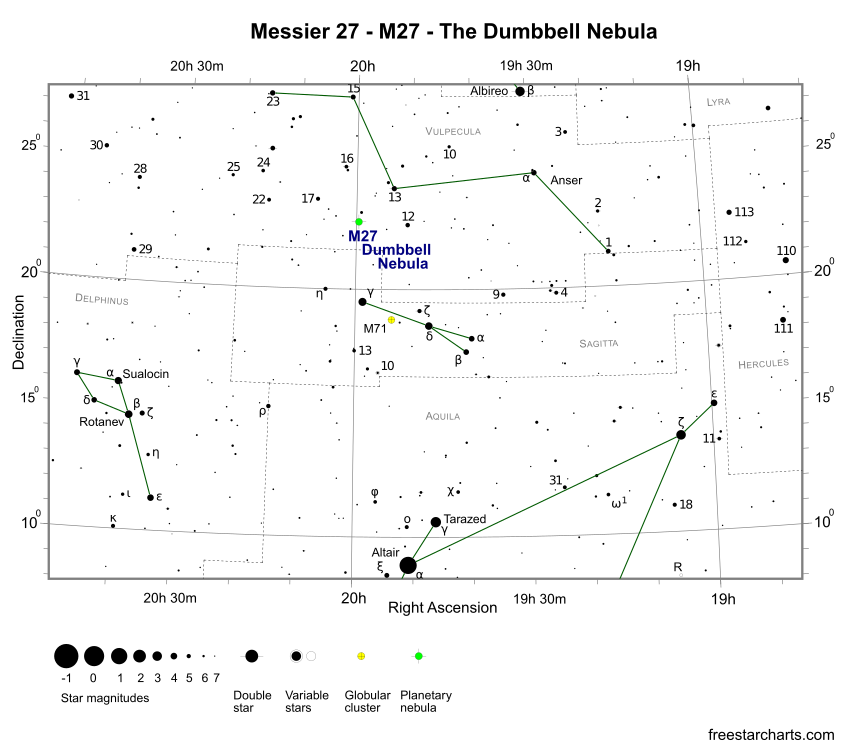
Messier 27 - M27 - The Dumbbell Nebula (Planetary Nebula)
The Dumbbell Nebula or M27 is a showpiece object that's a popular visual and imaging target for amateur astronomers. It's arguably the finest planetary nebula in the night sky and was the first of its type to be discovered. The name derives from its resemblance to a dumbbell shape, but it has also been compared to an apple core and an hourglass figure. With a mag. of +7.4, M27 is the second brightest planetary nebula in the sky. Only the Helix Nebula (NGC 7293) in Aquarius is brighter. However, the Dumbbell Nebula has a higher surface brightness and therefore the easier of the two targets to spot.
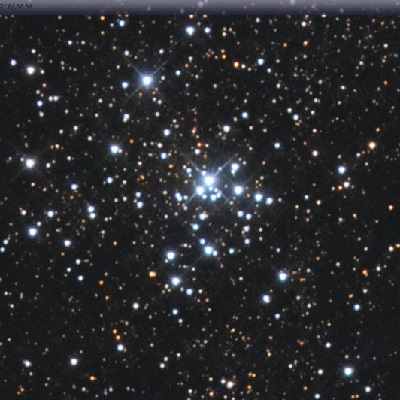
Messier 21 - M21 - Open Cluster
M21 is a compact open cluster in the constellation of Sagittarius, which is positioned less than one degree northeast of the Trifid Nebula (M20). It contains about 60 stars, mostly of them white but a sprinkling of blue giants, set in a tightly packed area covering 13 arc minutes. With an apparent mag. of +6.5, M21 is a nice sight in binoculars and small telescopes but compact enough that larger scopes also show it well, especially at low magnifications.
M21 was discovered - along with M20 - by Charles Messier on June 5, 1764. It's best seen from southern and equatorial regions during the months of June, July and August.
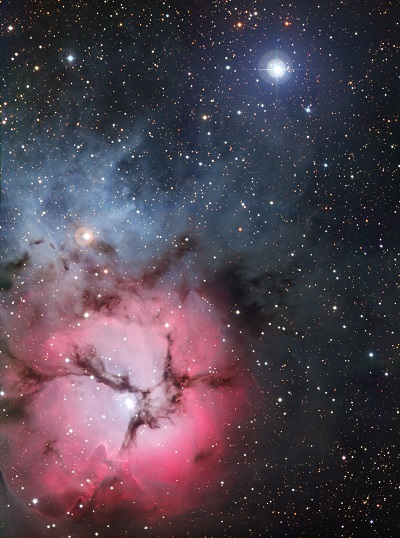
Messier 20 - M20 - Trifid Nebula (Emission and Reflection Nebula)
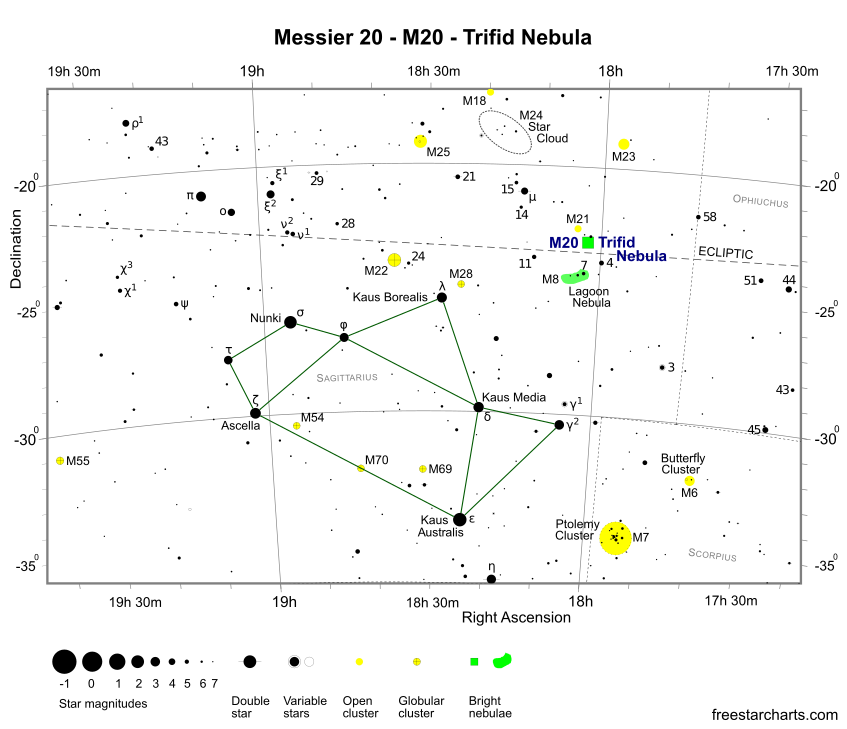
M20 is the famous Trifid Nebula, a bright colourful emission and reflection nebula that's located in the constellation of Sagittarius. At magnitude +6.3, it's visible with binoculars. This remarkable object not only contains an emission and reflection nebula but also a dark nebula and an embedded open cluster. When photographed or imaged it looks spectacular, with the emission nebula appearing red, the reflection nebula blue and numerous dark lanes mixed in between. The dark lanes appear to cut through the nebula splitting it into three prominent sections, hence the popular name Trifid, which means divided into three lobes.
The much larger and brighter Lagoon Nebula (M8) is located two degrees south of M20, with tightly packed open cluster M21 positioned 0.75 degrees northeast of M20.
Charles Messier discovered both M20 and M21 on June 5, 1764. He referred to M20 as an envelope of nebulosity. The surrounding area of sky is the richest part of the Milky Way. Here you are looking towards the direction of the galactic centre, hence the abundance of stars, open clusters, globular clusters and nebulae. This wonderful region of sky is perfect to scan with binoculars or small telescopes, especially at low magnifications.
To locate the Trifid, first focus on the bright familiar teapot asterism of Sagittarius. The top three stars of the teapot are Kaus Borealis (λ Sgr - mag. +2.8), Kaus Media (δ Sgr - mag. +2.7) and φ Sgr (mag. +3.2). Imagine a line connecting φ Sgr to Kaus Borealis and then extending it for just over 6 degrees to arrive at M20.
The Trifid is best seen from southern and equatorial regions during the months of June, July and August.
Algol eclipse dates and times for September 2020
Algol (β Per) is a bright eclipsing binary system located in the northern constellation of Perseus and one of the best-known variable stars in the sky. Often referred to as the "Demon Star", most of the time it shines at mag. +2.1 but every two days, 20 hours and 49 minutes it suddenly dips in brightness to mag. +3.4, remaining dim for about 10 hours before returning to its original state.
Why the brightness change. The Algol system consists of at least three-stars (β Per A, β Per B and β Per C) with the orbital plane of Algol A and B directly in line with the Earth. The regular dips in brightness occur when the dimmer B star moves in front of and eclipses the brighter A star. There is also an extra dimension in that a secondary eclipse occurs when the brighter star occults the fainter secondary, resulting in a very small dip in brightness that can be detected with photo-electrical equipment.

Messier 18 - M18 - Open Cluster
M18 is a small open cluster located among the rich Milky Way star fields of Sagittarius. With an apparent mag. of +7.5, it's easily visible with popular 7x50 or 10x50 binoculars appearing as a somewhat dim hazy patch of light. The cluster was one of Charles Messier's original discoveries, which he catalogued on June 3, 1764.
M18 can be found not far from the teapot asterism of Sagittarius. It's positioned 8.5 degrees north and a little west of Kaus Borealis (λ Sgr - mag. +2.8), the teapot's top star. The surrounding region of sky is a wonderfully rich area for astronomers that's filled to the brim with numerous open clusters, globular clusters and nebulae. Two prominent examples are the Omega Nebula (M17) and the sprawling Sagittarius Star Cloud (M24). They are positioned one degree north and two degrees south of M18 respectively, with all three objects visible in the same binocular field of view.

Messier 16 - M16 - Eagle Nebula (Emission Nebula with Open Cluster)
M16, also known as the Eagle Nebula, is a young open cluster of stars embedded within an extremely large cloud of interstellar gas and dust in the constellation of Serpens (Cauda). It's located in the next inner spiral arm of the Milky Way, 7,000 light-years distant. The emission part of the nebula or HII region is catalogued as IC 4703 and is an active star-forming region, which has already created a significant cluster of young stars. The cluster itself lies at the heart of the Eagle Nebula and is known as NGC 6611. M16 was discovered by Philippe Loys de Chéseaux in 1745-6, but Charles Messier was the first to record the associated nebulosity on June 3, 1764.
The constellation of Serpens is faint but unique as its split into two separate sections. One half, named Serpens Caput, lies to the west of Ophiuchus and the other half, Serpens Cauda, lies on the eastern side of Ophiuchus. At the very southern tip of Serpens Cauda close to the Scutum and Sagittarius border is M16. It can be found 2.5 degrees west of γ Sct (mag. +4.7) and a few degrees north of the Omega Nebula (M17), M18 and the Sagittarius Star Cloud (M24). This beautifully rich area of the sky is a delight to scan with binoculars.
The Eagle Nebula was immortalised in 1995 when imaged several times by the Hubble Space Telescope. The resulting iconic photograph, titled the Pillars of Creation, showed three magnificent columns of interstellar gas and dust displayed in sensational detail.

Algol eclipse dates and times for August 2020
Algol (β Per) is a bright eclipsing binary system located in the northern constellation of Perseus and one of the best-known variable stars in the sky. Often referred to as the "Demon Star", most of the time it shines at mag. +2.1 but every two days, 20 hours and 49 minutes it suddenly dips in brightness to mag. +3.4, remaining dim for about 10 hours before returning to its original state.
Why the brightness change. The Algol system consists of at least three-stars (β Per A, β Per B and β Per C) with the orbital plane of Algol A and B directly in line with the Earth. The regular dips in brightness occur when the dimmer B star moves in front of and eclipses the brighter A star. There is also an extra dimension in that a secondary eclipse occurs when the brighter star occults the fainter secondary, resulting in a very small dip in brightness that can be detected with photo-electrical equipment.
Algol eclipse dates and times for July 2020
Algol (β Per) is a bright eclipsing binary system located in the northern constellation of Perseus and one of the best-known variable stars in the sky. Often referred to as the "Demon Star", most of the time it shines at mag. +2.1 but every two days, 20 hours and 49 minutes it suddenly dips in brightness to mag. +3.4, remaining dim for about 10 hours before returning to its original state.
Why the brightness change. The Algol system consists of at least three-stars (β Per A, β Per B and β Per C) with the orbital plane of Algol A and B directly in line with the Earth. The regular dips in brightness occur when the dimmer B star moves in front of and eclipses the brighter A star. There is also an extra dimension in that a secondary eclipse occurs when the brighter star occults the fainter secondary, resulting in a very small dip in brightness that can be detected with photo-electrical equipment.
Algol eclipse dates and times for June 2020
Algol (β Per) is a bright eclipsing binary system located in the northern constellation of Perseus and one of the best-known variable stars in the sky. Often referred to as the "Demon Star", most of the time it shines at mag. +2.1 but every two days, 20 hours and 49 minutes it suddenly dips in brightness to mag. +3.4, remaining dim for about 10 hours before returning to its original state.
Why the brightness change. The Algol system consists of at least three-stars (β Per A, β Per B and β Per C) with the orbital plane of Algol A and B directly in line with the Earth. The regular dips in brightness occur when the dimmer B star moves in front of and eclipses the brighter A star. There is also an extra dimension in that a secondary eclipse occurs when the brighter star occults the fainter secondary, resulting in a very small dip in brightness that can be detected with photo-electrical equipment.