Guides / Star Charts
Contributions
If you like the website and want to contribute to the running costs then please do so below. All contributions are most welcome.
Melotte 111 - Mel 111 - The Coma Star Cluster (Open Cluster)
Although Coma Berenices is a small constellation it does contain one of the densest concentrations of galaxies in the sky. However, its most outstanding feature is not a galaxy but an extremely large and loose naked eye open cluster, called Melotte 111 or the Coma Star Cluster. In total, Melotte 111 contains about 50 stars spread over 6 degrees of apparent sky. It's located 280 light-years from Earth.
Although conspicuous and easily visible to the naked eye, the cluster was not included in either the Messier or NGC / IC catalogues. This was due to its loose nature, large apparent size and unproven status as a genuine open cluster. It was in 1938 when Swiss-American astronomer Robert J. Trumpler first identified 37 stars as members and therefore established its true nature. Before that in 1915, British astronomer Philibert J. Melotte included the object as number 111 in his catalogue of star clusters, hence the name Melotte 111 or Mel 111.
Moon, Mars and Spica conjunction visible on the mornings of January 3rd and January 4th, 2016
Mars starts the New Year in Virgo as a mag. +1.2 morning object that rises between 2am and 3am local time from northern temperate latitudes. Even better for observers further south, the planet rises slightly earlier than this. At this time of morning, the view towards the east / southeast has first magnitude star Spica (α Vir - mag. +1.0) positioned 7 degrees southwest of Mars with brilliant Jupiter (mag. -2.2) located higher up in the sky. Later in the night - but before sunrise - even brighter Venus (mag. -4.0) along with Saturn (mag. +0.6) both rise above the eastern horizon.
On January 3rd, the waning crescent Moon passes 5 degrees north of Spica at 4 UT then passes 1.5 degrees south of Mars at 19 UT. The trio form a wonderful pairing on the mornings of January 3rd and 4th.
Earth reaches perihelion on January 2, 2016
The Earth and all other planets in the Solar System orbit the Sun in slightly elliptical orbits and therefore the distance of each planet varies somewhat. Venus is the planet with the most circular orbit and Mercury the most eccentric. Orbital eccentricity is the parameter that describes the amount by which an orbit around another body deviates from a perfect circle. For Venus the value is 0.0068 which is close to a perfect circle. Mercury has a much more eccentric orbit at 0.2056 while the Earth has a value of 0.0167.
For our planet this means that the distance from the Sun varies between 0.9832899 AU at perihelion (closest) to 1.0167103 AU at aphelion (most distant). This corresponds to minimum and maximum distances of 147,098,074 kilometres (91,402,330 miles) and 152,097,701 kilometres (94,508,948 miles) respectively. However, the story is not so simple. Due to gravitational perturbations of the Moon and to a lesser extent the planets, the Earth's distance at perihelion and aphelion is not fixed and varies by up to 30,000 kilometres or 18,640 miles. The date of perihelion occurs between January 2nd and 5th. In 2016, the Earth reaches perihelion on January 2nd at a distance of 0.9833039 AU (147,100,170 kilometres or 91,403,632 million miles). This is slightly more than the mean value.
Algol eclipse dates and times for January 2016
Algol (β Per) is a bright eclipsing binary system located in the northern constellation of Perseus and one of the best-known variable stars in the sky. Often referred to as the "Demon Star" most of the time it shines at magnitude +2.1 but every two days, 20 hours and 49 minutes the star suddenly dips in brightness to magnitude +3.4, remaining dim for about 10 hours before returning to its original state.
Why the change in brightness? The Algol system consists of at least three-stars (β Per A, β Per B and β Per C) with the orbital plane of Algol A and B directly in line with the Earth. The regular dips in brightness occur when the dimmer B star moves in front of and eclipses the brighter A star. There is also an extra dimension in that a secondary eclipse occurs when the brighter star occults the fainter secondary but this results in a very small dip in brightness that can only be detected by those with access to photoelectrical equipment.

The Planets this Month - January 2016
Mercury
Mercury the nearest planet to the Sun is visible as both an evening and morning object during January. The small elusive planet can be seen for the first few days of the month low down above the southwestern horizon after sunset (mag. -0.3). During this time it's slightly easier to spot Mercury from tropical and southern locations. However it doesn't take long before the fading planet draws into the Sun and is lost to the bright twilight glare.
On January 14th, Mercury passes through inferior conjunction. Subsequently it re-appears in the morning sky and may be seen towards month's end low down above the ESE horizon, 45 minutes before sunrise (mag. +0.0). Much brighter Venus (mag. -3.9) is positioned 7 degrees west of Mercury.
Venus
Venus is now fading in brightness but continues to be visible as a brilliant morning object before sunrise towards the southeast (Northern Hemisphere) / east-southeast (Southern Hemisphere). The planet starts the month at magnitude -4.1, ending it at magnitude -3.9. Although now limbering towards the lower end of its brightness range it remains unmistakable, a dazzling beacon of light hovering above the horizon.
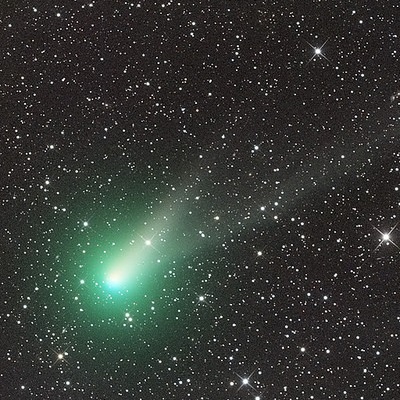
Comet Catalina (C/2013 US10) moves past Arcturus as it heads north during January. Remains visible with binoculars and small telescopes.
Comet Catalina is now well placed for observation in the morning sky for observers at Northern Hemisphere latitudes. For the last few months the comet has been brighter than 7th magnitude and therefore within the range of binoculars and small scopes. Catalina hasn't quite reached naked eye brightness and now seems unlikely to make it, but even so it should remain at this brightness level for a number of weeks to come. Visually it shows a small faint tail of a degree in length. Photographically the comet looks superb.
Quadrantids meteor shower peaks on January 4, 2016
The first annual meteor shower of the year to take place is always the January Quadrantids and it can be a good one with up to 100 meteors per hour visible at peak time. The high rate is comparable to other top showers such as the Perseids and the Geminids. However, unlike these well-observed events the Quadrantids are more elusive since the peak is short lived with a window of just a few hours. Consequently, it's no accident that they are challenging meteors and bagging a few of them makes a fine start to the new astronomical year.

Radiant and History
Meteor showers are named after the constellation (or nearby star) where the radiant is located but you will have difficulty figuring out the associated region for the Quadrantids; the reason being the constellation no longer exists. Today the Quadrantids radiant is located in northern Boötes not far from the tail of Ursa Major. When the shower was discovered by Adolphe Quetelet of the Brussels Observatory in the 1830s the radiant was in the now obsolete Quadrans Muralis, hence the name "The Quadrantids".
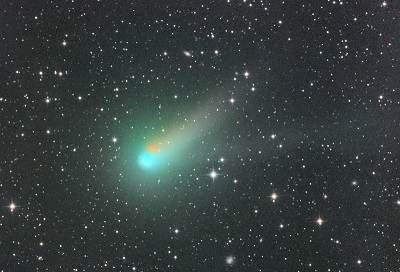
Comet Catalina (C/2013 US10) remains an early morning binocular and small telescope object
Comet Catalina is currently the brightest comet in the sky and remains well placed for observation from northern latitudes throughout December and into the New Year. It was originally predicted that we would now have a naked eye object but unfortunately that hasn't happened; its brightening slowed down significantly in September and now seems certain that it will peak at least 5 times fainter than hoped. Nevertheless, Catalina can be still be seen with binoculars / small telescopes and should remain so for many weeks to come.
Ursids meteor shower peaks on December 22/23, 2015
The major meteor event in December is the Geminids but there's another shower later in the month that's doesn't make as many headlines but on occasions can be quite good, the Ursids. With the radiant located close to the North Pole Star the Ursids are a Northern Hemisphere shower. They are much less dramatic than the Geminids with only about 10 meteors per hour visible but on several previous occasions they have shown significant bursts of activity and a re-occurrence may happen anytime.
This year's Ursid peak occurs on the night of December 22nd/23rd. The waxing gibbous Moon will obscure the evening viewing so the best time to look is during the early hours of the morning before sunrise. In addition the radiant point of the Ursid shower climbs upwards in the sky after the Moon sets.
Parent comet
The comet that sources and therefore responsible for the Ursid meteor shower is 8P/Tuttle (also known as Tuttle's Comet or Comet Tuttle). It has a period of 13.6 years and during the last perihelion on January 27, 2008 it was visible telescopically. Tuttle's comet passed Earth at a distance of 0.25282 AU (37,821,000 km or 23,501,000 miles) on January 1, 2008 and anticipation was high that the 2007 and 2008 showers may produce much increased activity but this was not to be. In the end only a small increase was noted.