Comet Catalina is currently the brightest comet in the sky and remains well placed for observation from northern latitudes throughout December and into the New Year. It was originally predicted that we would now have a naked eye object but unfortunately that hasn't happened; its brightening slowed down significantly in September and now seems certain that it will peak at least 5 times fainter than hoped. Nevertheless, Catalina can be still be seen with binoculars / small telescopes and should remain so for many weeks to come.
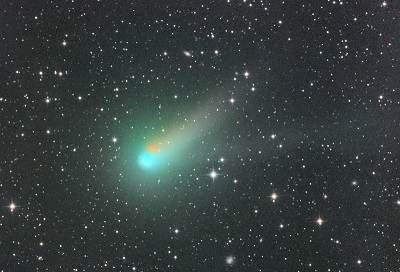
Location and star chart
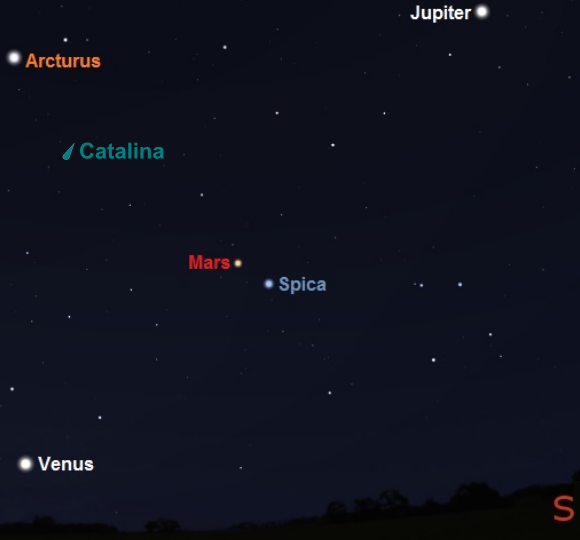
From northern latitudes Catalina is visible towards the east before sunrise. It's currently moving directly northwards with Venus, Mars, Jupiter and bright stars Arcturus and Spica nearby. Orange giant Arcturus at magnitude -0.04 is the fourth brightest star in the night sky and Catalina will pass within one degree of it on New Years Day. From southern latitudes the comet is now hardly observable.
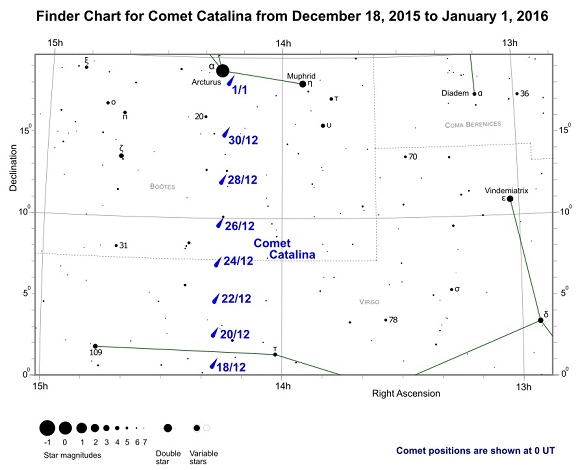
On January 17th, Catalina approaches to within 0.72 AU or 108 million kilometres (67 million miles) of Earth. The finder charts below show the positions of Catalina from November 18th to January 1st.

C/2013 US10 (Catalina) Data (at epoch November 15, 2014)
| Name | C/2013 US10 (Catalina) |
|---|---|
| Type | Comet |
| Discoverer | Catalina Sky Survey |
| Discovery date | October 31, 2013 |
| Perihelion (AU) | 0.82290 |
| Eccentricity | 1.00040 |
| Orbital period (years) | unknown |
| Inclination (degrees) | 148.8733 |
| Longitude of ascending node (degrees) | 186.1371 |
| Perihelion | November 15th, 2015 |
(C2013/US10) Catalina Data Table
| 01-Dec-2015 | 14h 19m 01s | -11d 28m 09s | 6.6 | 1.534 | Virgo |
| 02-Dec-2015 | 14h 18m 54s | -10d 53m 38s | 6.6 | 1.516 | Virgo |
| 03-Dec-2015 | 14h 18m 46s | -10d 18m 22s | 6.6 | 1.498 | Virgo |
| 04-Dec-2015 | 14h 18m 39s | -09d 42m 17s | 6.6 | 1.480 | Virgo |
| 05-Dec-2015 | 14h 18m 33s | -09d 05m 19s | 6.6 | 1.461 | Virgo |
| 06-Dec-2015 | 14h 18m 26s | -08d 27m 26s | 6.6 | 1.441 | Virgo |
| 07-Dec-2015 | 14h 18m 20s | -07d 48m 34s | 6.6 | 1.422 | Virgo |
| 08-Dec-2015 | 14h 18m 15s | -07d 08m 40s | 6.6 | 1.402 | Virgo |
| 09-Dec-2015 | 14h 18m 09s | -06d 27m 38s | 6.6 | 1.381 | Virgo |
| 10-Dec-2015 | 14h 18m 04s | -05d 45m 26s | 6.6 | 1.361 | Virgo |
| 11-Dec-2015 | 14h 17m 59s | -05d 01m 57s | 6.6 | 1.340 | Virgo |
| 12-Dec-2015 | 14h 17m 54s | -04d 17m 08s | 6.6 | 1.319 | Virgo |
| 13-Dec-2015 | 14h 17m 49s | -03d 30m 53s | 6.6 | 1.298 | Virgo |
| 14-Dec-2015 | 14h 17m 44s | -02d 43m 06s | 6.6 | 1.277 | Virgo |
| 15-Dec-2015 | 14h 17m 39s | -01d 53m 42s | 6.6 | 1.255 | Virgo |
| 16-Dec-2015 | 14h 17m 34s | -01d 02m 34s | 6.6 | 1.234 | Virgo |
| 17-Dec-2015 | 14h 17m 28s | -00d 09m 36s | 6.5 | 1.212 | Virgo |
| 18-Dec-2015 | 14h 17m 22s | 00d 45m 20s | 6.5 | 1.190 | Virgo |
| 19-Dec-2015 | 14h 17m 15s | 01d 42m 21s | 6.5 | 1.168 | Virgo |
| 20-Dec-2015 | 14h 17m 08s | 02d 41m 35s | 6.5 | 1.147 | Virgo |
| 21-Dec-2015 | 14h 17m 00s | 03d 43m 10s | 6.5 | 1.125 | Virgo |
| 22-Dec-2015 | 14h 16m 52s | 04d 47m 15s | 6.5 | 1.103 | Virgo |
| 23-Dec-2015 | 14h 16m 42s | 05d 53m 59s | 6.5 | 1.082 | Virgo |
| 24-Dec-2015 | 14h 16m 31s | 07d 03m 32s | 6.5 | 1.060 | Virgo |
| 25-Dec-2015 | 14h 16m 19s | 08d 16m 03s | 6.5 | 1.039 | Boötes |
| 26-Dec-2015 | 14h 16m 05s | 09d 31m 44s | 6.5 | 1.018 | Boötes |
| 27-Dec-2015 | 14h 15m 50s | 10d 50m 43s | 6.4 | 0.997 | Boötes |
| 28-Dec-2015 | 14h 15m 33s | 12d 13m 14s | 6.4 | 0.976 | Boötes |
| 29-Dec-2015 | 14h 15m 13s | 13d 39m 25s | 6.4 | 0.956 | Boötes |
| 30-Dec-2015 | 14h 14m 52s | 15d 09m 29s | 6.4 | 0.936 | Boötes |
| 31-Dec-2015 | 14h 14m 27s | 16d 43m 35s | 6.4 | 0.917 | Boötes |
| 01-Jan-2016 | 14h 13m 59s | 18d 21m 48s | 6.4 | 0.898 | Boötes |
| 02-Jan-2016 | 14h 13m 28s | 20d 04m 29s | 6.4 | 0.880 | Boötes |
| 03-Jan-2016 | 14h 12m 53s | 21d 51m 41s | 6.4 | 0.863 | Boötes |
| 04-Jan-2016 | 14h 12m 13s | 23d 43m 30s | 6.3 | 0.846 | Boötes |
| 05-Jan-2016 | 14h 11m 28s | 25d 40m 01s | 6.3 | 0.830 | Boötes |
| 06-Jan-2016 | 14h 10m 37s | 27d 41m 18s | 6.3 | 0.815 | Boötes |
| 07-Jan-2016 | 14h 09m 40s | 29d 47m 20s | 6.3 | 0.800 | Boötes |
| 08-Jan-2016 | 14h 08m 35s | 31d 58m 03s | 6.3 | 0.787 | Boötes |
| 09-Jan-2016 | 14h 07m 22s | 34d 13m 22s | 6.3 | 0.775 | Canes Venatici |
| 10-Jan-2016 | 14h 05m 59s | 36d 33m 03s | 6.3 | 0.764 | Canes Venatici |
| 11-Jan-2016 | 14h 04m 24s | 38d 56m 52s | 6.3 | 0.754 | Canes Venatici |
| 12-Jan-2016 | 14h 02m 36s | 41d 24m 25s | 6.3 | 0.746 | Canes Venatici |
| 13-Jan-2016 | 14h 00m 32s | 43d 55m 16s | 6.3 | 0.738 | Canes Venatici |
| 14-Jan-2016 | 13h 58m 11s | 46d 28m 54s | 6.3 | 0.733 | Canes Venatici |
| 15-Jan-2016 | 13h 55m 28s | 49d 04m 41s | 6.3 | 0.729 | Ursa Major |
| 16-Jan-2016 | 13h 52m 21s | 51d 41m 54s | 6.4 | 0.726 | Ursa Major |
| 17-Jan-2016 | 13h 48m 43s | 54d 19m 49s | 6.4 | 0.725 | Ursa Major |
| 18-Jan-2016 | 13h 44m 28s | 56d 57m 34s | 6.4 | 0.725 | Ursa Major |
| 19-Jan-2016 | 13h 39m 30s | 59d 34m 18s | 6.5 | 0.727 | Ursa Major |
| 20-Jan-2016 | 13h 33m 36s | 62d 09m 04s | 6.5 | 0.731 | Ursa Major |
| 21-Jan-2016 | 13h 26m 34s | 64d 40m 54s | 6.5 | 0.736 | Draco |
| 22-Jan-2016 | 13h 18m 05s | 67d 08m 46s | 6.6 | 0.743 | Draco |
| 23-Jan-2016 | 13h 07m 46s | 69d 31m 34s | 6.6 | 0.751 | Ursa Minor |
| 24-Jan-2016 | 12h 55m 03s | 71d 48m 02s | 6.7 | 0.761 | Draco |
| 25-Jan-2016 | 12h 39m 12s | 73d 56m 43s | 6.7 | 0.772 | Draco |
| 26-Jan-2016 | 12h 19m 14s | 75d 55m 44s | 6.7 | 0.785 | Draco |
| 27-Jan-2016 | 11h 53m 53s | 77d 42m 41s | 6.8 | 0.799 | Camelopardalis |
| 28-Jan-2016 | 11h 21m 47s | 79d 14m 21s | 6.8 | 0.814 | Draco |
| 29-Jan-2016 | 10h 41m 53s | 80d 26m 41s | 6.8 | 0.830 | Draco |
| 30-Jan-2016 | 09h 54m 33s | 81d 15m 18s | 6.9 | 0.848 | Draco |
| 31-Jan-2016 | 09h 02m 43s | 81d 37m 01s | 6.9 | 0.866 | Camelopardalis |
See also
Comet Catalina (C/2013 US10) moves past Kemble's Cascade during the last week of February 2016. Visible with binoculars and small telescopes from northern and tropical latitudes.
Comet Catalina (C/2013 US10) now fading as it recedes from Earth. Currently moving through the far northern constellations. Remains visible with binoculars and small telescopes.
Comet Catalina (C/2013 US10) remains visible with binoculars and small telescopes at it moves northwards. This month offers the last good chance to catch a glimpse before it fades significantly.
Catalina (C/2013 US10) an early morning binocular and small telescope comet
Comet Catalina (C/2013 US10) edges towards naked eye visibility
Comet Catalina (C/2013 US10) remains visible in the evening from Southern and Equatorial Latitudes during September 2015
Comet Catalina (C/2013 US10) now visible with binoculars from Southern and Equatorial Latitudes