Guides / Star Charts
Contributions
If you like the website and want to contribute to the running costs then please do so below. All contributions are most welcome.
NGC 6543 - The Cat's Eye Nebula - Planetary Nebula
NGC 6543, mag. +8.2, also known as the Cat's Eye Nebula is a planetary nebula located in the northern constellation of Draco. It was discovered by William Herschel on February 15, 1786 and is one of the brightest and finest examples of its type. Some of the most spectacularly images ever taken by the Hubble Space Telescope have been of NGC 6543, which display a wealth of exquisite details across a large complex eye-like structure.
In total, the extended halo of the nebula spans some 6.5 arc minutes of apparent sky. However, through amateur scopes only the small inner section is visible (approx. 20 arc seconds) and therefore it appears tiny and considerably smaller in apparent size than for example, Jupiter. However, the advantage of a compact centre is high surface brightness, and therefore NGC 6543 can be spotted with binoculars and is easily visible through small scopes.
Saturn's bizarre two-tone moon Iapetus reaches greatest western elongation on September 9, 2016, visible in small scopes
Saturn, mag. +0.5, is currently an evening object in the constellation of Ophiuchus. The planet famous for its spectacular ring system is visible towards the south-southwest from northern latitudes or towards the northwest from southern latitudes as soon as it's dark enough. Currently in the same region of sky is Mars (mag. -0.2) and red supergiant star Antares (α Sco - mag. +1.0). In addition on September 8th and 9th, the Moon passes just north of the the planets.

The Moon, Mars, Saturn and Antares close together during the evenings of September 8th and 9th, 2016
Although now past their best for the year, Mars and Saturn both remain prominent early evening objects during September. After sunset from mid-northern latitudes the planets can be seen for a few hours above the south-southwest horizon before setting. From further south the visibility is much better. For example from Sydney, Mars and Saturn appear high in the northern sky at sunset, remaining visible until around midnight.
On September 8th, the waxing crescent Moon will be about 4 degrees north of Saturn. The following day the Moon, now first quarter, passes 8 degrees north of Mars. Both days offer nice opportunities to spot the Moon, the two planets and also first magnitude red supergiant star Antares (α Sco) together in the early evening sky.
The images below show the view during the evenings of September 8th and 9th from New York. Mars shines at mag. -0.2, Saturn +0.5 and Antares +1.0. From other mid-latitude northern locations the scene will look similar.
IC 342 - Intermediate Spiral Galaxy
IC 342 is an 8th magnitude face-on intermediate spiral galaxy that's located in the faint northern constellation of Camelopardalis. Since positioned only 10 degrees from the galactic equator it's obscured heavily by Milky Way dust. As a result, this galaxy wasn't even discovered until famed British amateur astronomer William Frederick Denning found it in 1895. At the time it was originally thought to be a galactic nebula, but in 1934 Edwin Hubble and Milton Humason discovered its spiral nature and identified it as a galaxy. Visually IC 342 is less impressive than its magnitude suggests, but on very good nights when high overhead it's a fine sight in medium and large size amateur scopes.
The galaxy is best seen from the Northern Hemisphere during the months of November, December and January. It's circumpolar from all latitudes greater than 22N, but not well situated for southern observers where it never climbs very high above the northern horizon.
IC 342 is listed as number 5 in the Caldwell catalogue.
NGC 7023 - Iris Nebula - Reflection Nebula
NGC 7023 is a reflection nebula located in the west central section of the far northern constellation of Cepheus. This nebula contains at its centre an extremely young star named V380 Cep (mag. +7.1), which is believed to have burst into life just 5,500 years ago. Since incredibly young there is plenty of local dust surrounding the star, and when starlight hits the dust it's reflected to become the visible nebula.
NGC 7023 is located 6 degrees northwest of the brightest star in Cepheus, Alderamin (α Cep - mag. +2.5) with third magnitude Alfirk (β Cep) positioned about 3.5 degrees to the northeast. Only a degree east-northeast of NGC 7023 is Mira type variable star T Cep, which fluctuates between magnitudes +5.2 and +11.3 over a period of 388.14 days. A faint eleventh magnitude barred-spiral galaxy, NGC 6951, is positioned two degrees southwest of NGC 7023.
The nebula is also known as the Iris Nebula and is number 4 in the Caldwell catalogue. It was discovered by Sir William Herschel on October 18, 1794.

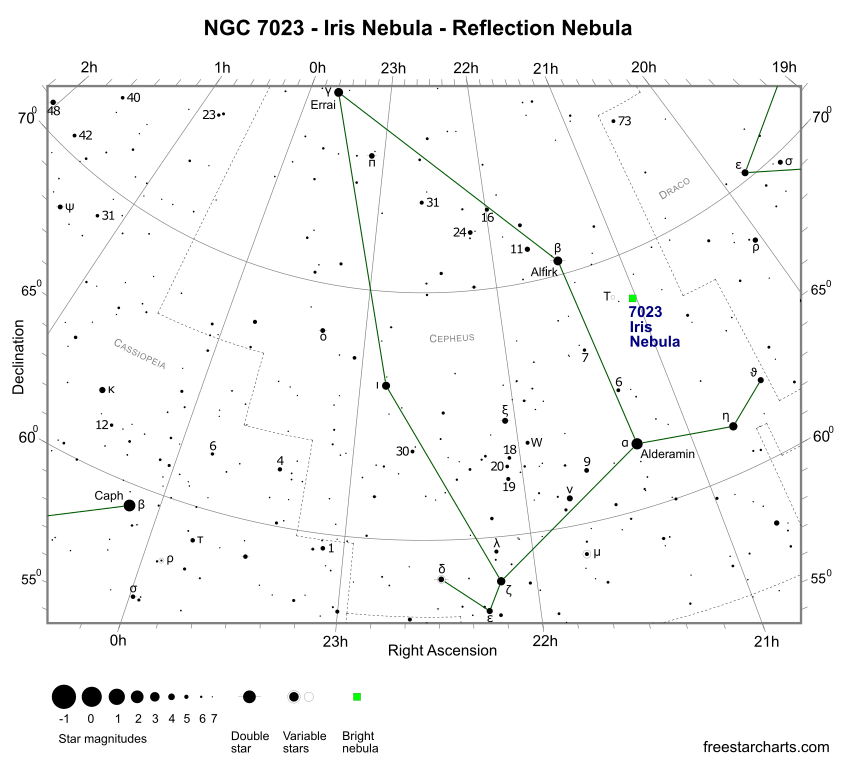
Finder Chart for NGC 7023 - pdf format (credit:- freestarcharts)
Algol eclipse dates and times for September 2016
Algol (β Per) is a bright eclipsing binary system located in the northern constellation of Perseus and one of the best-known variable stars in the sky. Often referred to as the "Demon Star" most of the time it shines at mag. +2.1 but every two days, 20 hours and 49 minutes the star suddenly dips in brightness to mag. +3.4, remaining dim for about 10 hours before returning to its original state.
Why the change in brightness? The Algol system consists of at least three-stars (β Per A, β Per B and β Per C) with the orbital plane of Algol A and B directly in line with the Earth. The regular dips in brightness occur when the dimmer B star moves in front of and eclipses the brighter A star. There is also an extra dimension in that a secondary eclipse occurs when the brighter star occults the fainter secondary resulting in a very small dip in brightness that can be detected with photo-electrical equipment.

The Planets this Month - September 2016
Mercury
For observers at northern temperate latitudes the latter part of September offers the best opportunity this year to spot Mercury in the morning sky. Before that the smallest planet in the Solar System begins the month as a challenging evening object visible very low down above the western horizon just after sunset from southern and equatorial latitudes. During the first few days of September, Venus (mag. -3.8) and Jupiter (mag. -1.7) form a compact triangle together with much fainter Mercury (mag. +1.3 on Sep 1st). Observing Mercury is made difficult due to its dimness and the bright evening twilight. Therefore viewing with binoculars is recommended but of course make sure that the Sun is hidden below the horizon before looking. On September 2nd and 3rd, the extremely thin crescent Moon is in the same region of sky but just a few days later Mercury is completely swallowed by the twilight as it heads towards inferior conjunction on September 13th.
The diagram below shows the view looking west 45 minutes after sunset between July 22nd and September 10th from latitude 35S, approx. equal to Sydney, Cape Town and Santiago. The view will be slightly different from other southerly latitudes.
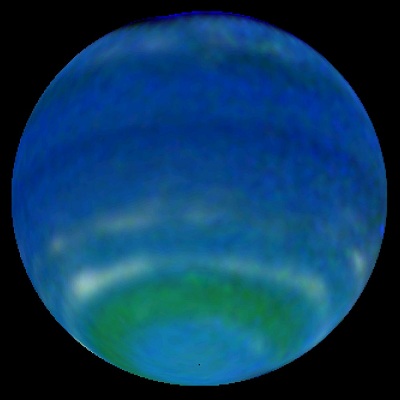
Neptune reaches opposition on September 2, 2016
Neptune the eighth planet from the Sun reaches opposition in Aquarius on September 2nd. On this day, the most distant planet in the Solar System will be 28.9454 AU (approx. 4330 million km or 2691 million miles) from Earth and visible all night long. It rises above the eastern horizon at sunset, reaches highest point in the sky during the middle of the night before setting in the west at sunrise.
With an apparent magnitude of +7.8, Neptune is the only planet that's not bright enough to be visible to the naked eye. However, provided you know exactly where to look it's relatively easy to find with binoculars and small scopes.
The Moon, Mars and Saturn close together during evenings of August 11 and August 12, 2016
Just after sunset as soon as its dark enough, planets Mars and Saturn can be seen towards the south from northern locations or towards the northeast from southern locations. Mars is now moving rapidly eastwards, started the month in Libra before crossing into Scorpius on August 2nd where it remains until the 21st. Saturn on the other hand reaches its secondary stationary point on August 13th, consequently appearing to the naked-eye effectively like a "fixed" star this month. Also located nearby is first magnitude red supergiant star Antares (α Sco) and of the three objects, Mars (mag. -0.6) is the brightest followed by Saturn (mag. +0.4) and then Antares (mag. +1.0).
On August 11th and August 12th, some pleasant early evening viewing opportunities occur when the Moon moves in the same region of sky. This also coincides with peak activity of the annual Perseids meteor shower, so some bright shooting stars may also be visible. However, of course the best time to view the meteors is during the early hours of the morning after the Moon has set. The images below show the view just before midnight on August 11th and 12th from London, England. From other mid-latitude northern locations the scene appears similar to that shown.