Guides / Star Charts
Contributions
If you like the website and want to contribute to the running costs then please do so below. All contributions are most welcome.
Algol eclipse dates and times for November 2020
Algol (β Per) is a bright eclipsing binary system located in the northern constellation of Perseus and one of the best-known variable stars in the sky. Often referred to as the "Demon Star", most of the time it shines at mag. +2.1 but every two days, 20 hours and 49 minutes it suddenly dips in brightness to mag. +3.4, remaining dim for about 10 hours before returning to its original state.
Why the brightness change. The Algol system consists of at least three-stars (β Per A, β Per B and β Per C) with the orbital plane of Algol A and B directly in line with the Earth. The regular dips in brightness occur when the dimmer B star moves in front of and eclipses the brighter A star. There is also an extra dimension in that a secondary eclipse occurs when the brighter star occults the fainter secondary, resulting in a very small dip in brightness that can be detected with photo-electrical equipment.

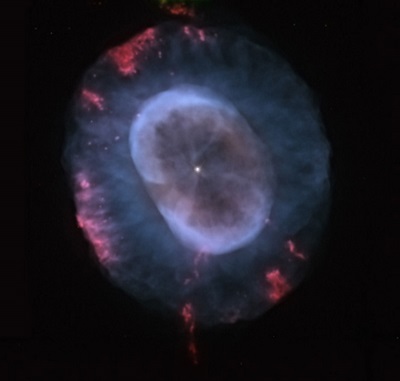
NGC 7662 - The Blue Snowball Nebula - Planetary Nebula
NGC 7662 is a planetary nebula located in Andromeda. It's also known as the Blue Snowball Nebula or Snowball Nebula and at apparent magnitude +8.6 is one of the brightest examples of its type and therefore a popular target for both amateur and professional astronomers. NGC 7662 is positioned 0.5 degrees southwest of star 13 And (mag. +5.7) and was discovered by William Herschel on October 6, 1784. It's best seen from Northern Hemisphere latitudes and appears high in the sky during the months of October, November and December.
Messier 105 - M105 - Elliptical Galaxy
M105, mag. +9.8, is an elliptical galaxy visible with small telescopes that's located in the constellation of Leo. It was discovered by Pierre Méchain on March 24, 1781, which was three days before he discovered M101. However, due to unknown reasons, this galaxy wasn't included in Charles Messier's final published catalogue version. It was eventually added by Helen Sawyer Hogg in 1947, together with M106 and M107. William Herschel independently rediscovered M105 on March 11, 1784.
M105 is the brightest elliptical member of the Leo I or M96 group of galaxies that also includes M95, M96 and at least another 21 fainter members. This grouping is one of many that lie within the Virgo Supercluster. M105 is located 35 million light-years distant and is known to contain a supermassive black hole at its centre.
They are best seen during the months of March, April and May.

Algol eclipse dates and times for December 2020
Algol (β Per) is a bright eclipsing binary system located in the northern constellation of Perseus and one of the best-known variable stars in the sky. Often referred to as the "Demon Star", most of the time it shines at mag. +2.1 but every two days, 20 hours and 49 minutes it suddenly dips in brightness to mag. +3.4, remaining dim for about 10 hours before returning to its original state.
Why the brightness change. The Algol system consists of at least three-stars (β Per A, β Per B and β Per C) with the orbital plane of Algol A and B directly in line with the Earth. The regular dips in brightness occur when the dimmer B star moves in front of and eclipses the brighter A star. There is also an extra dimension in that a secondary eclipse occurs when the brighter star occults the fainter secondary, resulting in a very small dip in brightness that can be detected with photo-electrical equipment.
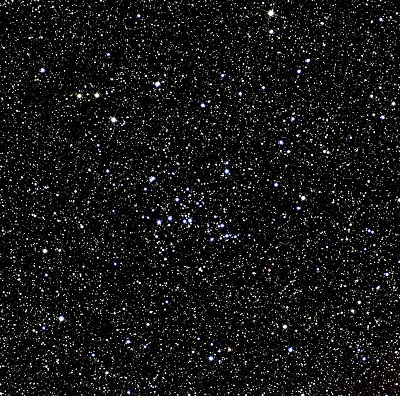
NGC 7243 - Open Cluster
NGC 7243 is a large sparse open cluster located in the faint northern constellation of Lacerta. The cluster shines at magnitude +6.4 and is therefore just beyond naked eye visibility but easily seen with binoculars and small scopes. It spans 21 arc minutes of apparent sky, which is equivalent to about 2/3rds of the apparent diameter of the full Moon. In total, NGC 7243 contains about 40 stars including some blue, yellow and red members. It was discovered by William Herschel on September 26, 1788.
Messier 62 - M62 - Globular Cluster
M62 is a magnitude +6.5 globular cluster in the constellation of Ophiuchus, right at the border with Scorpius. It's positioned close to the Milky Way centre, which may be the reason why it's one of the most irregular shaped globulars known. At a distance of only 6,100 light-years from the galactic centre, this cluster is subject to large deforming tidal forces. From Earth, it's considerably further away at 22,200 light-years.
M62 was discovered by Charles Messier on June 7, 1771. However, he didn't accurately measure its position until 1779 when including it in his catalogue. William Herschel first resolved the object into stars, describing it as a miniature version of M3. Finding M62 can be challenging since there are no bright stars positioned nearby. One method is to imagine a right angle triangle consisting of Antares (α Sco - mag. +1.0) and epsilon Scorpii (ε Sco - mag. +2.3) with M62 at the third corner. Antares is 7.5 degrees northwest of M62 with ε Scorpii 4.75 degrees to the southwest.
M62 is visible with binoculars as a faint small fuzzy ball of light. However, since it's located among the rich Milky Way starfields it can be easily missed. The cluster is best seen from tropical and Southern Hemisphere locations during the months of May, June and July. For mid-latitude Northern Hemisphere observers, it's a tricky object that doesn't rise particularly high above the southern horizon and therefore never well placed. Positioned 4.5 degrees north of M62 is the slightly fainter but larger globular cluster M19 (mag. +7.2).

Algol eclipse dates and times for October 2020
Algol (β Per) is a bright eclipsing binary system located in the northern constellation of Perseus and one of the best-known variable stars in the sky. Often referred to as the "Demon Star", most of the time it shines at mag. +2.1 but every two days, 20 hours and 49 minutes it suddenly dips in brightness to mag. +3.4, remaining dim for about 10 hours before returning to its original state.
Why the brightness change. The Algol system consists of at least three-stars (β Per A, β Per B and β Per C) with the orbital plane of Algol A and B directly in line with the Earth. The regular dips in brightness occur when the dimmer B star moves in front of and eclipses the brighter A star. There is also an extra dimension in that a secondary eclipse occurs when the brighter star occults the fainter secondary, resulting in a very small dip in brightness that can be detected with photo-electrical equipment.
NGC 559 - Open Cluster
NGC 559 is a magnitude +9.5 open cluster in Cassiopeia that's faintly visible with binoculars, but better seen with telescopes. The surrounding area of sky is full of bright clusters including NGC 457, M 52, M 103, NGC 129, NGC 7789, NGC 654, NGC 663 and IC 1848. As a result, tenth magnitude NGC 559 is not a standout object. However, it's easy to find and a nice target for small and medium size scopes.

Messier 25 - M25 - Open Cluster
M25 is a bright, mag. +4.6, naked eye open cluster in Sagittarius that's a wonderful sight in binoculars and small telescopes. It was discovered by Philippe Loys de Chéseaux in 1745 and subsequently catalogued by Charles Messier on June 20, 1764. There is however an unusual twist to the history of M25. For such a bright cluster it's reasonable to assume that it would have been included by John Herschel in his comprehensive 19th century General Catalogue. For unknown reasons it wasn't. This is despite the cluster been catalogued by Johann Elert Bode in 1777, observed by William Herschel in 1783 and described by Admiral Smyth in 1836. M25 was finally included in 1908, by J.L.E. Dreyer, in the supplementary Index Catalogue (as IC 4725).
Finding M25 is relatively easy. It's positioned 6.5 degrees north and a little east of the top star of the bright teapot asterism of Sagittarius, Kaus Borealis (λ Sgr - mag. +2.8). Only 3.5 degrees west of M25 is M24, the large Sagittarius Star Cloud.
The cluster is best seen from southern and equatorial regions during the months of June, July and August. For mid-latitude Northern Hemisphere observers, it appears low down during the summer months.

Algol eclipse dates and times for September 2020
Algol (β Per) is a bright eclipsing binary system located in the northern constellation of Perseus and one of the best-known variable stars in the sky. Often referred to as the "Demon Star", most of the time it shines at mag. +2.1 but every two days, 20 hours and 49 minutes it suddenly dips in brightness to mag. +3.4, remaining dim for about 10 hours before returning to its original state.
Why the brightness change. The Algol system consists of at least three-stars (β Per A, β Per B and β Per C) with the orbital plane of Algol A and B directly in line with the Earth. The regular dips in brightness occur when the dimmer B star moves in front of and eclipses the brighter A star. There is also an extra dimension in that a secondary eclipse occurs when the brighter star occults the fainter secondary, resulting in a very small dip in brightness that can be detected with photo-electrical equipment.
NGC 6882 / NGC 6885 - Open Cluster
NGC 6882/6885 is an open cluster in the faint constellation of Vulpecula that can just about be seen with the naked eye, is easy with binoculars and has up to 40 stars visible through telescopes. This object has somewhat of a confusing history. In September 1784, William Herschel discovered two open clusters, NGC 6882 and NGC 6885. He subsequently catalogued them, but with virtually identical descriptions. Since no cluster exists that matches the location and description of NGC 6882, many astronomers believe that Herschel made a mistake and simply repeated his observation. However, the story doesn't end here. Adding to the confusion is a fainter, smaller and less rich cluster, Collinder 416, that's positioned at the northwestern edge of NGC 6885. Some astronomers believe this to be NGC 6882.
NGC 6882/6885 is grouped around the brightest member star, 20 Vul (mag. +5.9). Located 1.5 degrees northeast of NGC 6882/6885 is 23 Vul, which at magnitude +4.5 is the second brightest star in the constellation. Positioned 9 degrees west-northwest of the cluster is the beautiful double star Albireo (mag. +2.9) in Cygnus.


Finder Chart for NGC 6882 / NGC 6885 - pdf format (credit:- freestarcharts)
Messier 69 - M69 - Globular Cluster
M69 is a globular cluster located inside the prominent teapot asterism of Sagittarius. It shines at magnitude +7.6 and is therefore within the range of good quality 7x50 or 10x50 binoculars, although it appears faint and star like.
This globular is located 29,700 light-years from Earth and was discovered by Charles Messier on August 31, 1780. On this night he also discovered M70, which is a physically close neighbour of M69. Spatially, they are separated by just 1,800 light-years and any potential observers located on planets inside one of these clusters, would have a spectacular view of the other and vice-versa. Of course, this is assuming that the many thousands of bright stars, visible in their own backyard, didn't block the view of the other cluster.
Finding M69 is easy once one is familiar with Sagittarius. Start by focusing on the base of the teapot and then image a line connecting Kaus Australis (ε Sgr - mag. +1.8) with Ascella (ζ Sgr - mag. +2.6). M69 is positioned 1.5 degrees along and 2 degrees to the north of this line. There are two 5th magnitude stars located just south of the cluster.
M69 is best seen from the Southern Hemisphere during the months of June, July and August. From mid-northern latitudes, it's a difficult object that never climbs particularly high above the southern horizon.

Messier 22 - M22 - Sagittarius Cluster (Globular Cluster)
M22 is a magnificent globular cluster located in the constellation of Sagittarius and one of the best objects of its type in the night sky. With a magnitude of +5.1, the cluster is visible to the naked eye under dark skies and also the brightest globular in the Messier catalogue. Only the two great southern globulars, Omega Centauri (NGC 5139) and 47 Tucanae (NGC 104) are more brilliant. Both of these are positioned far too south in the sky to have been seen by Messier. With an apparent diameter extending 32 arc minutes, M22 covers more sky than the Full Moon.
The main reason why M22 appears so large and bright is because it's close at only 10,400 light-years. It was probably the first globular to have been discovered - by Abraham Ihle in 1665 - although it has been suggested that Hevelius may have seen it earlier. M22 was included in Edmund Halley's list of 6 objects published in 1715 and then catalogued by Charles Messier on June 5, 1764. M22 is an easy object to locate as it's positioned 2.5 degrees northeast of the top star of the teapot asterism of Sagittarius, Kaus Borealis (λ Sag - mag. +2.8).
The globular is best seen from southern and equatorial regions during the months of June, July and August. From northern temperate locations it never rises particularly high above the southern horizon.

Messier 70 - M70 - Globular Cluster
M70 is an eighth magnitude globular cluster in Sagittarius that's faintly visible with binoculars, appearing as a star like point of light. It's much easier to spot with small telescopes where it appears obviously non-stellar but without detail. To resolve M70 into stars, larger scopes are required.
Charles Messier discovered M70 on August 31, 1780, describing it as a "nebula without stars". On the same night he also discovered M69, a neighbouring globular. M70 has an extremely dense core and is believed at some time to have suffered a core collapse, similar to Messier globulars M15, M30 and possibly M62. It was William Herschel who first resolved the cluster into stars, describing it as a miniature version of M3.
M70 is located 29,300 light-years away. Physically it's separated by just 1,800 light-years from M69 with both objects located near to the galactic centre. The clusters are best seen from the Southern Hemisphere during the months of June, July and August. From mid-northern latitudes they are never well positioned and at best climb just a few degrees above the horizon.

Algol eclipse dates and times for July 2020
Algol (β Per) is a bright eclipsing binary system located in the northern constellation of Perseus and one of the best-known variable stars in the sky. Often referred to as the "Demon Star", most of the time it shines at mag. +2.1 but every two days, 20 hours and 49 minutes it suddenly dips in brightness to mag. +3.4, remaining dim for about 10 hours before returning to its original state.
Why the brightness change. The Algol system consists of at least three-stars (β Per A, β Per B and β Per C) with the orbital plane of Algol A and B directly in line with the Earth. The regular dips in brightness occur when the dimmer B star moves in front of and eclipses the brighter A star. There is also an extra dimension in that a secondary eclipse occurs when the brighter star occults the fainter secondary, resulting in a very small dip in brightness that can be detected with photo-electrical equipment.
Algol eclipse dates and times for June 2020
Algol (β Per) is a bright eclipsing binary system located in the northern constellation of Perseus and one of the best-known variable stars in the sky. Often referred to as the "Demon Star", most of the time it shines at mag. +2.1 but every two days, 20 hours and 49 minutes it suddenly dips in brightness to mag. +3.4, remaining dim for about 10 hours before returning to its original state.
Why the brightness change. The Algol system consists of at least three-stars (β Per A, β Per B and β Per C) with the orbital plane of Algol A and B directly in line with the Earth. The regular dips in brightness occur when the dimmer B star moves in front of and eclipses the brighter A star. There is also an extra dimension in that a secondary eclipse occurs when the brighter star occults the fainter secondary, resulting in a very small dip in brightness that can be detected with photo-electrical equipment.
Algol eclipse dates and times for August 2020
Algol (β Per) is a bright eclipsing binary system located in the northern constellation of Perseus and one of the best-known variable stars in the sky. Often referred to as the "Demon Star", most of the time it shines at mag. +2.1 but every two days, 20 hours and 49 minutes it suddenly dips in brightness to mag. +3.4, remaining dim for about 10 hours before returning to its original state.
Why the brightness change. The Algol system consists of at least three-stars (β Per A, β Per B and β Per C) with the orbital plane of Algol A and B directly in line with the Earth. The regular dips in brightness occur when the dimmer B star moves in front of and eclipses the brighter A star. There is also an extra dimension in that a secondary eclipse occurs when the brighter star occults the fainter secondary, resulting in a very small dip in brightness that can be detected with photo-electrical equipment.
NGC 2403 - Intermediate Spiral Galaxy
NGC 2403 is an intermediate spiral galaxy located in the faint northern constellation of Camelopardalis. This superb magnitude +8.4 object is about 10 Million light-years distant and is an outlying member of the M81 group of galaxies, which also includes M81 and M82. Since it's relatively near, and almost face-on from our perspective, NGC 2403 displays intricate details in its spiral arms especially through large amateur scopes.
NGC 2403 was discovered on November 1, 1788 by William Herschel and is best seen from northern latitudes during the months of January, February and March. It's number 7 in the Caldwell catalogue.


Finder Chart for NGC 2403 - pdf format (credit:- freestarcharts)
NGC 891 - Silver Sliver - Unbarred Spiral Galaxy
NGC 891 is a tenth magnitude unbarred spiral galaxy located in Andromeda. Also known as the Silver Sliver, it's one of the best examples of an edge-on galaxy in the sky although a challenging object for small scopes. Due to its attractiveness and scientific appeal, NGC 891 was selected on October 12, 2005 to be the first light image of the Large Binocular Telescope at Mount Graham International Observatory in Arizona. In 2012, it was again selected as first light image, this time for the Discovery Channel Telescope (DCT) Large Monolithic Imager at the Lowell Observatory in Happy Jack, Arizona.
The Silver Sliver was discovered by William Herschel on October 6, 1784 and is best seen from the Northern Hemisphere during October, November and December. Astronomers think our Milky Way galaxy would look remarkably similar, if viewed edge-on.


Finder Chart for NGC 891 - pdf format (credit:- freestarcharts)
The Silver Sliver is located in eastern Andromeda close to the Perseus border. It's positioned 3.5 degrees east of beautiful double star Almach (γ And - mag. +2.1) with naked-eye open cluster M34 (mag. +5.5) a further 3.5 degrees to the east.
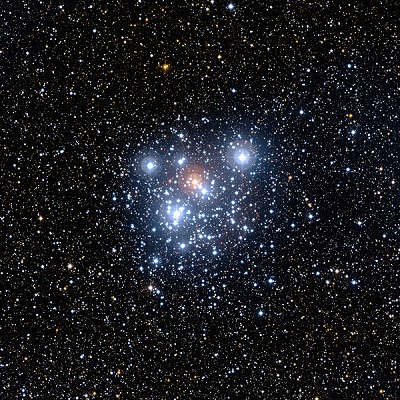
NGC 4755 - Jewel Box - Open Cluster
NGC 4755, also known as the Jewel Box or Kappa Crucis Cluster, is one of the finest open clusters in the sky. It's located in the small southern constellation of Crux and at magnitude +4.2 is bright enough to be seen with the naked eye. It contains over 100 stars, mostly blue or red, spread over 10 arc minutes of apparent sky. This cluster is one of a handful of night time objects that offers something for all observers of all telescope sizes.
NGC 4755 is located 6,440 light-years distant and is best seen from southern latitudes during the months of March, April and May. It's circumpolar from locations south of 30S and can also be seen from the tropics, although for many Northern Hemisphere observers it never rises above the southern horizon.