Guides / Star Charts
Contributions
If you like the website and want to contribute to the running costs then please do so below. All contributions are most welcome.
Astronomers announce discovery of 50 new exoplanets
Using the High Accuracy Radical velocity Planet Searcher (HARPS) spectrograph instrument at the 3.6m La Silla Observatory on the outskirts of the extremely dry Chilean Atacama desert, European astronomers on Monday 12th September 2011 announced the largest ever discovery of exoplanets at one time.
In total 50 new planets beyond our solar system have been found, including 16 so-called Super-Earths. These types of planets are of special interest as they are larger than our own Earth but not as large as gas giants such as Jupiter, Saturn, Uranus and Neptune. If the right environment exists on a Super-Earth, for example positioned inside its star’s "Goldilocks" zone with appropriate surface, temperature and atmospheric conditions then a potential habitable world may exist.
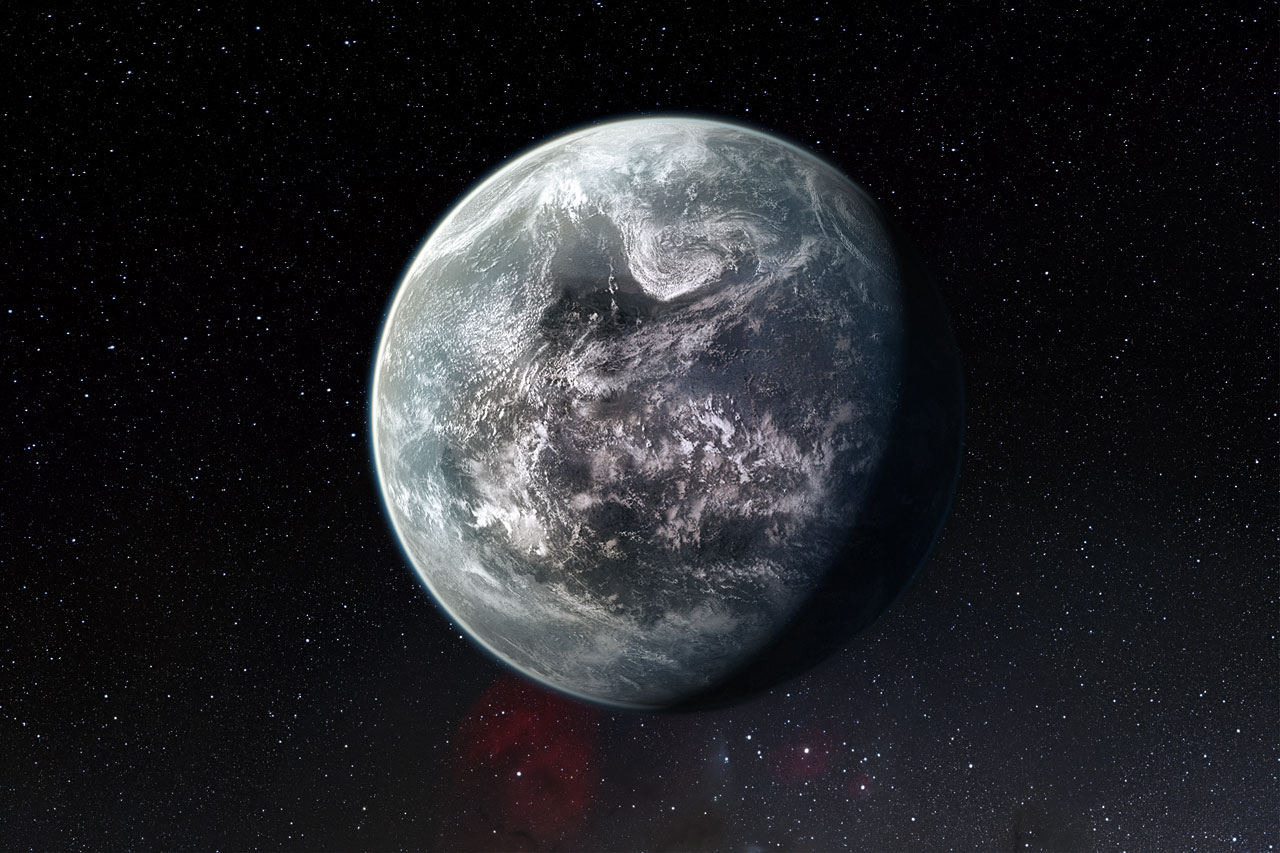
But what particularly excites the astronomers about the recent discoveries is one of the 16 new Super-Earths, HD 85512 b. Located 36 light years from Earth in the constellation of Vela, HD 85512 b is estimated to have a mass of only about 3.6 times that of the Earth and a temperature of around 25 degrees Celsius. It is close enough to be just inside the "Goldilocks" zone and hence the conditions are just right for the possibility of liquid water to exist on its surface and perhaps life itself.
NASA launches GRAIL Moon mission twin probes
The manned space shuttle program may recently have ended but unmanned space missions to explore the unknown are well and truly alive. Nasa latest space probe "The Gravity Recovery and Interior Laboratory" (GRAIL) is designed to map tiny variations of the Moon gravitational field and was launched from Cape Canaveral Complex 17B on the 10th September 2011.
Costing US$500 million the aim of GRAIL is to better understand the Moon's internal structure which should help to provide insight into many lunar mysteries. These include questions such as, why does the Moon's far side lack the great maria or "seas" that are prominent on the near side.
Spacecraft
The spacecraft actually consists of two small identical probes, named Grail-A and Grail-B, weighing 132 kg. Unlike the Apollo manned missions that took about three days to reach the Moon, GRAIL will use a much longer (via Sun-Earth Lagrange point L1) but fuel-efficient journey requiring nearly four months to reach lunar orbit.

Bright Supernova visible in M101
The nearest supernova of its type to be discovered for more than 40 years is expected to reach its maximum brightness around the 8th and 9th of September 2011.
The supernova (named PTF11kly) was discovered by British astronomers on the 24th August 2011 using the famous 48-inch Schmidt telescope at Mount Palomar. Operating the telescope remotely they found a "new" 17th mag. star lying within one of the spiral arms of M101 in Ursa Major. It has now brightened significantly and as of the 8th September the supernova hovers around magnitude 10, which is bright enough to be seen with an 80mm (3.1 inch) telescope under dark skies or even with good binoculars.

Vesta reaches opposition - August 2011
Vesta one of the largest asteroids reaches opposition on the 5th August 2011. Located in the constellation of Capricornus, Vesta will attain a maximum visual magnitude of 5.6, hence naked eye visibility for keen eyed observers from a dark site.
For surburbian observers and those who are not so lucky to have particularly dark skies, Vesta is still an easy binocular / small telescope object. So if you have never seen an asteroid before, now is an excellent time to do so.
Discovery
Vesta was the fourth asteroid to be discovered on the 29th March 1807 by the German astronomer Heinrich Wilhelm Olbers. Along with the other asteroids known at the time (Ceres, Pallas and Juno), Vesta was initially classified as a planet in its own right and subsequently was given its own planetary symbol. With further discoveries, all in the region between Mars and Jupiter, the general term asteroids was coined to describe them. Much later in 2006, the International Astronomical Union (IAU) defined a new classification of dwarf planet of which the largest asteroid Ceres is now a member.
Magnitude
Despite being only the third largest body in the main asteroid belt with a diameter of 530km (330 miles), Vesta is the brightest asteroid. It appears even brighter than the much larger dwarf planet Ceres and asteroid Pallas, which is slightly larger. This is because its approaches closer to the Earth than the other two and additionally has a much higher reflective surface. At favourable oppositions, the maximum visual magnitude of Vesta is 5.1 and therefore easily within naked eye visibility, especially from a dark site.
For opposition this year, Vesta will peak at mag 5.6.
Location
The second faintest constellation of the zodiac Capricornus provides the backdrop for this opposition. Capricornus is located at a declination of about -20 south and therefore never rises particular high in the sky for Northern hemisphere observers. Hence the best views of Vesta are seen from the Southern hemisphere, however for all observers the opportunity exists for a short time, to glimpse with the naked eye the only asteroid that is bright enough to do so.

FAQ
1. How are the charts produced?
All charts are computer generated with finishing touches applied using vector graphics program Inkscape. The star data for the charts comes from the Hipparcos and Tycho-2 Catalogues of the Hipparcos satellite, which was launched by the European Space Agency in 1989 and operational until 1993.
The Hipparcos Catalogue is a high-precision data-set of more than 100,000 stars and was published in 1997 along with the lower precision Tycho Catalogue of more than a million stars. An enhanced catalogue Tycho-2 with 2.5 million stars was published in 2000. Double stars were checked using the Washington double star catalogue. Data for deep sky objects such as nebula, galaxies, open clusters, globular clusters etc are checked against various sources.
2. Will the charts always be free?
Absolutely. All charts will be free to download and we will try to make them available in as many different formats as possible.
Help us
Every effort is made by the freestarcharts.com team to ensure that all-star charts and articles displayed on our website are of the highest quality and accuracy. Of course, there is always a chance of mistakes and here is where we would like your help. If you do notice any errors, however significant or insignificant then please do contact us at This email address is being protected from spambots. You need JavaScript enabled to view it..
But it not just error correcting that we are after; we are continuously trying to improve the quality, accuracy, presentation and usefulness of the charts. Any ideas, comments or suggestions that you may have in these areas would also be very welcome.
As always, we are truly grateful for all comments that we receive and hope that you enjoy using the star charts.
Thank you.
Here's to dark stars!
Your freestarcharts.com team.
About
Our aim is to promote Astronomy for all by providing information, articles, charts for anyone who wants to learn more about the stars, galaxies, the Sun, the planets, moon, asteroids, comets and whatever may be out there.