Guides / Star Charts
Contributions
If you like the website and want to contribute to the running costs then please do so below. All contributions are most welcome.
NGC 2477 - Open Cluster
NGC 2477 is a stunning open cluster located in the Milky Way rich constellation of Puppis. It's arguably the constellation's finest cluster, which also contains other superb examples such as M46, M47 and M93. At magnitude +5.8, NGC 2477 is faintly visible to the naked eye, but easily seen with binoculars and a fantastic telescope object especially in medium to large scopes. It's listed as number 71 in the Caldwell catalogue.
The cluster was discovered by French astronomer Nicolas Louis de Lacaille during his tour of South Africa in 1751-52. In total it contains about 300 stars packed into an area 27 arc minutes in diameter with the brightest member star shining at magnitude +9.8. The four-magnitude difference between the combined cluster magnitude and the brightest component is an indication of how rich the cluster is.
NGC 2477 is too far south to have been included in Charles Messier's catalogue, but if he had observed from a more southerly latitude than Paris he almost certainly would have noticed this striking object. Twentieth century America astronomer Robert Burnham described NGC 2477 as "probably the finest of the galactic clusters in Puppis".
The cluster is easily found 2 degrees northwest of zeta Pup (ζ Pup - mag. +2.2) and just northwest of magnitude +4.5 star, b Pup. Located 1.5 degrees west of NGC 2477, and in the same binocular field of view, lies large loose open cluster NGC 2451. Another binocular open cluster, NGC 2546, is positioned 4 degrees east of NGC 2477. They are best seen from southern latitudes during the months of December, January and February.

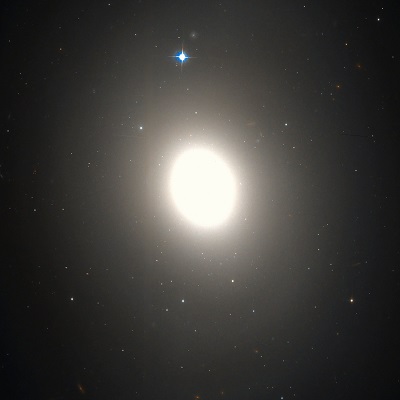
Messier 85 - M85 - Lenticular Galaxy (or Elliptical Galaxy)
M85 is a lenticular or elliptical galaxy located in Coma Berenices that's a member of the Virgo cluster of galaxies. At magnitude +9.5 and covering 7.1 x 5.5 arc minutes, it's similar in brightness and size to another Virgo cluster galaxy, M84. Spotting M85 with 7x50 or 10x50 binoculars is challenging and dark skies and good seeing conditions are a must. Small 80mm (3.1-inch) refractors, reveal a featureless ball of fuzz with a slightly brighter core. The view through amateur scopes in no way reflects the true nature of this distant object. It's a large galaxy that's located 60 million light-years away, making it one of the most remote objects in the Messier catalogue. Its actual diameter is 125,000 light-years and it's estimated to contain 400 billion stars. Long classified as a lenticular galaxy of type S0, recent observations have suggested M85 could be an elliptical galaxy of type E1.
Pierre Méchain discovered M85 on March 4, 1781. He reported the discovery to his friend Charles Messier, who subsequently catalogued it on March 18, 1781. On that night, Messier was very active. He discovered another seven galaxies, all of them Virgo Cluster members and also re-discovered bright globular cluster M92.
The main crux of the Virgo cluster lies about halfway along an imaginary line connecting Denebola (β Leo - mag. +2.1) with Vindemiatrix (ε Vir - mag. +2.8). Most of the group members can be found in this region of sky. However, M85 is located at the very northern edge of the cluster, some 6 degrees northwest of the group centre and one degree northeast of star 11 Comae Berenices (mag. +4.7).
It's best seen during the months of March, April and May.
Algol eclipse dates and times for August 2021
Algol (β Per) is a bright eclipsing binary system located in the northern constellation of Perseus and one of the best-known variable stars in the sky. Often referred to as the "Demon Star", most of the time it shines at mag. +2.1 but every two days, 20 hours and 49 minutes it suddenly dips in brightness to mag. +3.4, remaining dim for about 10 hours before returning to its original state.
Why the brightness change. The Algol system consists of at least three-stars (β Per A, β Per B and β Per C) with the orbital plane of Algol A and B directly in line with the Earth. The regular dips in brightness occur when the dimmer B star moves in front of and eclipses the brighter A star. There is also an extra dimension in that a secondary eclipse occurs when the brighter star occults the fainter secondary, resulting in a very small dip in brightness that can be detected with photo-electrical equipment.

Arcturus - Alpha Boötis - α Boo
Arcturus, mag. -0.04, is an orange giant that's usually regarded as the fourth brightest star in the night sky. However, it does have justifiable claims for third position since it's marginally brighter than both main components of the Alpha Centauri system. Arcturus is the brightest star in the northern section of the celestial hemisphere.
Arcturus is the stand out star in the large constellation of Boötes, the Herdsman or Plowman. A vague legend has it that the herdsman was placed in the heavens for successfully inventing the plough. The constellation's next brightest star, Izar (ε Boo), shines at magnitude +2.35 and is much fainter than Arcturus. As a bright night time star, Arcturus has been significant to observers since antiquity. It was mentioned in the Bible and featured on old Chinese maps with the name Dajido. In India, it was sometimes referred to as Nishtya or the Outcast, presumably because of its position in the sky far away from the zodiac and Milky Way band.

The name Arcturus derives from Arktouros, which means in ancient Greek the "Bear's Tail" or the "Keeper of the Bear". The name in Greek literature goes back to at least the time of Hesiod, who wrote about this star in his book "Works and Days." Despite being a beautiful star, Arcturus has not always been held in high regard. For example, seamen of ancient times regarded it as an unlucky omen.
More recently, Ptolemy called it "golden red" and curiously, in 1852, some well-respected astronomers observed a change in the star's colour, before it reverted back to normal a few years later. It's difficult to believe anything intrinsically had changed as Arcturus is not that type of star and it's more likely the "colour changes" were simply due to atmospheric effects.
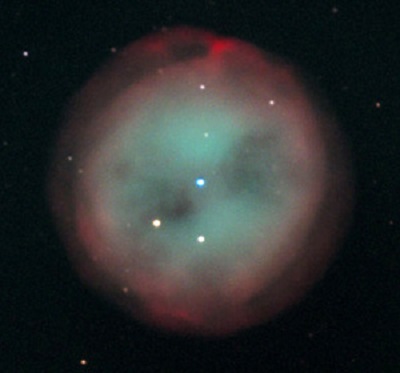
Messier 97 - M97 - The Owl Nebula (Planetary Nebula)
M97, also known as the Owl Nebula, is a famous planetary nebula located in the constellation of Ursa Major. It was discovered by Pierre Mechain on February 16, 1781 and is one of only four planetary nebulae listed in the Messier catalogue. Although not particularly bright at magnitude +9.9, it's a superb object and regarded as one of the most complex examples of its type. The name Owl Nebula was first coined in 1848 by William Parsons the 3rd Earl of Rosse, who noticed owl-like "eyes".
Locating M97 is easy as it's positioned only 2.5 degrees southeast of bright star Merak (β UMa - mag. +2.3). This is the southwest corner star of the bowl of the famous Plough or Big Dipper asterism of Ursa Major. In the same wide field telescope field of view, 50 arc minutes northwest of M97, is barred spiral galaxy M108 (mag. +10.2).
The Owl Nebula is best seen from Northern Hemisphere latitudes during the months of March, April and May. From latitudes north of 35N, it's circumpolar and therefore never sets.

Finder Chart for M97 - pdf format (credit:- freestarcharts)

Algol eclipse dates and times for July 2021
Algol (β Per) is a bright eclipsing binary system located in the northern constellation of Perseus and one of the best-known variable stars in the sky. Often referred to as the "Demon Star", most of the time it shines at mag. +2.1 but every two days, 20 hours and 49 minutes it suddenly dips in brightness to mag. +3.4, remaining dim for about 10 hours before returning to its original state.
Why the brightness change. The Algol system consists of at least three-stars (β Per A, β Per B and β Per C) with the orbital plane of Algol A and B directly in line with the Earth. The regular dips in brightness occur when the dimmer B star moves in front of and eclipses the brighter A star. There is also an extra dimension in that a secondary eclipse occurs when the brighter star occults the fainter secondary, resulting in a very small dip in brightness that can be detected with photo-electrical equipment.
Cassiopeia - Constellation Guide
Cassiopeia
Cassiopeiae
Cas
The Seated Queen
Introduction
Cassiopeia is a prominent northern constellation named after Queen Cassiopeia, the wife of King Cepheus of Ethiopia. In Greek mythology, the Queen was arrogant and extremely boastful about her beauty. Legend has it she claimed both her and her daughter, Andromeda, were more beautiful than all the Nereids the nymph-daughters of the sea god Nereus. This brought the wrath of the ruling god of the sea Poseidon who decided to destroy the kingdom.
After consulting a wise oracle, the only way the King and Queen could stop Poseidon from carrying out his threat was to scarify Andromeda. The princess was left helplessly chained to a rock at the sea edge, awaiting her fate at the hands of Cetus, the sea monster. However, just in time, the hero Perseus arrived to save Andromeda and in the process killed the sea monster. Although Andromeda lived to marry Perseus, Poseidon deemed that Cassiopeia should not escape punishment and banished her to the sky forever, tied to the chair of torture!
The constellation is one of the original 48 plotted by second century astronomer Ptolemy and remains as one of the 88 modern constellations. It's one of the most recognisable constellations due to the distinctive W shape of its five brightest stars. This asterism forms part of the chair and consists of γ Cas (mag.(v) +1.6 -> +3.0), Schedar (α Cas - mag. +2.24), Caph (β Cas - mag. +2.28), Ruchbah (δ Cas - mag. +2.66) and ε Cas (mag. +3.35). Variable star γ Cas can peak at magnitude +1.6 and when it does it's easily the brightest member but currently it hovers around magnitude +2.15.
Since located right bang at the centre of the rich northern Milky Way, Cassiopeia is full of wonderful deep-sky objects. It contains over a dozen bright open clusters visible in small scopes. In addition, there are some beautiful double stars and interesting variable stars. At Cassiopeia's southern end there are three faint galaxies, two of which are dwarfs and members of the M31 Group. For larger scopes there are four faint nebulae within range.
Algol eclipse dates and times for June 2021
Algol (β Per) is a bright eclipsing binary system located in the northern constellation of Perseus and one of the best-known variable stars in the sky. Often referred to as the "Demon Star", most of the time it shines at mag. +2.1 but every two days, 20 hours and 49 minutes it suddenly dips in brightness to mag. +3.4, remaining dim for about 10 hours before returning to its original state.
Why the brightness change. The Algol system consists of at least three-stars (β Per A, β Per B and β Per C) with the orbital plane of Algol A and B directly in line with the Earth. The regular dips in brightness occur when the dimmer B star moves in front of and eclipses the brighter A star. There is also an extra dimension in that a secondary eclipse occurs when the brighter star occults the fainter secondary, resulting in a very small dip in brightness that can be detected with photo-electrical equipment.
Messier 82 - M82 - Cigar Galaxy (Starburst Galaxy)
M82 is a superb irregular galaxy located in the constellation of Ursa Major. It has an apparent magnitude of +8.4 and is visible with binoculars. Separated by only 38 arc minutes from M82 is an even brighter and equally stunning galaxy, M81. However, they are very different objects. M81 (mag. +6.9) appears almost face-on, is of a grand spiral deign and therefore exhibits prominent near perfect and well defined spiral arms. On the other hand, M82 (mag. +8.4) is edge on, appears long and thin and is known as the Cigar galaxy. It's classified as the prototype starburst galaxy in which stars are forming at exceptionally high rates.
These two objects are the largest members of the Ursa Major or M81 group of galaxies, which at a distance of 11.7 million light-years is one of the closest groups of galaxies beyond the Local Group. Spatially, M81 and M82 are close and are physically separated by only about 150,000 light-years. When seen through binoculars and telescopes at low powers they form a striking pair.
Both M81 and M82 were discovered by Johann Elert Bode on December 31, 1774. Pierre Mechain then independently rediscovered them in August 1779. He reported his observations to Charles Messier, who added both galaxies to his catalogue on February 9, 1781. Finding M82 is not particularly difficult as the Plough asterism of Ursa Major can be used as a starting point. First focus on Dubhe (α UMa - mag. +1.8) the northwest corner star of the bowl. The M81 / M82 pair is located 10 degrees northwest of this star, with M82 positioned directly north of M81.
The galaxies are best seen from the Northern Hemisphere during the months of March, April and May. From locations north of +21 degrees they are circumpolar and always visible.