Guides / Star Charts
Contributions
If you like the website and want to contribute to the running costs then please do so below. All contributions are most welcome.
NGC 752 - Open Cluster
NGC 752 is a large sprawling open cluster in the constellation of Andromeda. With an apparent magnitude of +5.7 it's visible to the naked eye from a dark site, appearing as a large unresolved fuzzy patch of light. The cluster is one of the finest large open clusters in the sky and contains over 70 stars spread across a huge 1.25 degrees of apparent sky. Due to its size, NGC 752 is best observed with binoculars or wide field telescopes at low powers.
NGC 752 is located 5 degrees south and slightly west of outstanding double star Almach (γ And - mag. +2.1), the third brightest star in Andromeda. This cluster was discovered by Caroline Herschel on September 29, 1783 although it was probably observed sometime before 1654 by Italian astronomer Giovanni Battista Hodierna. Caroline's brother, William Herschel, subsequently added it to his catalogue a couple of years later.
NGC 752 is best seen from northern latitudes during the months of October, November and December. It's number 28 in the Caldwell catalogue.

Messier 47 - M47 - Open Cluster
M47 is a bright, loose naked eye, open cluster located in the Milky Way star fields of the constellation of Puppis. It was discovered by Giovanni Batista Hodierna before 1654 and independently by Charles Messier on February 19, 1771. The cluster is best seen from southern and equatorial latitudes during the months of December, January and February.
Finding M47 is quite easy, since Sirius (mag. -1.46), the brightest star in the night-time sky is near by. To do this, imagine a line connecting Mirzam (mag. +1.98) with Sirius and extend it for 14 degrees in a north-easterly direction to arrive at the cluster. Just over a degree to the southeast of M47, and in the same binocular field of view, is another Messier open cluster, M46. Both clusters have about the same apparent size (approx. 0.5 degrees) although M47 is noticeably brighter. A third Messier cluster in Puppis, M93, is located about 9 degrees south of the M46, M47 pair.

Messier 93 - M93 - Open Cluster
M93, mag. +6.0, is a bright large open cluster of about 80 stars located in the southern constellation of Puppis. It has an apparent diameter of 22 arc minutes, which is equivalent to about 2/3rds the apparent diameter of the full Moon. Under dark skies, M93 is visible to the naked eye appearing as a misty patch of light. This cluster is an easy binocular object and a wonderful sight in small telescopes where the brightest members form a distinct central triangle. It was one of the last deep sky objects discovered by Charles Messier, which he catalogued on March 20, 1781.
Finding M93 is not difficult. It's positioned in western Puppis a few degrees from the Canis Major border and not far from Sirius (α CMa), the brightest star in the night sky. Sirius can be found by connecting the three bright stars of Orion's belt and extending the line southwards. Positioned 8 degrees southeast of Sirius are Omicron1 CMa (ο1 CMa - mag. +3.9) and Omicron2 CMa (ο2 CMa - mag. +3.0). To locate M93, imagine a line connecting these two stars and then extend it eastwards and slightly southwards for about 10 degrees to reach the cluster.
It's best seen from southern latitudes during the months of December, January and February.

The Planets this Month - November 2017
Mercury
Mercury reaches greatest elongation on November 24th when it moves out to 22 degrees east of the Sun. This month offers an excellent opportunity for observers located at southern and tropical latitudes to spot the elusive planet, low down above the western horizon just after sunset. For example, from latitude 35S (approx. equal to Sydney, Cape Town and Santiago), Mercury shines at mag. -0.4 and appears 4 degrees above the horizon, 45 minutes after sunset on November 1st. By the 24th, it improves to 11 degrees altitude. The planet's brightness remains relatively constant throughout the month, except for the last few days when it fades slightly. From mid-latitude northern latitudes, Mercury is not well placed for observation but keen eyed observers may be able to spot the planet in evening twilight, low down above the western horizon around the time of elongation.
From about November 25th to the 30th, Saturn is positioned within four degrees of Mercury. At mag. +0.6, Saturn appears about 2.5 times fainter than its much closer Solar System neighbour. On November 20th, the thin waxing crescent Moon passing 7 degrees north of Mercury.
Uranus reaches opposition on October 19, 2017
Uranus, the seventh planet from the Sun, reaches opposition on October 19th. The distant "Ice Giant" shines at mag. +5.7 and is located in the constellation of Pisces. It's marginally bright enough to seen with the naked eye and easy to spot with binoculars and small scopes.

Uranus is positioned close to the Aries constellation border. It's about 15 degrees south and 30 degrees east of the centre of the Great Square of Pegasus and a couple of degrees west and slightly north of omicron Piscium (ο Psc - mag. +4.3). Further to the northeast is Taurus, which contains first magnitude orange star Aldebaran and naked eye open clusters, the Pleiades and Hyades.
Uranus is visible all night during October. It rises above the eastern horizon around sunset, reaching its highest point in the sky at midnight, and then sets in the west as the Sun reappears. At opposition, the planet is approx. 18.915 AU (2,829.6 million kilometres or 1,758.3 million miles) from the Earth. With an apparent diameter of 3.7 arc seconds, small telescopes at medium to high powers will reveal a small bluish-green disk. However, when viewed through even the largest of amateur scopes, it's difficult to spot much detail.
IC 59 and IC 63 - Reflection and Emission Nebulae
IC 59 and IC 63 are faint reflection and emission nebula located in the northern constellation of Cassiopeia. They are challenging objects to spot with telescopes for a number of reasons. Both nebulae are faint at apparent mag. +10, they have extremely low surface brightness and surround bright variable star gamma Cas (γ Cas). This remarkable star is partly unstable and is known as a "shell star". It currently shines at mag. +2.15, making it the brightest star in Cassiopeia.
IC 59 and IC 63 are 610 light-years distant. From our perspective, IC 59 is located on the northern side of gamma Cas and IC 63 to the northeast. Spatially the nebulae are roughly 3 light-years from gamma Cas, although IC 63 is slightly closer to the star. As a result, it's appears mostly red due to a dominance of H-alpha emission, whereas IC 59 exhibits much less H-alpha emission and appears mostly blue due to dust reflected starlight.
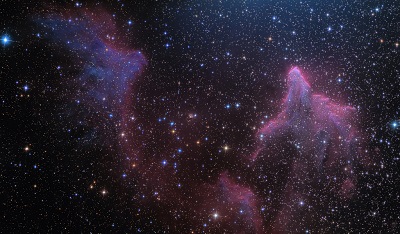

Finder Chart for IC 59 and IC 63 - pdf format (credit:- freestarcharts)
NGC 6946 - Fireworks Galaxy - Spiral Galaxy
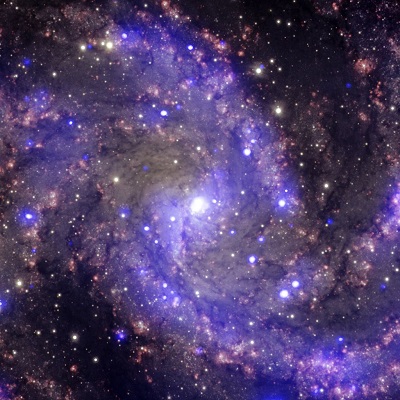
NGC 6946, also known as the Fireworks Galaxy, is a 9th magnitude face-on spiral galaxy positioned on the border between Cepheus and Cygnus. At 22.5 Million light-years it's one of the nearest galaxies outside of the Local Group. In the past 100 years, 9 supernovae have been observed in NGC 6946, hence the nickname the Fireworks Galaxy.
NGC 6946 was discovered by William Herschel on September 9, 1798. It's best seen from northern locations during the months of October, November and December. From latitudes greater than +30N the galaxy is circumpolar. However, from southern locations it appears low down or never even rises at all.
The Planets this Month - October 2017
Mercury
Mercury reaches superior conjunction on the far side of the Sun on October 8th. From northern locations, the planet is not visible this month but may be seen just after sunset towards the end of month from southern latitudes, close to the west-northwestern horizon.
On October 29th, Mercury reaches aphelion when it's 0.467 AU (approx. 69.9 million kilometres or 43.4 million miles) from the Sun.
Venus
Venus, mag. -3.9, continues to move back towards the Sun but remains a morning object for most of October. From northern temperate locations, the brilliant planet can be seen low down above the eastern horizon just before sunrise, although by month's end observers may have difficulty spotting it against the bright twilight. Venus can also be seen from southern locations, but with a reduced visibility period.
On October 3rd, Venus reaches perihelion when it's 0.718 AU (approx. 107 million kilometres or 66.7 million miles) from the Sun. A close conjunction occurs on October 5th when Venus and Mars are separated by only 1/5 of a degree. At mag. +1.8, Mars appears almost 200x fainter than Venus and binoculars will help to spot it. On the mornings of October 17th and 18th, the thin waning crescent Moon appears near the two planets creating pleasant viewing.
NGC 40 - Bow Tie Nebula - Planetary Nebula
NGC 40, mag. +10.7, is a planetary nebula located in the northern constellation of Cepheus. It was discovered by William Herschel on November 25, 1788. He described it as "a 9th magnitude star, surrounded with milky nebulosity". Herschel used his 475mm (18.7-inch) telescope to make the discovery, but today's amateur astronomers don't require such a large instrument and it can be glimpsed with just a 100mm (4-inch) refractor. NGC 40 is also known as the Bow Tie nebula, a nickname it shares with another planetary nebula, NGC 2440 in Puppis. It's listed as number 2 in the Caldwell catalogue.
NGC 40 is located just over 17 degrees from the North Celestial Pole and is therefore circumpolar from most northern latitudes. It's one of the finest examples of its type in the far northern section of sky. The best time to look for the nebula is during October, November and December when it appears high in the sky during early evening. The Bow Tie nebula is also visible, although lower down, from most tropical latitudes. However, from southern temperate locations it never rises above the horizon.
Finding NGC 40 can be tricky as it's positioned in a star poor region of eastern Cepheus. One method is to imagine a line connecting Errai (γ Cep - mag. +3.21) with γ Cassiopeiae (mag. +2.15). The planetary lies approximately one-third of the way along this line.