Guides / Star Charts
Contributions
If you like the website and want to contribute to the running costs then please do so below. All contributions are most welcome.
Algol eclipse dates and times for September 2022
Algol (β Per) is a bright eclipsing binary system located in the northern constellation of Perseus and one of the best-known variable stars in the sky. Often referred to as the "Demon Star", most of the time it shines at mag. +2.1 but every two days, 20 hours and 49 minutes it suddenly dips in brightness to mag. +3.4, remaining dim for about 10 hours before returning to its original state.
Why the brightness change. The Algol system consists of at least three-stars (β Per A, β Per B and β Per C) with the orbital plane of Algol A and B directly in line with the Earth. The regular dips in brightness occur when the dimmer B star moves in front of and eclipses the brighter A star. There is also an extra dimension in that a secondary eclipse occurs when the brighter star occults the fainter secondary, resulting in a very small dip in brightness that can be detected with photo-electrical equipment.

Algol eclipse dates and times for August 2022
Algol (β Per) is a bright eclipsing binary system located in the northern constellation of Perseus and one of the best-known variable stars in the sky. Often referred to as the "Demon Star", most of the time it shines at mag. +2.1 but every two days, 20 hours and 49 minutes it suddenly dips in brightness to mag. +3.4, remaining dim for about 10 hours before returning to its original state.
Why the brightness change. The Algol system consists of at least three-stars (β Per A, β Per B and β Per C) with the orbital plane of Algol A and B directly in line with the Earth. The regular dips in brightness occur when the dimmer B star moves in front of and eclipses the brighter A star. There is also an extra dimension in that a secondary eclipse occurs when the brighter star occults the fainter secondary, resulting in a very small dip in brightness that can be detected with photo-electrical equipment.
Messier 25 - M25 - Open Cluster
M25 is a bright, mag. +4.6, naked eye open cluster in Sagittarius that's a wonderful sight in binoculars and small telescopes. It was discovered by Philippe Loys de Chéseaux in 1745 and subsequently catalogued by Charles Messier on June 20, 1764. There is however an unusual twist to the history of M25. For such a bright cluster it's reasonable to assume that it would have been included by John Herschel in his comprehensive 19th century General Catalogue. For unknown reasons it wasn't. This is despite the cluster been catalogued by Johann Elert Bode in 1777, observed by William Herschel in 1783 and described by Admiral Smyth in 1836. M25 was finally included in 1908, by J.L.E. Dreyer, in the supplementary Index Catalogue (as IC 4725).
Finding M25 is relatively easy. It's positioned 6.5 degrees north and a little east of the top star of the bright teapot asterism of Sagittarius, Kaus Borealis (λ Sgr - mag. +2.8). Only 3.5 degrees west of M25 is M24, the large Sagittarius Star Cloud.
The cluster is best seen from southern and equatorial regions during the months of June, July and August. For mid-latitude Northern Hemisphere observers, it appears low down during the summer months.

Messier 24 - M24 - Small Sagittarius Star Cloud
M24, also known as the Small Sagittarius Star Cloud, is a large naked eye expanse of stars, clusters, nebulosity and other objects located in Sagittarius. At mag. +2.5 and covering 1.5 degrees of sky, it's visible to the naked eye as a large detached part of the Milky Way. The object is a fantastic sight in binoculars and small telescopes. It's claimed that M24 has the densest concentration of individual stars visible, around a thousand, in a single binocular field of view. It should not be confused with the nearby Large Sagittarius Star Cloud which lies about ten degrees to the south.
The Small Sagittarius Star Cloud is not a true deep sky object but results from a rare alignment between the Earth and the centre of our galaxy. We would expect this region to be packed with interstellar dust, however by chance we are looking through a gap in the dust. As a result, many thousands of distant stars, clusters and nebulae are visible that would otherwise be obscured. Spatially, M24 covers a volume up to 16,000 light-years deep.
M24 can be found 7 degrees north and a little west of the top star of the bright teapot asterism, Kaus Borealis (λ Sgr - mag. +2.8). Positioned north of M24 is open cluster M18 and the Omega Nebula (M17). All three objects are visible in the same binocular field of view. Open clusters M23 and M25 are located a few degrees west and east of M24 respectively.
M24 was discovered by Charles Messier on June 20, 1764. It's best seen from southern or equatorial latitudes during the months of June, July and August.


Algol eclipse dates and times for June 2022
Algol (β Per) is a bright eclipsing binary system located in the northern constellation of Perseus and one of the best-known variable stars in the sky. Often referred to as the "Demon Star", most of the time it shines at mag. +2.1 but every two days, 20 hours and 49 minutes it suddenly dips in brightness to mag. +3.4, remaining dim for about 10 hours before returning to its original state.
Why the brightness change. The Algol system consists of at least three-stars (β Per A, β Per B and β Per C) with the orbital plane of Algol A and B directly in line with the Earth. The regular dips in brightness occur when the dimmer B star moves in front of and eclipses the brighter A star. There is also an extra dimension in that a secondary eclipse occurs when the brighter star occults the fainter secondary, resulting in a very small dip in brightness that can be detected with photo-electrical equipment.
Messier 44 - M44 - The Praesepe (Open Cluster)
M44, also known as the Praesepe or Beehive cluster, is a sprawling open cluster. It's the brightest and most prominent deep sky object in the constellation of Cancer. Visible to the naked eye under dark skies, the cluster appears like a large misty cloud covering over 1.5 degrees of sky. The brightness and size of M44 results from its close proximity to Earth; it lies a mere 577 light-years distant. Only the Hyades (at 153 light-years), Coma cluster (280 light-years), the Pleiades (M45) (425 light-years), Southern Pleiades (480 light-years) and IC 2391 (500 light-years) are nearer. Consequently, M44 is one of the brightest and largest objects of its type in the night sky.
The constellation of Cancer is a faint zodiac constellation that's bordered by much brighter Leo to the east and Gemini to the west. To the north is faint Lynx, with Canis Minor and Hydra located on the southern side. At the heart of Cancer is a grouping of four faint stars. They are Asellus Australis (δ Cnc - mag. +3.9), Asellus Borealis (γ Cnc - mag. +4.7), η Cnc (mag. +5.3) and θ Cnc (mag. +5.3). Of these, the brighter two are relatively easy naked eye objects, the fainter ones more difficult. Positioned at the centre of this grouping is M44. An alternative method of locating M44 is to imagine a line extending in a southeastern direction from Pollux (β Gem - mag. +1.1) for 37 degrees to Regulus (α Leo - mag. +1.4). M44 is positioned approximately at the mid-point of this line.
Algol eclipse dates and times for July 2022
Algol (β Per) is a bright eclipsing binary system located in the northern constellation of Perseus and one of the best-known variable stars in the sky. Often referred to as the "Demon Star", most of the time it shines at mag. +2.1 but every two days, 20 hours and 49 minutes it suddenly dips in brightness to mag. +3.4, remaining dim for about 10 hours before returning to its original state.
Why the brightness change. The Algol system consists of at least three-stars (β Per A, β Per B and β Per C) with the orbital plane of Algol A and B directly in line with the Earth. The regular dips in brightness occur when the dimmer B star moves in front of and eclipses the brighter A star. There is also an extra dimension in that a secondary eclipse occurs when the brighter star occults the fainter secondary, resulting in a very small dip in brightness that can be detected with photo-electrical equipment.
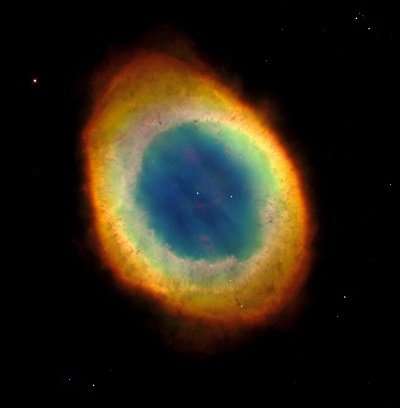
Messier 57 - M57 - The Ring Nebula (Planetary Nebula)
M57, the Ring Nebula, is a showpiece planetary nebula located in the constellation of Lyra. It's probably the most well-known, studied and photographed object of its kind and a perennial favourite with amateur astronomers. The nebula is relatively bright at magnitude +8.8 and easy to locate. It can be found about 40% the way along an imaginary line connecting stars, Sheliak (β Lyr - mag. +3.5) and Sulafat (γ Lyr - mag. +3.2). For Northern Hemisphere observers, it appears high in the sky during the warm summer months although from southern latitudes it appears much lower down.
M57 was discovered by Antoine Darquier de Pellepoix in January 1779.
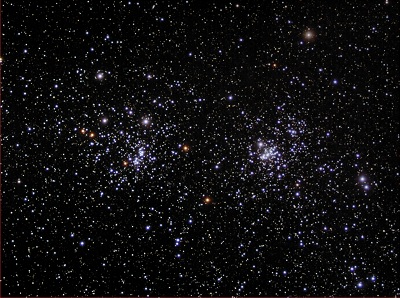
NGC 869 and NGC 884 - The Double Cluster - Open Clusters
NGC 869 and NGC 884 are two bright open clusters in the constellation of Perseus, that are separated by only half a degree of apparent sky. Together they are commonly known as the "Double Cluster" and form a famous showpiece object, that's easily visible to the naked eye and a wonderful sight in binoculars and telescopes. Both clusters have been known since antiquity and probably pre-historically. Greek astronomer Hipparchus first catalogued them around 130 B.C, with early celestial cartographers naming them as "h Persei" (NGC 869) and "χ Persei" (NGC 884).
The Double Cluster is located in the far northwestern part of Perseus, close to the border with Cassiopeia. With a declination of 57N, it's circumpolar from many northern locations and therefore never sets. To locate the object, draw an imaginary line from Mirfak (α Per - mag +1.8) in a northwesterly direction towards the centre of the "W" of Cassiopeia. The Double Cluster lies just over halfway along this line.
It's listed as number 14 in the Caldwell catalogue.

Finder Chart for NGC 869 and NGC 884 The Double Cluster - pdf format (credit:- freestarcharts)