Guides / Star Charts
Contributions
If you like the website and want to contribute to the running costs then please do so below. All contributions are most welcome.
NGC 2419 - The Intergalactic Tramp - Globular Cluster
Lynx is home to the fascinating globular cluster, NGC 2419. Although visually small and faint what makes it special is its distance, at 275,000 light-years it's one of the furthest known Milky Way globulars. In fact, twentieth century American astronomer Harlow Shapley nicknamed it "The Intergalactic Tramp", believing it to have broken possibly away from the Milky Way and headed off into deep intergalactic space. However, recent observations indicate Shapley hypothesis was incorrect and NGC 2419 is still gravitationally bound to the Milky Way, just moving in a highly eccentric orbit.
NGC 2419 or Caldwell 25 was discovered by William Herschel on December 31, 1788. It's located 275,000 light-years from the Solar System and about 300,000 light-years from the galactic centre, which is almost twice as far as the Large Magellanic Cloud. At such a distance, it's estimated NGC 2419 will take about 3 billion years to complete a single orbit around the centre of the galaxy.
NGC 2419 is positioned 7 degrees north and slightly east of the second brightest star in Gemini, Castor (α Gem - mag. +1.58). About 4 arc minutes west of NGC 2419 is a mag. +7.2 star with a double star of mag. +7.9 a few more arc minutes further west. Even Herschel with his super telescopes of the time, couldn't resolve NGC 2419 into stars. William Parsons, the 3rd Earl of Rosse, using his 72-inch (1.83 m) reflecting telescope at Birr Castle in Ireland - the largest optical telescope in the world at the time - was first the first to do so in 1850.

IC 2497 and Hanny's Voorwerp
IC 2497 is a spiral galaxy located about 650 million light-years distant in the small northern constellation of Leo Minor. Although similar in size to our Milky Way, it appears very small and faint due to its vast distance from us. At magnitude +15.8, this galaxy is beyond the reach of most amateur backyard scopes and seemingly just one of the many thousands of faint galaxies populating the night sky. However, a few years ago IC 2497 made international news not because of the galaxy itself, but due to a new strangle object that was discovered next to it - Hanny's Voorwerp.
Hanny's Voorwerp
In 2007, Dutch school teacher Hanny van Arkel signed up to the newly created on-line citizen science project Galaxy Zoo. The project enlisted help from the public to classify vast numbers of galaxies based on their physical appearance. The original dataset used was obtained from the Sloan Digital Sky Survey and contained almost 1 million galaxies. With so many galaxies it was thought that the analysis would take years, but the organisers were in for a pleasant surprise - within 24 hours the website was receiving almost 70,000 classifications an hour and the site even crashed temporarily due to intense traffic.
Epsilon Lyrae - ε Lyr - The Double Double
Of all known multiple star systems consisting of at least three stars, probably the finest and most celebrated of all is Epsilon Lyrae (ε Lyr). This system, also known as the "Double Double" offers something for everyone from naked-eye observers to those with large telescopes.

Epsilon Lyrae is located in the constellation of Lyra, close to bright star, Vega (mag. 0.0). For Northern Hemisphere observers, Vega appears high in the sky during the summer months. Epsilon Lyrae is positioned about 1.5 degrees northeast of this star. At first glance, mag. +3.9, Epsilon Lyrae doesn't appear very remarkable. However, on further inspection you may notice a close double star of two almost identical white components. This pair of stars, named Epsilon1 Lyrae and Epsilon2 Lyrae, have a separation of 208 arc seconds with a position angle of 172 degrees. It's often said if you can split the famous Mizar / Alcor pair in Ursa Major with the naked eye then you have good eyesight. With a separation of 708 arc seconds the Mizar / Alcor pair is a piece of cake to split compared to the much tighter Epsilon1 / Epsilon2 Lyrae pair. Split the latter and you need not worry, your eyesight is of the highest order.
NGC 1275 - Perseus A - Seyfert Galaxy
NGC 1275, also known as Perseus A, is a Seyfert galaxy in the constellation Perseus. It's lies at the centre of the Perseus cluster of galaxies (Abell 426) and is the group's dominant member. At 230 million light-years distant, it's way beyond the Local Group but can be spotted in medium size backyard scopes under dark skies and good seeing conditions. This galaxy shines at apparent mag. +11.7.
NGC 1275 is a strong radio and X-ray source that produces peculiar emission lines in its nucleus. It's listed as entry 3C 84 in the 3rd Cambridge Catalogue of Radio Sources and Carl Seyfert include it in his original list of active galaxies. NGC 1275 is actually a complex system consisting of a main galaxy and a high velocity system (HVS). Tidal interactions between the two objects result in large amounts of dust disruption, gas stripping and star formation. In addition, tidal forces send existing gas and dust swirling into the supermassive black hole at centre of the main galaxy, resulting in the powerful X-ray and radio wave emissions.
NGC 1275 was discovered by William Herschel on October 17, 1786.

Messier 30 - M30 - Globular Cluster
M30 (mag. +7.4) is a dense globular cluster in the southern constellation of Capricornus. Located 26,100 light-years from Earth, it's visible in binoculars appearing as a slightly elongated smudge of light. M30 is unusual in that it orbits the galaxy in the opposite direction (retrograde) to most other globulars, suggesting that it was acquired from a satellite galaxy rather than forming within the Milky Way. It's best seen during July, August and September from tropical and Southern Hemisphere locations.
The globular was discovered by Charles Messier on August 3, 1764, who noted it as "a round nebula without stars". It was later described in John L. E. Dreyer's New General Catalogue (NGC) as a "remarkable globular, bright, large, slightly oval." Since it's located in the dim constellation of Capricornus, M30 is one of the more challenging Messier objects to locate. This is especially true for Northern Hemisphere based observers, where the cluster never climbs very high above the southern horizon.
Capricornus is the second faintest zodiac constellation after Cancer. It's positioned to the east of Sagittarius, south of Aquarius and southeast of Aquila. A good starting point to find M30 is the brightest star in the constellation, Deneb Algiedi (δ Cap - mag. +2.9). Next move about 7 degrees southwest to arrive at stars 36 Cap (mag. +4.5) and zeta Cap (ζ Cap - mag. +3.8). Located just over 3 degrees southeast of this pair is M30. Right next to M30 on the eastern side is mag. +5.2 star 41 Cap, which acts as a good marker.

NGC 6882 / NGC 6885 - Open Cluster
NGC 6882/6885 is an open cluster in the faint constellation of Vulpecula that can just about be seen with the naked eye, is easy with binoculars and has up to 40 stars visible through telescopes. This object has somewhat of a confusing history. In September 1784, William Herschel discovered two open clusters, NGC 6882 and NGC 6885. He subsequently catalogued them, but with virtually identical descriptions. Since no cluster exists that matches the location and description of NGC 6882, many astronomers believe that Herschel made a mistake and simply repeated his observation. However, the story doesn't end here. Adding to the confusion is a fainter, smaller and less rich cluster, Collinder 416, that's positioned at the northwestern edge of NGC 6885. Some astronomers believe this to be NGC 6882.
NGC 6882/6885 is grouped around the brightest member star, 20 Vul (mag. +5.9). Located 1.5 degrees northeast of NGC 6882/6885 is 23 Vul, which at magnitude +4.5 is the second brightest star in the constellation. Positioned 9 degrees west-northwest of the cluster is the beautiful double star Albireo (mag. +2.9) in Cygnus.


Finder Chart for NGC 6882 / NGC 6885 - pdf format (credit:- freestarcharts)
Messier 29 - M29 - Open Cluster
M29 is a binocular and telescope open cluster that's situated in the highly crowded Milky Way region of Cygnus. The cluster isn't particularly impressive in terms of brightness, number of stars and compactness but certainly worth a look due to its location and unusual shape. It appears like a squashed dipper that loosely resembles the main stars of Ursa Major. Adding to the view is a stunning backdrop of literally thousands of distant Milky Way stars.
M29 was one of Charles Messier original discoveries, which he catalogued on July 29, 1764. He described it as "a cluster of 7 or 8 very small stars below Gamma Cygni". What is surprising in such a rich constellation is that Messier recorded only two deep sky objects, the other being open cluster M39.

Messier 11 - M11 - The Wild Duck Cluster (Open Cluster)
M11, also known as the Wild Duck Cluster, is a famous open cluster located in the constellation of Scutum. It's just beyond naked eye visibility but easily visible with binoculars and an outstanding telescope object. The brightest stars form a triangle that has been likened to a flock of flying ducks, hence the name Wild Duck Cluster. Of all know open clusters, M11 is one of the richest and most compact with about 2,900 members spread over a diameter of 25 light-years.
M11 was discovered by German astronomer Gottfried Kirch of the Berlin observatory in 1681. English clergyman William Derham is believed to have been the first person to resolve it into stars (around 1733), with Charles Messier adding it to his catalogue on May 30, 1764. The name the Wild Duck Cluster was provided by British Admiral William Smyth, who imagined the distinct V shape of the cluster as a flock of flying ducks.
The cluster is an easy target to find despite been located in the small and dim constellation of Scutum, whose brightest stars are of only 4th magnitude. The starting point on the way to the Wild Duck Cluster is to locate Altair (α Aql - mag. 0.8), the brightest star in Aquila and 12th brightest in the night sky. Altair forms the southern corner of the famous Summer triangle along with first magnitude stars, Vega in Lyra and Deneb in Cygnus.
To the southwest of Altair is mag. 3.4 star delta Aql (δ Aql). First imagine a line connecting Altair with δ Aql and then curve this line southwards for about the same distance again until you reach two 4th magnitude stars, λ Aql and 12 Aql. Located just over two degrees west of 12 Aql is the Wild Duck cluster.


Algol eclipse dates and times for August 2019
Algol (β Per) is a bright eclipsing binary system located in the northern constellation of Perseus and one of the best-known variable stars in the sky. Often referred to as the "Demon Star", most of the time it shines at mag. +2.1 but every two days, 20 hours and 49 minutes it suddenly dips in brightness to mag. +3.4, remaining dim for about 10 hours before returning to its original state.
Why the brightness change. The Algol system consists of at least three-stars (β Per A, β Per B and β Per C) with the orbital plane of Algol A and B directly in line with the Earth. The regular dips in brightness occur when the dimmer B star moves in front of and eclipses the brighter A star. There is also an extra dimension in that a secondary eclipse occurs when the brighter star occults the fainter secondary, resulting in a very small dip in brightness that can be detected with photo-electrical equipment.

Algol is located in Perseus among the stars of the northern Milky Way. It's positioned west of mag. +0.1 Capella (α Aur) and southeast of the well known "W" of Cassiopeia. The finder chart below shows the position of Algol along with magnitude data of some surrounding stars for comparative purposes.
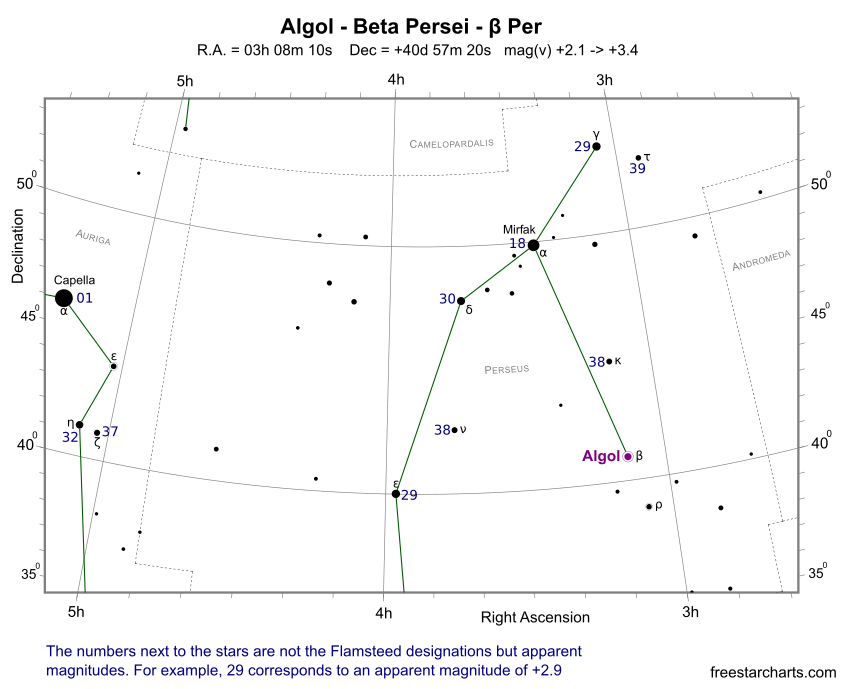
Finder Chart for Algol - pdf format (credit:- freestarcharts.com)