Guides / Star Charts
Contributions
If you like the website and want to contribute to the running costs then please do so below. All contributions are most welcome.
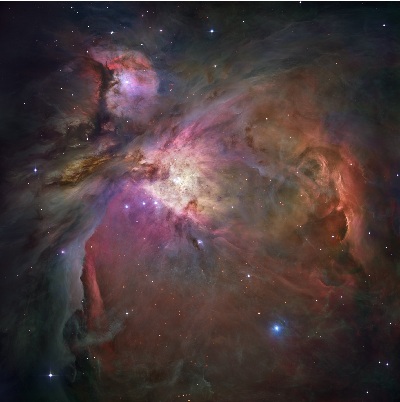
M42, also known as the Great Orion Nebula or Orion Nebula, is the prime deep sky attraction in the constellation of Orion and a showpiece deep sky object. With an apparent magnitude of +4.0, it's easily visible to the naked eye. This emission / reflection nebula and star forming region spans more than a degree of sky and is therefore one of the largest and brightest objects of its type.
Orion is a prominent constellation and one of the most recognizable and familiar sights. Located on the celestial equator, it's visible throughout the World and best seen during the months of December, January and February. The constellation is filled with bright stars, including first magnitude Rigel and Betelgeuse plus a further five second magnitude stars. Three of the second magnitude stars (Mintaka, Alnilam and Alnitak) form the famous belt of Orion. Positioned just 5 degrees south of the belt is the Orion Nebula itself, which is part of the Hunters Sword.

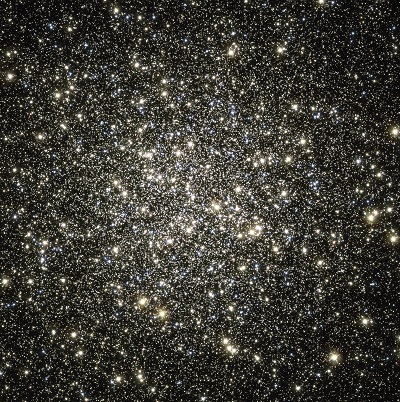
M92, mag. +6.4, is a bright globular cluster located in the northern part of the constellation of Hercules. Despite being almost visible to the naked eye, it's often overlooked due to its close proximity to more spectacular, M13.
M92 is one of the original discoveries of Johann Elert Bode who found it on December 27, 1777. He described it as "a nebula that's more or less round with a pale glow". Charles Messier independently rediscovered it and catalogued it on March 18, 1781. Incidentally, this proved to be Messier's most productive night, during which he discovered another 8 objects all of them Virgo Cluster galaxies (M84 to M91). As with many globulars, it was William Herschel who first resolved it into stars. To date, only about 16 variables have been discovered in M92 of which 14 are of the RR Lyrae type, and one is a rare globular eclipsing W Ursae Majoris type binary.

M13 is a spectacular globular cluster and the best example of its type in the northern section of sky. It's the standout deep sky object in the constellation of Hercules and is sometimes referred to as the Great Hercules Globular Cluster. At mag. +5.8, it's just about visible to the naked eye and an easy binocular target. The popularity of M13 is mainly due to its declination; it lies at 36N and from northern temperate latitudes is well placed high in the sky during summer months. There are many other globulars larger and brighter than M13, but all are located in the southern section of the sky. As a result, they either never rise or appear low down from most North America, European and Asian locations. Hence, M13 is perhaps the most observed and studied globular cluster of all.
M13 was discovered by the Astronomer Royal, Sir Edmond Halley in 1714. He described it as "a little patch, but shews itself to the naked eye, when the sky is serene and the Moon is absent". Fifty years later, Charles Messier catalogued it on June 1, 1764.
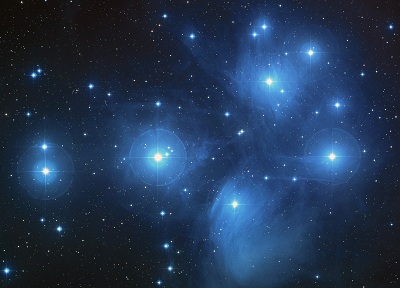
M45, commonly known as the Pleiades or Seven Sisters, is the finest open cluster in the sky. It's a breathtaking site, known since antiquity and easily visible to the naked eye. Located in the large and prominent zodiac constellation of Taurus, this showpiece object is best seen during the Northern Hemisphere Winter and the Southern Hemisphere Summer months.
Finding M45 is easy. The cluster is positioned about 14 degrees northwest of orange giant star Aldebaran (mag. +0.9), the brightest star in Taurus. At first glance with the naked eye, it's obvious that something is special about this small section of sky. On closer inspection, M45 reveals itself to be a beautiful cluster of about half a dozen white stars, covering an area much greater than that of the full Moon. At the heart of the cluster is a set of stars that form a small dipper shape, similar to the brightest stars of Ursa Major. Even under light polluted skies the dipper shape is readily visible. From dark sites, the Pleiades is an outstanding naked eye object. The main stars appear bright and striking, with up to 10 or more visible under ideal conditions.

M25 is a bright, mag. +4.6, naked eye open cluster in Sagittarius that's a wonderful sight in binoculars and small telescopes. It was discovered by Philippe Loys de Chéseaux in 1745 and subsequently catalogued by Charles Messier on June 20, 1764. There is however an unusual twist to the history of M25. For such a bright cluster it's reasonable to assume that it would have been included by John Herschel in his comprehensive 19th century General Catalogue. For unknown reasons it wasn't. This is despite the cluster been catalogued by Johann Elert Bode in 1777, observed by William Herschel in 1783 and described by Admiral Smyth in 1836. M25 was finally included in 1908, by J.L.E. Dreyer, in the supplementary Index Catalogue (as IC 4725).
Finding M25 is relatively easy. It's positioned 6.5 degrees north and a little east of the top star of the bright teapot asterism of Sagittarius, Kaus Borealis (λ Sgr - mag. +2.8). Only 3.5 degrees west of M25 is M24, the large Sagittarius Star Cloud.
The cluster is best seen from southern and equatorial regions during the months of June, July and August. For mid-latitude Northern Hemisphere observers, it appears low down during the summer months.

M24, also known as the Small Sagittarius Star Cloud, is a large naked eye expanse of stars, clusters, nebulosity and other objects located in Sagittarius. At mag. +2.5 and covering 1.5 degrees of sky, it's visible to the naked eye as a large detached part of the Milky Way. The object is a fantastic sight in binoculars and small telescopes. It's claimed that M24 has the densest concentration of individual stars visible, around a thousand, in a single binocular field of view. It should not be confused with the nearby Large Sagittarius Star Cloud which lies about ten degrees to the south.
The Small Sagittarius Star Cloud is not a true deep sky object but results from a rare alignment between the Earth and the centre of our galaxy. We would expect this region to be packed with interstellar dust, however by chance we are looking through a gap in the dust. As a result, many thousands of distant stars, clusters and nebulae are visible that would otherwise be obscured. Spatially, M24 covers a volume up to 16,000 light-years deep.
M24 can be found 7 degrees north and a little west of the top star of the bright teapot asterism, Kaus Borealis (λ Sgr - mag. +2.8). Positioned north of M24 is open cluster M18 and the Omega Nebula (M17). All three objects are visible in the same binocular field of view. Open clusters M23 and M25 are located a few degrees west and east of M24 respectively.
M24 was discovered by Charles Messier on June 20, 1764. It's best seen from southern or equatorial latitudes during the months of June, July and August.


M44, also known as the Praesepe or Beehive cluster, is a sprawling open cluster. It's the brightest and most prominent deep sky object in the constellation of Cancer. Visible to the naked eye under dark skies, the cluster appears like a large misty cloud covering over 1.5 degrees of sky. The brightness and size of M44 results from its close proximity to Earth; it lies a mere 577 light-years distant. Only the Hyades (at 153 light-years), Coma cluster (280 light-years), the Pleiades (M45) (425 light-years), Southern Pleiades (480 light-years) and IC 2391 (500 light-years) are nearer. Consequently, M44 is one of the brightest and largest objects of its type in the night sky.
The constellation of Cancer is a faint zodiac constellation that's bordered by much brighter Leo to the east and Gemini to the west. To the north is faint Lynx, with Canis Minor and Hydra located on the southern side. At the heart of Cancer is a grouping of four faint stars. They are Asellus Australis (δ Cnc - mag. +3.9), Asellus Borealis (γ Cnc - mag. +4.7), η Cnc (mag. +5.3) and θ Cnc (mag. +5.3). Of these, the brighter two are relatively easy naked eye objects, the fainter ones more difficult. Positioned at the centre of this grouping is M44. An alternative method of locating M44 is to imagine a line extending in a southeastern direction from Pollux (β Gem - mag. +1.1) for 37 degrees to Regulus (α Leo - mag. +1.4). M44 is positioned approximately at the mid-point of this line.
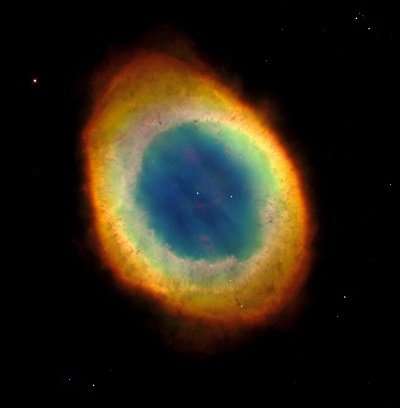
M57, the Ring Nebula, is a showpiece planetary nebula located in the constellation of Lyra. It's probably the most well-known, studied and photographed object of its kind and a perennial favourite with amateur astronomers. The nebula is relatively bright at magnitude +8.8 and easy to locate. It can be found about 40% the way along an imaginary line connecting stars, Sheliak (β Lyr - mag. +3.5) and Sulafat (γ Lyr - mag. +3.2). For Northern Hemisphere observers, it appears high in the sky during the warm summer months although from southern latitudes it appears much lower down.
M57 was discovered by Antoine Darquier de Pellepoix in January 1779.
Messier 67 is a very old open cluster located in the constellation of Cancer. Estimations of its age vary between 3.2 and 5 billion years, with recent valuations putting it at 4 billion. This makes it one of the oldest known open clusters. As a consequence, M67 contains a variety of stellar types including many Sun like stars, red giants and white dwarfs. It's easily the most ancient Messier open cluster. For comparison, the Praesepe (M44) is 600 million years old and the brilliant Pleiades (M45) a very youthful 100 million years.
The constellation of Cancer is a faint zodiac constellation that's bordered by much brighter Leo to the east and Gemini to the west. To the north lies Lynx, with Canis Minor and Hydra positioned on the southern side. To find M67, first locate stars Asellus Australis (δ Cnc - mag. +3.9), Asellus Borealis (γ Cnc - mag. +4.7), η Cnc (mag. +5.3) and θ Cnc (mag. +5.3). This quadrangle forms the main part of the constellation and located at its centre is M44. Next focus on another faint star, α Cnc (mag. +4.3), which is positioned 9 degrees further to the southeast. M67 is positioned 1.75 degrees west of this star.
M67 was discovered sometime before 1779 by German astronomer Johann Gottfried Koehler. He described it as being rather conspicuous and nebula like, although with his basic telescope he was unable to resolve any stars. Charles Messier then independently rediscovered M67, resolved it into stars and catalogued it on April 6, 1780. He noted it as a "cluster of small stars with nebulosity, below the southern claw of Cancer. The position determined from the star Alpha [Cancri].".
M67 is best seen from the Northern Hemisphere during the months of February, March and April.
