Mercury
Mercury remains visible in the early evening sky during the first part of August. From southern and tropical locations, the elusive planet can be seen low down towards the west-northwest horizon just after sunset. At the beginning of the month it shines at magnitude +0.4 and sets a couple of hours after sunset. By the second week, Mercury will be increasingly difficult to spot as it battles against the bright evening twilight. From mid-latitude northern temperate locations, the planet isn't well placed but can be spotted hugging the western horizon for a few days at the start of month.
On August 2nd, Mercury reaches aphelion when it's 0.467 AU (approx. 69.9 million kilometres or 43.4 million miles) from the Sun. On August 26th, the planet passes through inferior conjunction.
Venus
Venus continues as a brilliant early morning object throughout August. The planet rises around 3 hours before sunrise from northern temperate locations, although considerably less from further south. Its magnitude dims slightly from -4.0 to -3.9 with the illuminated phase increasing from 74% to 83% as the month progresses.
On August 12th, Venus passes 2 degrees south of dwarf planet, Ceres. At magnitude +8.9, Ceres requires at least a pair of binoculars - but more likely a small telescope - to be seen. The waning crescent Moon passes 2 degrees south of the planet on August 19th. On the final day of the month, Venus is just over two degrees west of the large naked eye open cluster, M44, the Praesepe or Beehive.

Mars
Mars passed through solar conjunction at the end of last month and remains unsuitably placed for observation throughout August.
Jupiter
Jupiter is moving direct in Virgo. Even though long past opposition and heading towards solar conjunction, it remains a lovely evening object. The giant planet can be seen towards the west just after sunset. However, from northern temperate latitudes by months end it sets only an hour after the Sun, although observers in the Southern Hemisphere have a couple of extra hours visibility time.
As the month progresses, Jupiter's brightness decreases slightly from magnitude -1.9 to -1.7 with its apparent size shrinking from 34 to 32 arc seconds.
On August 25th, the waxing crescent Moon passes 4 degrees north of the planet.
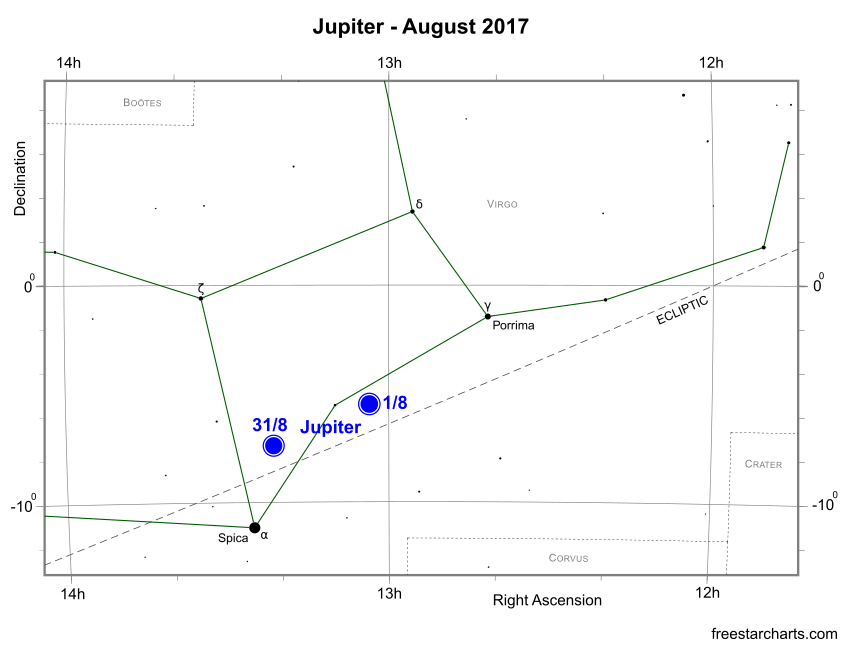
Jupiter during August 2017 - pdf format (credit:- freestarcharts)
Saturn
Saturn remains a well-placed evening object in Ophiuchus. The "Ringed" planet begins the month moving retrograde before reaching its secondary stationary point on August 25th, after which direct motion is once again resumed. This is often regarded as signaling the end of the opposition period. To the naked eye, Saturn hardly appears to move this month.
From mid-latitude northern locations, Saturn sets around midnight by months end but over two hours later from those located further south. During August, its brightness decreases slightly from mag. +0.3 to +0.4 with its apparent size decreasing marginally from 17.8 to 17.0 arc seconds.
The waxing gibbous Moon passes 4 degrees north of Saturn on August 3rd and again on August 30th.

Saturn during August 2017 - pdf format (credit:- freestarcharts)
Uranus
Uranus, mag. +5.8, is an evening object in Pisces close to the border with Aries. At the beginning of the month from northern temperate locations the distant ice giant rises about midnight, improving to a couple of hours before midnight by months end. For those living further south it rises about 30 minutes later than this. On August 3rd, the planet reaches its first stationary point, which signals the beginning of this year's opposition period. It then commences retrograde motion.
Uranus is positioned a degree north of omicron Psc (ο Psc - mag. +4.3). Although just visible to the naked eye, it's much easier to spot with optical aid. Popular 7x50 or 10x50 binoculars easily reveal a "star" like point of light. By observing the planet over a number of days its slow movement relative to the "fixed" background stars can be noticed.
The waning gibbous Moon passes 4 degrees south of Uranus on August 13th.
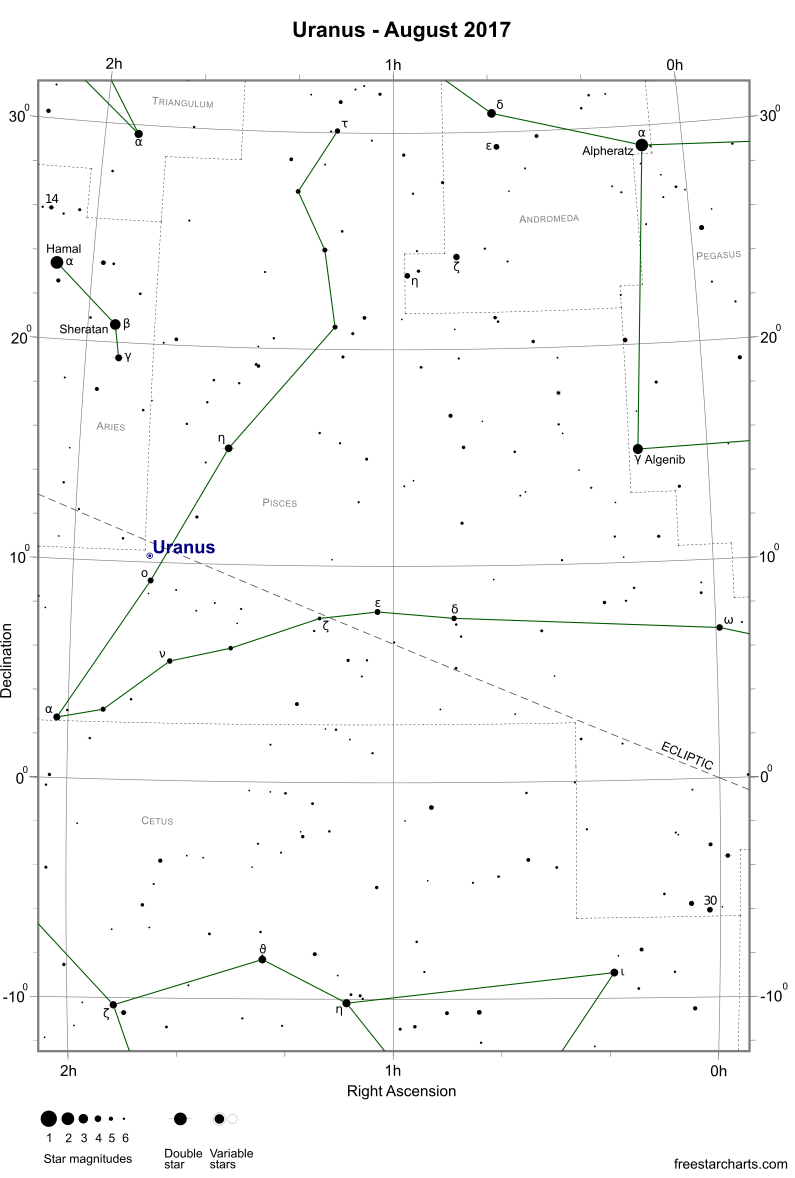
Uranus during August 2017 - pdf format (credit:- freestarcharts)
Neptune
Neptune, mag. +7.8, continues to move retrograde among the stars of Aquarius. The outermost planet reaches opposition on September 5th and is therefore superbly placed for observation. It rises above the eastern horizon just after sunset then remains visible for the rest of the evening. With a declination of 7 degrees south, Neptune is currently better placed from tropical and southern temperate latitudes where it appears higher in the sky.
Neptune is always too faint to be spotted with the naked eye. However, it's a relatively easy binocular and small telescope target. The planet can be found about 30 degrees south of the centre of the Great Square of Pegasus and 2 degrees east of lambda Aqr (λ Aqr - mag. +3.7). First magnitude star, Fomalhaut (α Psc - mag. +1.2), is 22 degrees directly south of Neptune.
Even though its apparent diameter is only 2.4 arc seconds an 80mm (3.1-inch) refractor at medium to high magnifications will reveal a small featureless blue disk. However, even large amateur reflectors don't significantly improve the view. A scope of at least 300mm (12 inches) aperture is recommended to spot Neptune's largest moon, Triton (mag. +14.0).
On August 9th, Moon the waning gibbous Moon passes a degree south of the planet.
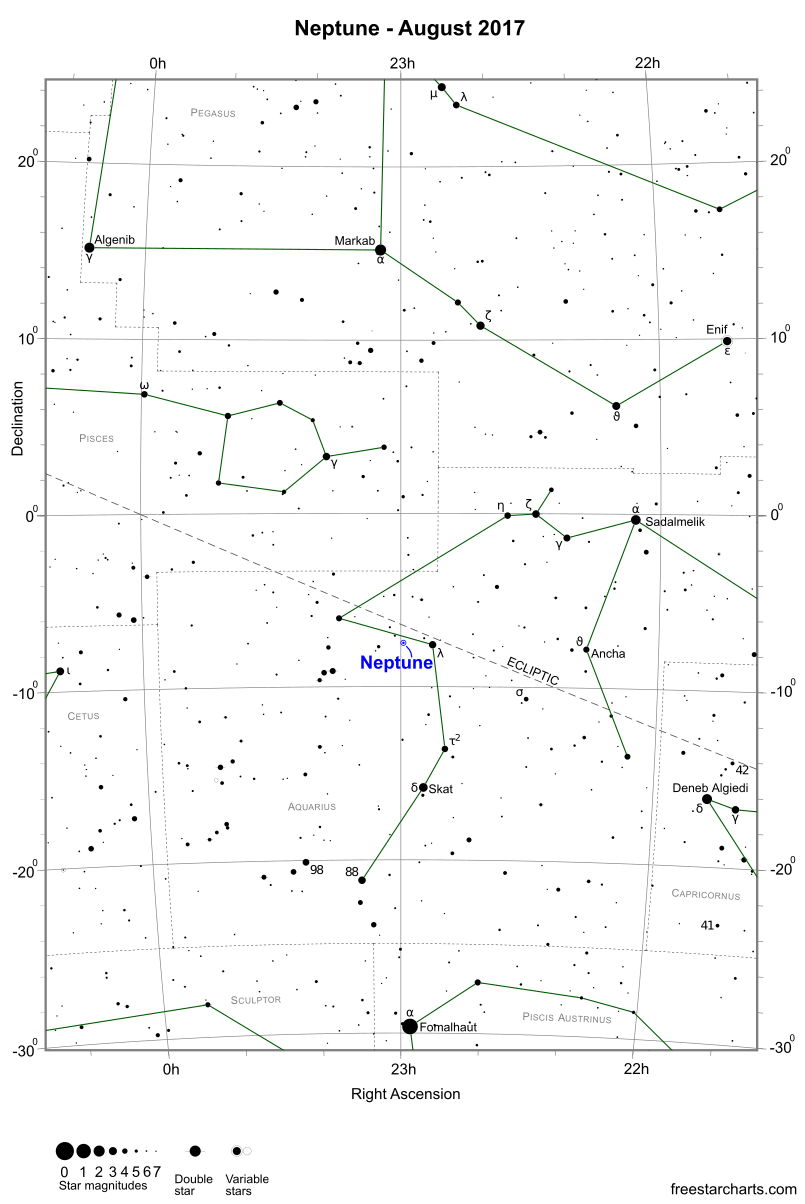
Neptune during August 2017 - pdf format (credit:- freestarcharts)
Solar System Data Table August 2017
| Date | Right Ascension | Declination | Apparent Magnitude | Apparent Size | Illum. (%) | Distance from Earth (AU) | Constellation | |
|---|---|---|---|---|---|---|---|---|
| Sun | Aug 5 | 09h 00m 01.2s | 17d 02m 27.5s | -26.7 | 31.5' | 100 | 1.014 | Cancer |
| Sun | Aug 15 | 09h 37m 58.1s | 14d 07m 57.1s | -26.7 | 31.6' | 100 | 1.013 | Leo |
| Sun | Aug 25 | 10h 15m 03.4s | 10d 50m 55.8s | -26.7 | 31.6' | 100 | 1.011 | Leo |
| Mercury | Aug 5 | 10h 37m 50.1s | 06d 01m 59.8s | +0.6 | 08.5" | 37 | 0.788 | Sextans |
| Mercury | Aug 15 | 10h 44m 17.3s | 03d 26m 20.1s | +1.7 | 10.1" | 18 | 0.665 | Sextans |
| Mercury | Aug 25 | 10h 21m 39.4s | 05d 24m 33.9s | +4.9 | 10.9" | 02 | 0.618 | Sextans |
| Venus | Aug 5 | 06h 20m 49.3s | 21d 58m 49.8s | -4.0 | 14.2" | 76 | 1.174 | Gemini |
| Venus | Aug 15 | 07h 11m 11.2s | 21d 35m 28.7s | -4.0 | 13.5" | 79 | 1.240 | Gemini |
| Venus | Aug 25 | 08h 01m 34.7s | 20d 12m 33.7s | -3.9 | 12.8" | 82 | 1.302 | Cancer |
| Mars | Aug 5 | 08h 49m 56.5s | 18d 53m 38.5s | +1.7 | 03.5" | 100 | 2.658 | Cancer |
| Mars | Aug 15 | 09h 15m 45.9s | 17d 05m 27.4s | +1.8 | 03.5" | 100 | 2.655 | Cancer |
| Mars | Aug 25 | 09h 41m 00.5s | 15d 06m 11.0s | +1.8 | 03.5" | 100 | 2.646 | Leo |
| Jupiter | Aug 5 | 13h 05m 38.5s | -05d 42m 49.1s | -1.9 | 34.0" | 99 | 5.804 | Virgo |
| Jupiter | Aug 15 | 13h 11m 13.4s | -06d 19m 05.0s | -1.8 | 33.2" | 99 | 5.939 | Virgo |
| Jupiter | Aug 25 | 13h 17m 25.9s | -06d 58m 32.7s | -1.8 | 32.5" | 100 | 6.061 | Virgo |
| Saturn | Aug 5 | 17h 22m 20.5s | -21d 54m 41.5s | +0.3 | 17.7" | 100 | 9.395 | Ophiuchus |
| Saturn | Aug 15 | 17h 21m 17.0s | -21d 55m 31.7s | +0.4 | 17.4" | 100 | 9.532 | Ophiuchus |
| Saturn | Aug 25 | 17h 20m 53.7s | -21d 57m 01.4s | +0.4 | 17.2" | 100 | 9.684 | Ophiuchus |
| Uranus | Aug 5 | 01h 45m 56.0s | 10d 18m 53.2s | +5.8 | 03.6" | 100 | 19.644 | Pisces |
| Uranus | Aug 15 | 01h 45m 43.6s | 10d 17m 28.6s | +5.8 | 03.6" | 100 | 19.485 | Pisces |
| Uranus | Aug 25 | 01h 45m 13.1s | 10d 14m 23.8s | +5.7 | 03.6" | 100 | 19.338 | Pisces |
| Neptune | Aug 5 | 23h 00m 17.2s | -07d 22m 46.7s | +7.8 | 02.3" | 100 | 29.072 | Aquarius |
| Neptune | Aug 15 | 22h 59m 23.9s | -07d 28m 31.7s | +7.8 | 02.4" | 100 | 29.000 | Aquarius |
| Neptune | Aug 25 | 22h 58m 25.8s | -07d 34m 43.2s | +7.8 | 02.4" | 100 | 28.955 | Aquarius |