Guides / Star Charts
Contributions
If you like the website and want to contribute to the running costs then please do so below. All contributions are most welcome.
Algol eclipse dates and times for February 2020
Algol (β Per) is a bright eclipsing binary system located in the northern constellation of Perseus and one of the best-known variable stars in the sky. Often referred to as the "Demon Star", most of the time it shines at mag. +2.1 but every two days, 20 hours and 49 minutes it suddenly dips in brightness to mag. +3.4, remaining dim for about 10 hours before returning to its original state.
Why the brightness change. The Algol system consists of at least three-stars (β Per A, β Per B and β Per C) with the orbital plane of Algol A and B directly in line with the Earth. The regular dips in brightness occur when the dimmer B star moves in front of and eclipses the brighter A star. There is also an extra dimension in that a secondary eclipse occurs when the brighter star occults the fainter secondary, resulting in a very small dip in brightness that can be detected with photo-electrical equipment.

Messier 101 - M101 - The Pinwheel Galaxy (Spiral Galaxy)
M101 is a large face-on spiral galaxy located 22 million light-years away in the constellation of Ursa Major. At magnitude +7.9, it can be glimpsed in binoculars or small telescopes from dark sites. However, this galaxy suffers from low surface brightness and in bad seeing conditions or light polluted areas is sometimes difficult to spot even with 200mm (8-inch) scopes. M101 is best seen from the Northern Hemisphere during the months of March, April and May.
M101 is also known as the Pinwheel galaxy and was discovered by Pierre Méchain on March 27, 1781. He described it as "nebula without star, very obscure and pretty large, 6' to 7' in diameter, between the left hand of Boötes and the tail of the great Bear." He communicated this to Charles Messier, who verified its position and then included it in his catalogue as one of the final entries.
Locating the part of sky where M101 is positioned is easy, since it's close to the handle of the bowl that forms the Plough or Big Dipper asterism of Ursa Major. The Pinwheel galaxy is located at one corner of an equatorial triangle formed with second magnitude stars Mizar (ζ UMa - mag. +2.2) and Alkaid (η UMa - mag. +1.8). M101 is 5.5 degrees east of Mizar (the celebrated naked eye double star) and 5.5 degrees northeast of Alkaid.

Andromeda - Constellation Guide
Andromeda
Andromedae
And
The Chained Woman
Introduction
Andromeda is located in the northern part of the sky away from the plane of the Milky Way. It was one of the original 48 constellations plotted by second century astronomer Ptolemy and remains today as one of the modern 88 constellations defined by the IAU (International Astronomical Union). Andromeda is named after the princess in Greek Mythology who was the daughter of King Cepheus and Queen Cassiopeia. Legend has it, she was chained to a rock on the coast to be sacrificed in order to save the land from the large sea monster, Cetus. Returning Perseus came across the shackled princess and lay in waiting for the monster, before killing it and then marrying the princess.
For amateurs, Andromeda contains one famous galaxy, many faint galaxies, a selection of nice double stars, a couple of bright open clusters, a few variable stars and a beautiful planetary nebula. The deep sky object that dominates the constellation is the spectacular Andromeda galaxy (M31), which is the largest member of our Local Group. At 2.54 Million light-years, it's the most distant object in the night sky that's easily visible with the naked eye.
Algol eclipse dates and times for January 2020
Algol (β Per) is a bright eclipsing binary system located in the northern constellation of Perseus and one of the best-known variable stars in the sky. Often referred to as the "Demon Star", most of the time it shines at mag. +2.1 but every two days, 20 hours and 49 minutes it suddenly dips in brightness to mag. +3.4, remaining dim for about 10 hours before returning to its original state.
Why the brightness change. The Algol system consists of at least three-stars (β Per A, β Per B and β Per C) with the orbital plane of Algol A and B directly in line with the Earth. The regular dips in brightness occur when the dimmer B star moves in front of and eclipses the brighter A star. There is also an extra dimension in that a secondary eclipse occurs when the brighter star occults the fainter secondary, resulting in a very small dip in brightness that can be detected with photo-electrical equipment.
Algol is located in Perseus among the stars of the northern Milky Way. It's positioned west of mag. +0.1 Capella (α Aur) and southeast of the well known "W" of Cassiopeia. The finder chart below shows the position of Algol along with magnitude data of some surrounding stars for comparative purposes.
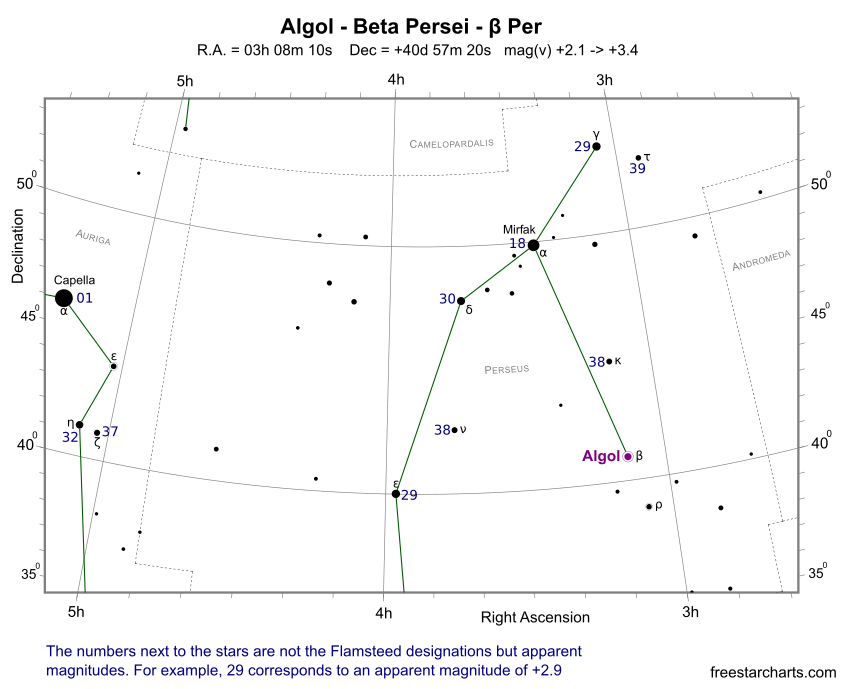
Finder Chart for Algol - pdf format (credit:- freestarcharts.com)
Messier 41 - M41 - Open Cluster
M41 is a stunning, large bright open cluster located in the constellation of Canis Major. Of the many clusters in Canis Major, it's the stand out object and the constellation's only
M41 was discovered by Giovanni Batista Hodierna sometime before 1654, although it was probably known to Aristotle as far back as 325 BC. If true, this would make it the faintest object recorded in classical antiquity, but caution prevails as Aristotle may have described a nearby part of the Milky Way instead. The cluster was catalogued by Charles Messier on January 16, 1765 and is best seen during the months of December, January and February from the tropics and Southern Hemisphere.
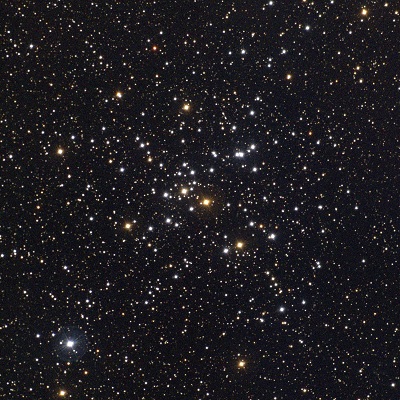

Finder Chart for M41 - pdf format (credit:- freestarcharts)
47 Tucanae - NGC 104 - Globular Cluster
47 Tucanae or 47 Tuc is a spectacular globular cluster located in the southern constellation of Tucana. At magnitude +4.5, it appears to the naked eye as a slightly fuzzy star similar to the head of a tail-less comet. Always hidden from view for European and North American observers, 47 Tuc was discovered by French astronomer Nicolas Louis de Lacaille on September 14, 1751. Initially Lacaille though he had found a comet until further inspection revealed its true nature.
47 Tuc is the second brightest globular in the sky, only Omega Centauri is more brilliant. It has an extremely dense core and is one of the most massive globular clusters surrounding the Milky Way. The cluster is located 2.5 degrees west of the Small Magellanic Cloud (SMC) and from most of the Southern Hemisphere it's circumpolar and never sets. In contrast from latitudes of 18N or greater, the globular can never be seen as it fails to rise above the horizon.
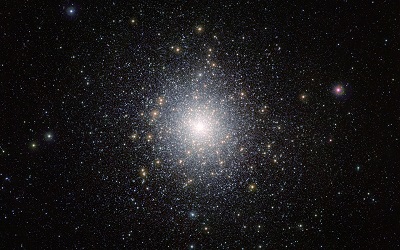
Through 7x50 or 10x50 binoculars, 47 Tuc appears as a bright starlight nucleus surrounding by a halo of soft pearly light. It's clearly non-stellar in nature. Telescopically the cluster is stunning and a showpiece object of the night sky. It total it spans 31 arc minutes of apparent sky, almost exactly the same diameter as the full Moon. For comparison, 47 Tuc is 50% larger and 3x brighter than M13 "the Great Hercules Globular Cluster" widely regarded as the finest globular in the northern section of the sky.
A small 100mm (4-inch) scope reveals a bright compact core surrounded by a large 15 arc minute sphere with the brightest members resolvable. Even through small telescopes it's a superb sight. A 200mm (8-inch) instrument shows a swarm of stars in a glittering 3D view. The dense centre remains unresolvable in stark contrast to the less dense outer regions. Overall it's a breathtaking object for all sizes and types of telescopes.
NGC 457 - Owl Cluster - Open Cluster
NGC 457 is the brightest open cluster in Cassiopeia and one of the finest objects of its type in the northern sky. At magnitude +6.4, it's just beyond naked-eye visibility but easily seen with binoculars and a beautiful sight through telescopes. The brightest cluster stars are arranged in prominent lines and curves that resemble an Owl shape, hence the popular name "The Owl Cluster".
NGC 457 was discovered by William Herschel in 1787. Finding the Owl Cluster is easy as it's located two degrees south-southeast of eclipsing binary star system Ruchbah (δ Cas - mag. +2.7). This star is one component of the characteristic "W" asterism of Cassiopeia. The brightest star inside NGC 457 is Phi Cassiopeiae (φ Cas - mag. +5.0). Despite not being a member of the cluster, this foreground star is visible to the naked eye. Together with another non-cluster star, seventh magnitude HD 7902 (HIP 6229), they form the bright eyes of the Owl.
NGC 457 is best seen from Northern Hemisphere latitudes during August, September and October. It appears high in the sky and even overhead from many locations. From latitudes greater than 32N, the Owl is circumpolar and therefore never sets.


Finder Chart for NGC 457 - pdf format (credit:- freestarcharts)
Capella - Alpha Aurigae - α Aur
Capella is a bright yellow star located in the northern section of sky. With an apparent magnitude of +0.08, it's marginally fainter than another bright northern star, Vega. Capella is the standout star of the relatively large constellation of Auriga, the Charioteer. The Milky Way passes through the heart of Auriga and as a result it contains numerous bright open clusters, nebulae and interesting stars.
Capella is the northernmost first magnitude star and is circumpolar from latitudes greater than +44 degrees. The star can still be spotted from most southerly regions including Australia, New Zealand and Argentina. However, it's not visible from the Falkland Islands or Antarctica.

Caldwell 41 - C41 - The Hyades - Open Cluster
The Hyades is a very large loose naked eye open cluster located in the constellation of Taurus. It spans 5.5 degrees of sky, which is equivalent to 11 times the diameter of the full Moon. At a distance of 153 light-years this is the nearest open cluster - the Ursa Major Moving Group is closer, but's extremely scattered and more of a cluster like object than a true cluster. Consequently, the Hyades is one of the top studied open clusters of all.
The Hyades is easily found as it circles the brightest star in Taurus, first magnitude orange giant star Aldebaran (α Tau - mag. +0.87). It's not unreasonable to assume that Aldebaran is also a member of the Hyades. However, it's purely a foreground star, an interloper located only 65 light-years distant that happens to be in the same line of sight. As a naked-eye object, the Hyades have been known since prehistoric times.
The cluster is best seen from northern latitudes during the months of November, December and January.
