Guides / Star Charts
Contributions
If you like the website and want to contribute to the running costs then please do so below. All contributions are most welcome.
The Planets this Month - April 2016
Mercury
Mercury is visible as an evening object for observers at northern and equatorial latitudes during April (apart from the few days at the start and end of the month). For this apparition the planet can be seen low down above the west-northwestern horizon just after sunset. The peak altitude occurs on April 18th when greatest elongation east (GEE) is reached. On this day, from London for example, the planet will be visible as a mag. -0.1 point of light 10 degrees above the horizon, 45 minutes after sunset. Observers should also note that Mercury is at its brightest at the start of the month and before GEE occurs. It decreases from mag. -1.4 to +2.1 during the visibility period.
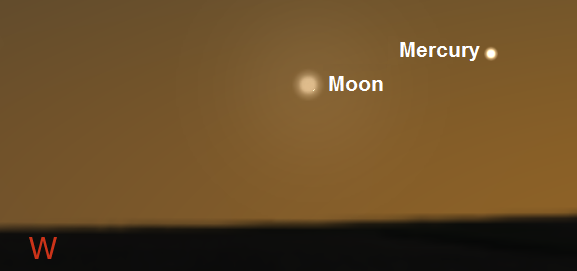
On April 8th the thin waxing crescent Moon passes 5 degrees south of Mercury, aiding in locating the planet.
Mars, Saturn and the Moon close together between March 28th and 30th, 2016
Mars and Saturn are currently positioned only a few degrees apart in their respective southern constellations of Scorpius and Ophiuchus. From March 28th to 30th some nice visual and photographic opportunities occur when the waning gibbous Moon is also positioned close by.
Currently the two planets are better seen from tropical and southern locations where they rise earlier in the evening and appear higher in the sky than for those living further north. For example, from Cape Town, South Africa or Sydney, Australia the planets are visible well before midnight but from locations such as London, England or New York, USA they don't rise until a few hours later.

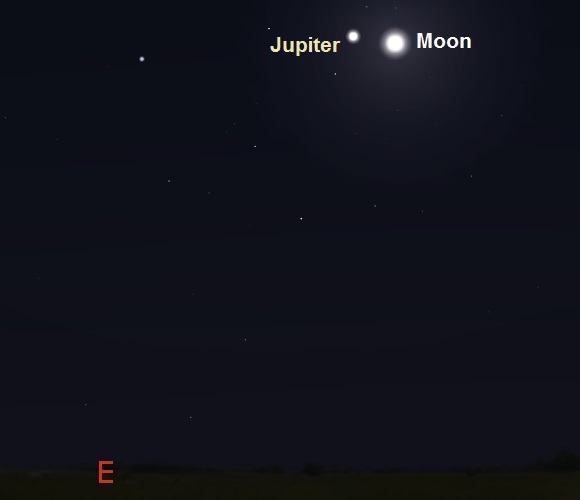
Jupiter and the Moon close together during the evening of March 21, 2016
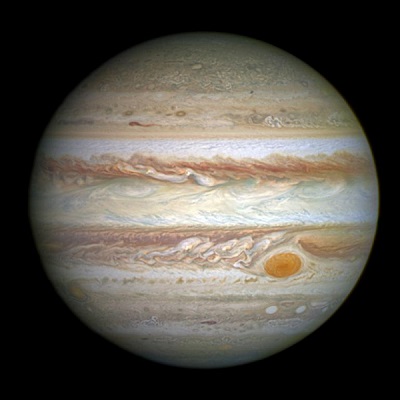
Jupiter is now just past a few days past opposition and remains a brilliant object moving retrograde in southeastern Leo. The giant planet with a diameter 11 times that of the Earth rises in the east just before sunset remaining visible for most of the night. Now at its best for the year the "King of the planets" is unmistakable (mag. -2.5) and much brighter than all night time stars.
On March 21st a nice visual event occurs when the almost full Moon passes 2 degrees south of Jupiter in the evening sky.
Total Solar Eclipse of March 9, 2016
A total solar eclipse visible from Indonesia and the central Pacific region takes place on March 9, 2016. On this occasion the narrow totality band starts at sunrise over Sumatra before passing through Bangka Island, Palau Belitung, Central Kalimantan, Central Sulawesi, North Maluku, Woleai Atoll and ending in the Pacific Ocean north of Hawaii. A partial eclipse is visible from large parts of Southeast Asia, Northern Australia, Papua New Guinea, Hawaii, China and Alaska. Readers should be aware that since the shadow crosses the International Date Line for locations such as Alaska and Hawaii the eclipse takes place on March 8th.
A total solar eclipse occurs when the Moon passes directly between the Earth and the Sun, hence the Sun's disk is obscured as seen from the ground. Total eclipses are only possible due to a large slice of nature's luck. By sheer coincidence the Sun is about 400 times larger in size than the Moon but also 400 times more distance resulting in both objects appearing about the same size in the sky. However, it should be noted that due to distance variations the apparent sizes of the Sun and Moon do show small variations and at times the Moon will appear slightly larger in the sky than the Sun and vice-versa. A total solar eclipse occurs when the Moon's apparent diameter is large enough to completely cover the Sun and therefore block all direct sunlight, in the process turning day into darkness.
Algol eclipse dates and times for March 2016
Algol (β Per) is a bright eclipsing binary system located in the northern constellation of Perseus and one of the best-known variable stars in the sky. Often referred to as the "Demon Star" most of the time it shines at magnitude +2.1 but every two days, 20 hours and 49 minutes the star suddenly dips in brightness to magnitude +3.4, remaining dim for about 10 hours before returning to its original state.
Why the change in brightness? The Algol system consists of at least three-stars (β Per A, β Per B and β Per C) with the orbital plane of Algol A and B directly in line with the Earth. The regular dips in brightness occur when the dimmer B star moves in front of and eclipses the brighter A star. There is also an extra dimension in that a secondary eclipse occurs when the brighter star occults the fainter secondary but this results in a very small dip in brightness that can only be detected by those with access to photoelectrical equipment.

The Planets this Month - March 2016
Mercury
During the first week of March from equatorial and southern regions Mercury can be seen low down above the eastern horizon just before sunrise. Also visible six degrees above the planet is much more brilliant Venus which acts as a good marker. For comparison, Mercury shines about mag. -0.4 while Venus is at mag. -3.8, a difference of 22x.
On March 8th the very thin waning crescent Moon passes 4 degrees north of Mercury although spotting the planet with the naked eye is likely difficult and binoculars will probably be necessary. After that Mercury continues to draw into the Sun before reaching superior conjunction on March 23rd.
From northern temperate latitudes the planet is not suitable placed for observation throughout the month.

On the evening of February 23rd and the morning of February 24th the waning gibbous Moon is positioned just a couple of degrees south of Jupiter
Jupiter is currently a brilliant object moving retrograde in southeastern Leo. The giant planet which has a diameter 11 times that of the Earth rises in the east just after sunset and remains visible for the rest of the night. With only two weeks to go until opposition it's now the best time of year to view the "King of the planets". At magnitude -2.5 it's unmistakable and much brighter than any other night-time star.
On the evening of February 23rd and the morning of February 24th a nice visual and imaging opportunity occurs when the waning gibbous Moon (almost full) passes less than 2 degrees south of Jupiter.

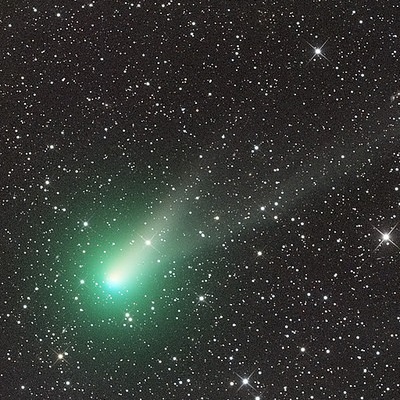
Comet Catalina (C/2013 US10) moves past Kemble's Cascade during the last week of February 2016. Visible with binoculars and small telescopes from northern and tropical latitudes.
Despite moving away from Earth as it heads towards the outer reaches of the Solar System comet Catalina remains well placed from Northern Hemisphere and tropical locations during February. At the start of the month the comet shone at magnitude +6.9 and beyond naked eye visibility but easily within binocular range. Unless something now dramatic happens it's expected to fade by another two magnitudes by months end, becoming increasingly difficult to spot with binoculars. At this level of brightness a small size telescope - preferably larger - is recommended for observing. From mid southern locations Catalina can no longer be seen.
Jupiter reaches opposition on March 8, 2016
Jupiter is now an unmistakable dazzling object moving retrograde among the stars of Leo. On March 8th the current apparition peaks when opposition is reached. On this day the "King of the planets" shines brightest for the year attaining its largest apparent size. Visible all night long Jupiter rises in the east at sunset, reaches its highest point in the sky around midnight before setting in the west at sunrise.