Guides / Star Charts
Contributions
If you like the website and want to contribute to the running costs then please do so below. All contributions are most welcome.
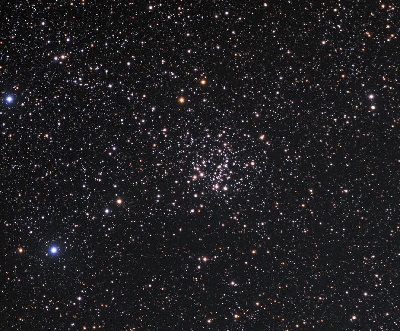
NGC 663 - Open Cluster
NGC 663, mag. +7.1, is a young open cluster that's one of a number of bright clusters that can be seen with binoculars in the constellation of Cassiopeia. It contains at least 80 stars visible in amateur telescopes spread over a diameter of 16 arc minutes. A 100mm (4-inch) scope reveals a bright rich grouping immersed in a hazy glow with many stars resolvable. NGC 663 is striking in larger scopes, appearing reasonably concentrated towards the centre, with dozens of stars spread across the cluster face. Double star Struve 152 is a cluster member.
The Moon, Mars and Saturn close together during evenings from June 16th to 19th, 2016
Mars and Saturn are currently visible as soon as it's dark enough and remain so until the early hours of the morning. The two planets are positioned about 15 degrees apart in their respective constellations of Libra and Ophiuchus. Due to their southern declinations they are better placed from tropical and southern latitudes, appearing higher in the sky with a longer visibility period than at mid-northern latitudes. This rich area of sky also contains many deep sky objects and bright stars, including first magnitude red supergiant Antares (α Sco - mag. +1.0). Of the three objects Mars (mag. -1.7) is the brightest followed by Saturn (mag. +0.1) then Antares.
Some pleasant viewing opportunities occur between June 16th to 19th when the Moon is also in the same region of sky. On June 17th, it passes 7 degrees north of Mars and two days later 3 degrees north of Saturn. The image below shows the view just before midnight from London, England. From other mid-latitude northern locations the scene will be similar to that shown.
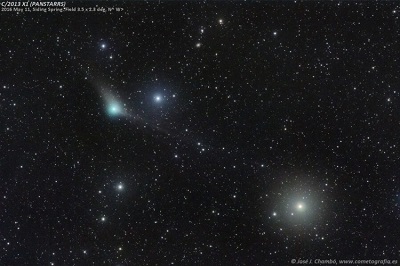
Comet PanSTARRS visible during June with binoculars and small telescopes. Best seen from southern and tropical latitudes.
Comet PanSTARRS (C/2013 X1) is visible with binoculars in the evening sky during June from southern and tropical latitudes. At the beginning of the month the comet was rising in the southeast before midnight local time. By months end it can be seen just after sunset. Although probably remaining beyond naked eye visibility it's predicted to reach about mag. +6.0 towards the end of the month and therefore an easy binocular object. Indeed throughout June, PanSTARRS should be at least as bright as mag. +6.5. However comets are unpredictable and anything can happen, so keep watching!
Due to its southerly declination, those living at mid-northern latitudes aren't so lucky. Observers may be able to spot the comet low down in the southern sky just before morning twilight during the first half of the month. After that it will no longer be visible.
Jupiter and the waxing crescent Moon form a nice early evening pairing on June 11, 2016
Jupiter despite fading remains visible as a beautiful evening object towards the west just after sunset. The planet can't be mistaken; at mag. -2.0 it dominates its surrounding region of sky. No other currently visible celestial objects apart from the Sun and Moon are brighter than Jupiter although Mars is only marginally fainter. However, it's impossible to confuse the two planets. Mars is visible towards the east on the opposite side of the sky and is deep orange in colour compared to brilliant white Jupiter.

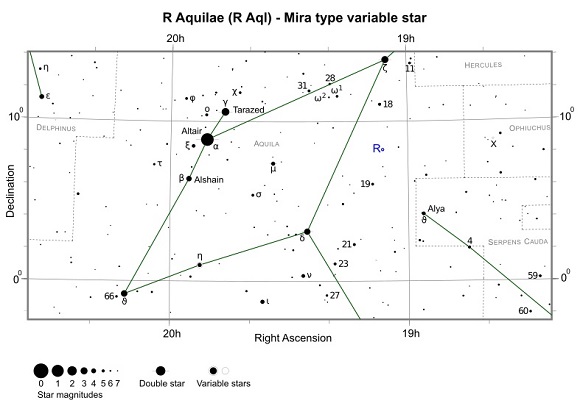
Mira type variable star R Aquilae (R Aql) now within binocular range
Variable star R Aquilae in the constellation Aquila is now towards the bright end of its range and currently easily visible with binoculars and small scopes. The star is a Mira type that normally fluctuates between magnitudes +5.5 and +12.0 over a period of 284 days. At it's brightest it can be glimpsed faintly with the naked eye. At it's faintest a minimum 80mm (3.1-inch) scope is required.
Algol eclipse dates and times for June 2016
Algol (β Per) is a bright eclipsing binary system located in the northern constellation of Perseus and one of the best-known variable stars in the sky. Often referred to as the "Demon Star" most of the time it shines at magnitude +2.1 but every two days, 20 hours and 49 minutes the star suddenly dips in brightness to magnitude +3.4, remaining dim for about 10 hours before returning to its original state.
Why the change in brightness? The Algol system consists of at least three-stars (β Per A, β Per B and β Per C) with the orbital plane of Algol A and B directly in line with the Earth. The regular dips in brightness occur when the dimmer B star moves in front of and eclipses the brighter A star. There is also an extra dimension in that a secondary eclipse occurs when the brighter star occults the fainter secondary but this results in a very small dip in brightness that can only be detected by those with access to photo-electrical equipment.

The Planets this Month - June 2016
Mercury
Mercury reaches greatest elongation on June 5th when it's positioned 24.2 degrees west of the Sun. Despite this at northern latitudes the angle of the ecliptic is unfavourable and the planet will be challenging to spot low down above the eastern horizon. However it's a different story from the Southern Hemisphere where elusive Mercury puts on a respectable morning show for the first three weeks of the month. During week one it rises more than two hours before the Sun and can be seen 10 degrees above the east-northeastern horizon an hour before sunrise. After that Mercury slips back towards the Sun until it's finally lost to the bright twilight during the last week of June. It should be noted that the planet gains in brightness from mag. +0.8 to -1.0 during the visibility period.
On June 3rd, the thin waning crescent Moon passes 0.7 degrees south of Mercury (mag. +0.5) with an occultation visible from southern Africa and Madagascar (9:47 UT).
Venus
Venus reaches superior conjunction on June 6th. Since the planet is currently located on the far side of the Sun it's not suitably placed for observation. Indeed from June 5th to June 7th, Venus passes directly behind the Sun as seen from Earth. This "occultation" lasts some 46 hours and for its duration no Earth based instrument will be able to detect the planet.
At conjunction Venus and the Earth are separated by 1.74 AU (260 million kilometers or 161 million miles).
Saturn reaches opposition on June 3, 2016
Saturn reaches opposition in Ophiuchus on June 3rd. On this day the planet is visible all night long and at its best for the year. With a declination of -20.5 degrees it's much better placed from southern and tropical locations. For example, the planet reaches at maximum altitude of 77 degrees and is visible for over 13 hours from Sydney, Australia. Whereas from New York City, it climbs just 29 degrees high, visibility only 9 hours.
The surrounding region of sky also contains Mars (mag. -2.0) about 15 degrees to the west and first magnitude red supergiant star Antares (α Sco - mag. +1.0) approx. 6 degrees southwest of Saturn. Of the three objects Mars is easily the brightest followed by Saturn then Antares. Saturn reaches its highest point in the sky at around midnight local time.

How to see comet PanSTARRS (C/2013 X1) with binoculars and small telescopes during May and June 2016
PanSTARRS (C/2013 X1) is currently the brightest comet in the sky and can be seen with binoculars and small telescopes in early morning. The comet is currently approaching Earth and will continue to brighten slightly, peaking at mag. +6.0 when closest approach is reached at the end of June. It's better placed from southern and equatorial latitudes where it appears high in the sky than from northern temperate locations where it always keeps low down.
