Guides / Star Charts
Contributions
If you like the website and want to contribute to the running costs then please do so below. All contributions are most welcome.
The Planets this Month - May 2017
Mercury
Mercury reaches greatest elongation west on May 17th when it's positioned 26 degrees from the Sun. The planet is not well placed for observation at northern temperate locations, but from southern latitudes this happens to be the most favourable morning apparition of the year. With an extended period of visibility it can be seen in the morning skies until mid June.
On May 1st, from latitude 35S (approx. equal to Sydney, Cape Town and Santiago), Mercury rises over an hour before the Sun. At magnitude +2.5, binoculars will be required to spot the elusive planet against the bright dawn sky. Positioned a degree from Mercury is fainter Uranus (mag. +5.9). As the month progress the visibility of Mercury improves until greatest elongation west is reached. On May 17th, the planet shines at magnitude +0.5 and appears 15 degrees above the east-northeastern horizon, 45 minutes before sunrise. For the remainder of the month it gradually sinks back towards the horizon. It should be noted that Mercury improves in brightness throughout May and on the 31st it will shine at magnitude -0.3. Brilliant Venus is positioned above Mercury throughout this time.
From mid-northern temperate latitudes, Mercury can be seen for a short while around the time of greatest elongation. However, it's always low down and at best just a few degrees above the horizon.
On May 24th, the thin waning crescent Moon passes 2 degrees south of Mercury.
Eta Aquariids meteor shower peaks on May 5th and 6th, 2017
The annual Eta Aquariids meteor shower, occasionally written as Eta Aquarids, peaks on May 5th / 6th and this year's event is favourable as the waxing gibbous Moon will have set a few hours before sunrise. The shower is best seen in the early morning hours just before sunrise from southern and equatorial regions.
Parent Comet
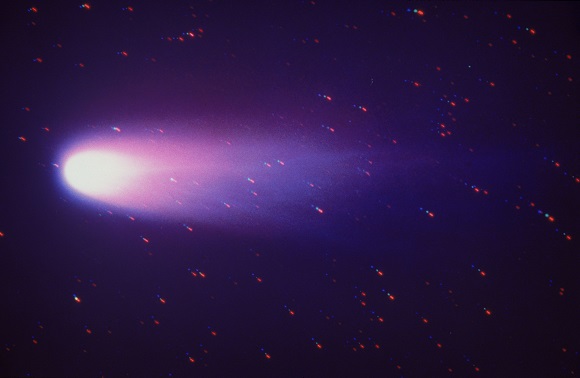
The parent body for the Eta Aquariids meteor shower is Halley's comet (1P/Halley). This isn't the only annual shower associated with the famous comet, the Orionids in October also originate from the same source. Although Halley has now left the inner Solar System and won't return until 2061, it's worth remembering that every Eta Aquariids meteor is a small part of the famous comet burning up in the Earth's atmosphere.
Algol eclipse dates and times for May 2017
Algol (β Per) is a bright eclipsing binary system located in the northern constellation of Perseus and one of the best-known variable stars in the sky. Often referred to as the "Demon Star", most of the time it shines at mag. +2.1 but every two days, 20 hours and 49 minutes it suddenly dips in brightness to mag. +3.4, remaining dim for about 10 hours before returning to its original state.
Why the change in brightness? The Algol system consists of at least three-stars (β Per A, β Per B and β Per C) with the orbital plane of Algol A and B directly in line with the Earth. The regular dips in brightness occur when the dimmer B star moves in front of and eclipses the brighter A star. There is also an extra dimension in that a secondary eclipse occurs when the brighter star occults the fainter secondary, resulting in a very small dip in brightness that can be detected with photo-electrical equipment.

Lyrids meteor shower peaks on the night of April 21/22, 2017
The annual Lyrids meteor shower peaks during the night of April 21st/22nd and this year's event promises to be a good one, as the 23% illuminated waning crescent Moon in Aquarius, won't significantly interfere. Normally, you can expect to see up to 20 meteors per hour under ideal conditions. In addition, the Lyrids do occasionally produce brilliant fireballs, that streak through the sky and cast shadows as they disintegrate in the Earth's atmosphere.

Jupiter reaches opposition on April 7, 2017
Jupiter remains a dazzling object this month and on April 7th the planet is at its best for the year, when opposition is reached. On this day, it will shine at mag. -2.5 and to the naked eye, the largest planet in the Solar System is unmistakable and easily brighter than any night-time star. It's currently located in Virgo, 4 degrees northeast of the constellation's brightest star, Spica (α Vir - mag. +1.0).
At opposition, Jupiter is visible all night long. The planet rises in the east at sunset, reaches its highest point in the sky around midnight before setting in the west at sunrise. It's best seen from equatorial regions, although from northern and southern temperate locations it still reaches a reasonable altitude during late evening and early morning.

The Planets this Month - April 2017
Mercury
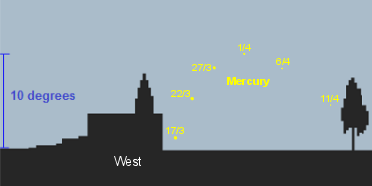
Mercury reaches greatest eastern elongation (GEE) on April 1st, when it moves out to 19 degrees from the Sun. On this day from mid-latitude northern locations, the innermost planet will shine at mag. -0.2, 10 degrees above the western horizon, 45 minutes after sunset. It remains visible, although fading, until the second week of the month when eventually lost to the bright evening twilight. From mid-northern latitudes, this also happens to be the best evening apparition of the year. However, from southern locations, Mercury is unsuitably placed for observation during this time.
The diagram below shows the altitude of Mercury, 45 minutes after sunset as seen from latitude of 51.5N (e.g. London, England). A similar view exists at other northern temperate latitudes.
Algol eclipse dates and times for April 2017
Algol (β Per) is a bright eclipsing binary system located in the northern constellation of Perseus and one of the best-known variable stars in the sky. Often referred to as the "Demon Star", most of the time it shines at mag. +2.1, but every two days, 20 hours and 49 minutes it suddenly dips in brightness to mag. +3.4, remaining dim for about 10 hours before returning to its original state.
Why the change in brightness? The Algol system consists of at least three-stars (β Per A, β Per B and β Per C) with the orbital plane of Algol A and B directly in line with the Earth. The regular dips in brightness occur when the dimmer B star moves in front of and eclipses the brighter A star. There is also an extra dimension in that a secondary eclipse occurs when the brighter star occults the fainter secondary, resulting in a very small dip in brightness that can be detected with photo-electrical equipment.
Mercury reaches greatest elongation east on April 1, 2017
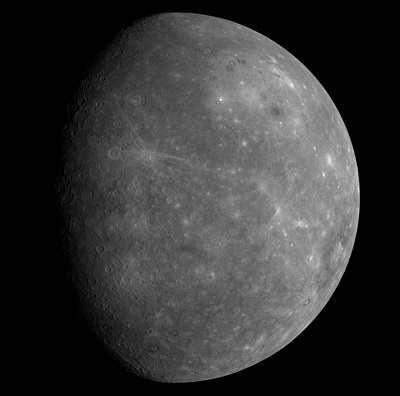
Mercury, the innermost planet, is now heading towards greatest eastern elongation (GEE), which it reaches on April 1, 2017. From mid-March, observers at northern-based locations should be able to spot the elusive planet, low down above the western horizon just after sunset. Each subsequent evening it improves in visibility until GEE is reached. After that, Mercury sinks gradually back towards the horizon until about 10 days later when it becomes lost to the bright twilight sky. This also happens to be the best evening apparition of the year from northern locations.
From southern latitudes, Mercury is unsuitably placed for observation this time.
Comet 41P/Tuttle-Giacobini-Kresak now visible with binoculars as it heads towards perihelion
Unfortunately, we haven't had a very bright comet for some time now, but there are a number of short-period comets that regularly approach the inner Solar System, and a few of them can even be spotted with binoculars. One of the more interesting is 41P/Tuttle-Giacobini-Kresak. It has an orbital period of 5.4 years and is currently heading back towards perihelion, which it reaches on April 12th. Over the coming months, this comet will be superbly placed in the evening sky for northern-based observers and bright enough to be seen with binoculars. It may even reach naked eye visibility.
