Guides / Star Charts
Contributions
If you like the website and want to contribute to the running costs then please do so below. All contributions are most welcome.
The Planets this Month - March 2018
Mercury
Mercury, the innermost planet, is now heading towards greatest eastern elongation (GEE), which it reaches on March 15th. Observers at northern-based locations should be able to spot the elusive planet just after sunset during the first 3 weeks of the month, when it appears low down above the western horizon. Each subsequent evening, from March 1st, it gradually improves in altitude with a longer visibility until GEE is reached. The planet will then be positioned 18 degrees from the Sun and shine at magnitude -0.4. After that, Mercury gradually sinks back towards the horizon until about 10 days later when it's finally lost to the bright twilight sky. From northern locations this also happens to be the best evening apparition of the year.
During the first few days of the month, Venus and Mercury appear close together. Venus is 12x brighter than its inner neighbour and on March 5th the two planets are separated by 1.4 degrees. Binoculars will assist locating Mercury, especially in the bright twilight, but don't use them until after the Sun has set. From southern latitudes, Mercury is not so well placed at this time. At GEE it sets only forty minutes after the Sun and will be difficult to spot in twilight. However, much brighter Venus is situated four degrees to the south and acts as a good marker.
Venus
Venus, mag. -3.9, can be seen low towards the west after sunset. As the month progresses the brilliant planet rises a little higher in the sky each subsequent evening and by months end, from northern temperature latitudes, sets about 90 minutes after the Sun. For those further south, the planet sets an hour after the Sun on the last day of the month.
As mentioned above, Mercury and Venus are positioned close together during the start of the month. On March 19th, the thin waxing crescent Moon passes 4 degrees south of Venus and on March 29th, Venus passes only 0.1 degrees south of Uranus. At mag. +5.9, Uranus is almost 10,000x fainter than Venus. Binoculars or a small telescope will be required to spot distant Uranus, although both planets will easily fit in the same field of view.

The Planets this Month - February 2018
Mercury
Mercury is currently located on the far side of the Sun. The innermost planet passes through superior conjunction on February 16th. Throughout the month it remains too close to the Sun to be safely observed.
Venus
Venus returns to the evening sky for the first time since March 2017. The brilliant planet shines at mag. -3.9 and can be seen during twilight from northern locations, very low above the western horizon towards the end of month. However, those living further south will struggle to spot the planet.

NGC 4565 - Needle Galaxy - Spiral Galaxy
NGC 4565, also known as the Needle Galaxy, is the finest and brightest example of an edge-on spiral galaxy in the sky. It shines at magnitude +9.5 and therefore is bright enough to be seen with small telescopes. The galaxy is located in the constellation of Coma Berenices. Since positioned at the eastern edge of the sprawling naked eye Coma Star Cluster (Mel 111), it's easy to find.
NGC 4565 was discovered by William Herschel on April 6, 1785. It's number 38 in the Caldwell catalogue and is best seen from northern locations during the months of March, April and May. This spiral is physically large and similar in size to the Andromeda Galaxy (M31).

Algol eclipse dates and times for February 2018
Algol (β Per) is a bright eclipsing binary system located in the northern constellation of Perseus and one of the best-known variable stars in the sky. Often referred to as the "Demon Star", most of the time it shines at mag. +2.1 but every two days, 20 hours and 49 minutes it suddenly dips in brightness to mag. +3.4, remaining dim for about 10 hours before returning to its original state.
Why the brightness change. The Algol system consists of at least three-stars (β Per A, β Per B and β Per C) with the orbital plane of Algol A and B directly in line with the Earth. The regular dips in brightness occur when the dimmer B star moves in front of and eclipses the brighter A star. There is also an extra dimension in that a secondary eclipse occurs when the brighter star occults the fainter secondary, resulting in a very small dip in brightness that can be detected with photo-electrical equipment.

Ceres reaches opposition on January 31, 2018
Dwarf planet Ceres, the largest object in the asteroid belt, reaches opposition on January 31st. It will peak at magnitude +6.8, as it moves retrograde in Cancer. Bright stars Castor (α Gem - mag. +1.6) and Pollux (β Gem - mag. +1.1) in Gemini can be found about 20 degrees further west. Since Ceres travels quickly with respect to the "fixed" background stars, it can be tracked on a nightly basis. Although Ceres is too faint to be spotted with the naked eye, it's easily visible with binoculars and small telescopes. In addition, this opposition is very favourable as this dwarf planet peaks close to its maximum possible brightness. At opposition, it will be 1.602 AU (approx. 239.7 million kilometres or 148.9 million miles) distant from Earth.

Mira reaches peak magnitude in January 2018
Variable star Mira (omicron Ceti - ο Ceti) is now close to peak magnitude and for the next couple of months will be visible to the naked eye. This popular variable star, also known as "the Wonderful", is located in the constellation of Cetus. It can be seen as soon as it's dark enough, towards the south from northern locations or towards the north from southern locations, and remains visible until around midnight.
Mira's peak magnitude is expected to be about +3.4. The star climbs very quickly from minimum to maximum brightness over a period of about a month and then takes a quieter route on the downward slope, requiring 6 months to reach minimum. The minimum magnitude is usually of the order of +9, when at least a pair of binoculars and dark skies will be required to spot it.

Quadrantids meteor shower peaks on January 3, 2018
The first annual meteor shower of the year is the Quadrantids and it can be a good one with up to 60 meteors per hour visible at peak time. This rate is comparable to the much observed Perseids and Geminids, but unlike these showers the Quadrantids are elusive with a narrow peak activity window lasting just a few hours. Unfortunately, this year's event is not favourable. The Moon, just past full, will significantly interfere and therefore wash out all but the brightest meteors.
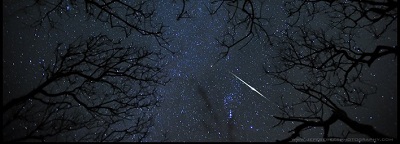
Radiant and History
Meteor showers are usually named after the constellation that contains the radiant, but you will have difficulty figuring out the relevant constellation for the Quadrantids. The reason is it no longer exists. Today, the Quadrantids radiant is located in Boötes, not far from the tail of Ursa Major. When the shower was discovered in the 1830s by Adolphe Quetelet of the Brussels Observatory the radiant was located in the now obsolete constellation of Quadrans Muralis, hence the name "The Quadrantids".
The Planets this Month - January 2018
Mercury
Mercury reaches greatest elongation on New Years Day when it moves out to 22.7 degrees west of the Sun. The innermost planet can be seen just before sunrise during the first two weeks of the month, low down above the south-eastern horizon. During this period its brightness is fairly constant at magnitude -0.3, with its illuminated phase increasing from 62% to 85%.
Mercury passes less than a degree south of Saturn on January 13th. Two days later the thin waning crescent Moon passing 3 degrees north of Mercury.
Venus
Venus passes through superior conjunction on January 9th. It remains too close to the Sun to be safely observed throughout the month.
Earth
Earth reaches perihelion or closest point to the Sun on January 3rd at a distance of 0.983 AU or 147.1 million kilometres (91.4 million miles).
Algol eclipse dates and times for January 2018
Algol (β Per) is a bright eclipsing binary system located in the northern constellation of Perseus and one of the best-known variable stars in the sky. Often referred to as the "Demon Star", most of the time it shines at mag. +2.1 but every two days, 20 hours and 49 minutes it suddenly dips in brightness to mag. +3.4, remaining dim for about 10 hours before returning to its original state.
Why the change in brightness? The Algol system consists of at least three-stars (β Per A, β Per B and β Per C) with the orbital plane of Algol A and B directly in line with the Earth. The regular dips in brightness occur when the dimmer B star moves in front of and eclipses the brighter A star. There is also an extra dimension in that a secondary eclipse occurs when the brighter star occults the fainter secondary, resulting in a very small dip in brightness that can be detected with photo-electrical equipment.