Guides / Star Charts
Contributions
If you like the website and want to contribute to the running costs then please do so below. All contributions are most welcome.
Algol eclipse dates and times for September 2018
Algol (β Per) is a bright eclipsing binary system located in the northern constellation of Perseus and one of the best-known variable stars in the sky. Often referred to as the "Demon Star", most of the time it shines at mag. +2.1 but every two days, 20 hours and 49 minutes it suddenly dips in brightness to mag. +3.4, remaining dim for about 10 hours before returning to its original state.
Why the brightness change. The Algol system consists of at least three-stars (β Per A, β Per B and β Per C) with the orbital plane of Algol A and B directly in line with the Earth. The regular dips in brightness occur when the dimmer B star moves in front of and eclipses the brighter A star. There is also an extra dimension in that a secondary eclipse occurs when the brighter star occults the fainter secondary, resulting in a very small dip in brightness that can be detected with photo-electrical equipment.

Perseids meteor shower peaks on the nights of August 11-12 and August 12-13, 2018
The Perseid meteor shower is among the finest annual meteor showers, always reliable, producing a flux of fast and bright meteors. This year's event peaks on the nights of August 11-12 and August 12-13. The best time to look is during the early morning hours, and on this occasion it's extremely favourable as the new Moon will not interfere. At peak of about 60 meteors per hour are predicted. Recent analysis by NASA has rated the Perseids as the best meteor shower when it comes to fireballs.
The Perseids favour northern based observers. For those at southern locations, the radiant remains close to or never rises above the horizon. This considerably reduces the amount of visible meteors, although it's possible to spot some of them coming up above the northern horizon.

The Planets this Month - August 2018
Mercury
Mercury passes through inferior conjunction on August 8th. The fast moving planet then moves into the morning sky, reaching greatest elongation west on August 26th. On this day, it will shine at magnitude -0.1 and be positioned 18 degrees from the Sun. From northern temperate latitudes, Mercury will rise 90 minutes before sunrise and be visible very low down above the eastern horizon.
From southern locations, Mercury is not suitably placed for observation this month.
Venus
Venus remains a brilliant early evening object, visible above the western horizon as soon as it's dark enough. On the first day of August, the planet moves from Leo into Virgo where it remains for the rest of the month.
Venus increases in magnitude -4.3 to -4.6, with its illuminated phase decreasing from 57% to 41%. During this time, the planet's apparent diameter increases from 20 to 29 arc seconds. On August 14th, the waxing crescent Moon passes 6 degrees north of Venus offering pleasant early evening viewing. On the last day of the month, Venus passes within 2 degrees of first magnitude Spica (α Vir - mag. 1.0), the brightest star in Virgo.

Algol eclipse dates and times for August 2018
Algol (β Per) is a bright eclipsing binary system located in the northern constellation of Perseus and one of the best-known variable stars in the sky. Often referred to as the "Demon Star", most of the time it shines at mag. +2.1 but every two days, 20 hours and 49 minutes it suddenly dips in brightness to mag. +3.4, remaining dim for about 10 hours before returning to its original state.
Why the brightness change. The Algol system consists of at least three-stars (β Per A, β Per B and β Per C) with the orbital plane of Algol A and B directly in line with the Earth. The regular dips in brightness occur when the dimmer B star moves in front of and eclipses the brighter A star. There is also an extra dimension in that a secondary eclipse occurs when the brighter star occults the fainter secondary, resulting in a very small dip in brightness that can be detected with photo-electrical equipment.
Algol is located in Perseus among the stars of the northern Milky Way. It's positioned west of mag. +0.1 Capella (α Aur) and southeast of the well known "W" of Cassiopeia. The finder chart below shows the position of Algol along with magnitude data of some surrounding stars for comparative purposes.
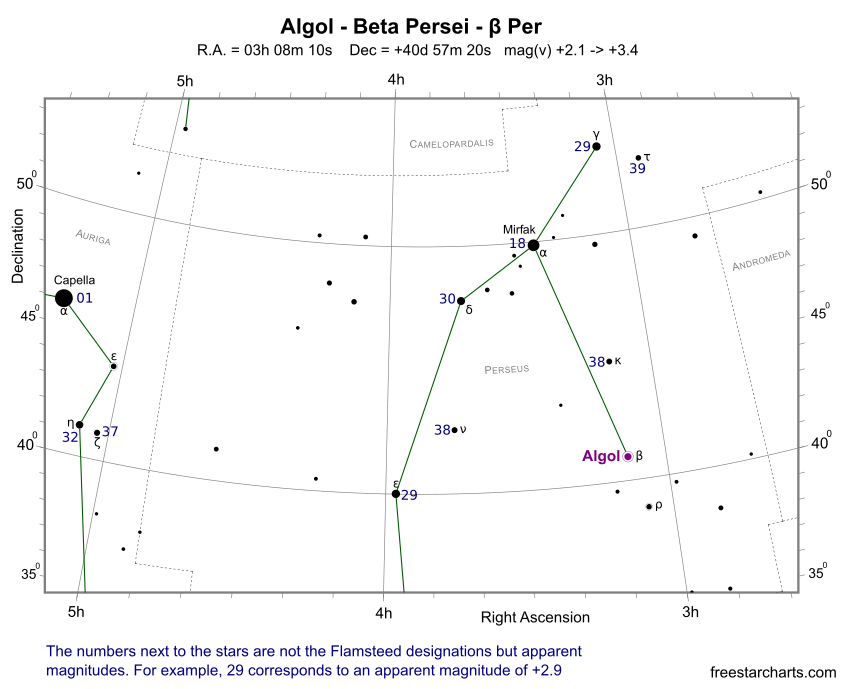
Finder Chart for Algol - pdf format (credit:- freestarcharts)
Mars reaches opposition on July 27, 2018
July 2018 is a special month for Mars observers with the planet reaching opposition on July 27th, and making its closest approach to Earth since 2003. On this occasion the red planet will peak at magnitude -2.8 and come within 0.386 AU (approx. 57.7 million kilometres or 35.9 million miles) of the Earth. Of all planets, only Venus currently appears brighter than Mars. On the same day as Mars reaches opposition, a total lunar eclipse can be seen from Africa, Asia, South America, Europe and Australia.
Mars is currently moving retrograde in the faint constellation of Capricornus. To the naked eye it's unmistakable, deep orange in colour and easily brighter than any surrounding stars. Located about 30 degrees west of Mars is fainter Saturn (mag. +0.2). At opposition, Mars is visible all night, but due to its southerly declination, it's much better placed from Southern Hemisphere and tropical latitudes. For example on July 27th from London, Mars rises at 21:35 and sets at 04:45; a visibility period of just over 7 hours. Whereas from Sydney, it rises at 16:50, sets at 07:25 and therefore is visible for over 14 hours. In addition, Mars reaches a maximum altitude of just 13 degrees above the southern horizon from London. For comparison, from Sydney it can be seen 81 degrees high and therefore appears almost overhead.

The orbit of Mars is eccentric which means the difference in distance between its closest (perihelion) and furthest (aphelion) orbital nodes are considerable. At perihelion, Mars is 1.3815 AU (206.7 million kilometres or 128.4 million miles) from the Sun, whereas at aphelion it's 1.666 AU (249.2 million kilometres or 154.9 million miles) away. This corresponds to an orbital eccentricity of 9.3%, compared to just 1.7% for the Earth. As a result, the brightness and apparent size of Mars, as viewed from Earth, varies greatly depending on the positions of the two planets in their respective orbits.
Another reason why Martian oppositions are special is because they don't occur as frequently as other outer planets. Generally speaking, Jupiter, Saturn, Uranus and Neptune reach opposition once a year, but Mars takes roughly 780 days from one opposition to the next. The reason is due to orbital dynamics. Mars is the nearest outer planet, orbits faster compared to the others and therefore it takes the Earth twice as long to catch up.

The position of Mars at opposition on July 27, 2018 - pdf format (credit:- freestarcharts)
The Planets this Month - July 2018
Mercury
Mercury reaches greatest elongation on July 12th, when it moves out to 26.4 degrees east of the Sun. The planet is visible just after sunset low down above the western horizon in evening twilight. On July 3rd and 4th, Mercury passes within a degree of sprawling open cluster M44, also known as the Praesepe or Beehive cluster. This cluster can be seen with the naked eye under dark skies, but not against the twilight sky. However, it should be visible with binoculars. From northern temperate locations, Mercury rapidly fades from view after greatest elongation and by the third week of the month will be lost to the bright twilight. For those further south, the planets visibility period is better still.
From July 1st to 15th, Mercury fades in brightness from magnitude -0.1 to 0.5. Much brighter Venus, mag. -4.2, appears about 15 degrees above Mercury. On July 14th, the thin waxing crescent Moon passes 2 degrees north of Mercury.
Venus
Venus, remains a brilliant early evening object that can be seen throughout July. The planet can be seen above the western horizon as soon as it's dark enough, although it sinks towards the horizon as the month progresses. As previously mentioned, much fainter Mercury can be seen below Venus hugging the horizon.
During July, Venus increases in magnitude -4.1 to -4.3, with its illuminated phase decreasing from 70% to 57%. On July 9th, Venus passes just over a degree north of Regulus (mag. +1.4). Later on July 15th, the waxing crescent Moon passes just north of Venus offering pleasant early evening viewing.

Mars
Mars reaches opposition on July 27th when it approaches to within 0.386 AU (approx. 57.7 million kilometres or 35.9 million miles) from the Earth. This month is a very special time for observers of the red planet as it makes its closest approach to Earth since 2003. Currently moving retrograde in Capricornus, Mars rises a couple of hours after the Sun at the beginning of the month, and by months end it's visible all night. As the month progresses its brightness increases from magnitude -2.2 to -2.8. At peak Mars spans some 24.3 arc seconds of apparent size and exceeds 24 arc seconds for a week before and after opposition. Even with a small 80mm (3.1-inch) refractor it's possible to spot prominent details, such as Syrtis Major, on its salmon-pink surface.
On July 1st, the waning gibbous Moon passes 5 degrees north of Mars. On the same day as Mars reaches opposition, a total lunar eclipse is visible from Africa, Asia, South America, Europe and Australia.

Mars and Saturn during July 2018 - pdf format (credit:- freestarcharts)
Algol eclipse dates and times for July 2018
Algol (β Per) is a bright eclipsing binary system located in the northern constellation of Perseus and one of the best-known variable stars in the sky. Often referred to as the "Demon Star", most of the time it shines at mag. +2.1 but every two days, 20 hours and 49 minutes it suddenly dips in brightness to mag. +3.4, remaining dim for about 10 hours before returning to its original state.
Why the brightness change. The Algol system consists of at least three-stars (β Per A, β Per B and β Per C) with the orbital plane of Algol A and B directly in line with the Earth. The regular dips in brightness occur when the dimmer B star moves in front of and eclipses the brighter A star. There is also an extra dimension in that a secondary eclipse occurs when the brighter star occults the fainter secondary, resulting in a very small dip in brightness that can be detected with photo-electrical equipment.
Vesta reaches opposition on June 20, 2018
Vesta the brightest asteroid or minor planet is currently easily visible with binoculars and small telescopes as it reaches opposition on June 20th. In addition, this opposition is extremely favourable and keen eyed observers, from dark locations, may even be able to glimpse the asteroid with the naked eye. Vesta shines at magnitude +5.3 for a few days either side of June 20th. It stays above magnitude +6.0 until the middle of July, and remains bright enough to be easily followed for the next few months with binoculars and small scopes.

Discovery
Vesta was the fourth asteroid to be discovered on March 29, 1807 by German astronomer Heinrich Wilhelm Olbers. With a diameter 530 kilometres (330 miles) it's the third largest body in the main asteroid belt after Ceres and Pallas. However, Vesta is the brightest asteroid because it approaches closer to Earth and has a higher albedo or reflective surface.
Saturn reaches opposition on June 27, 2018
Saturn is now at its best for the year and on June 27th opposition is reached. Currently located in Sagittarius the planet is visible all night long, but with a declination of -22 degrees is much better placed from southern and tropical locations. For example, Saturn reaches a maximum altitude of 78 degrees and is visible for over 13 hours from Sydney, Australia. Whereas from New York City, it climbs just 28 degrees high with a visibility period lasting 9 hours.

At opposition, Saturn shines at magnitude 0.0 and is located 9.049 AU (approx. 1,354 million kilometres or 841 million miles) from Earth. Of course, the spectacular rings are its most famous feature and even a small telescope will show them. The rings are currently displayed wide open with a 26.5 degrees tilt, and last October they were at their widest possible, an inclination of 27 degrees. In addition, a handful of Saturn's moons are also visible. The largest and brightest is eighth magnitude Titan, which can be seen with binoculars. A 100mm (4-inch) refractor will show others, including Rhea, Tethys and Dione. At this time of year the moons are also at their brightest.