Inner planet Mercury reaches greatest western elongation (GWE) on February 7th when it's positioned 26 degrees from the Sun. This apparition offers an excellent opportunity for observers located at southern and tropical latitudes to spot the elusive planet in the morning sky. For those observers, Mercury is visible above the eastern horizon just before sunrise and remains so until the second week of March. From northern temperate latitudes it can also be seen around the time of greatest elongation although much lower down, skirting the horizon.
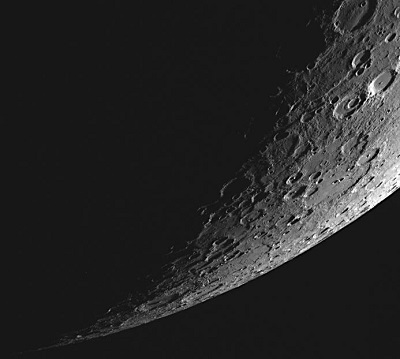
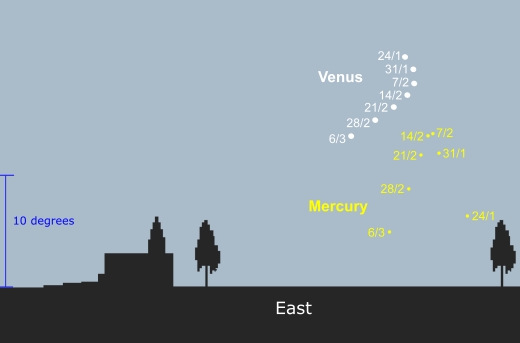
From latitude 35S (approx. equal to Sydney, Cape Town and Santiago) Mercury appeared 12 degrees above the eastern horizon, 45 minutes before sunrise on February 1st. At magnitude 0.0 it was relatively easy to spot the smallest planet in the Solar System. If you do have trouble locating Mercury, binoculars do greatly assist. Also, much brighter Venus (mag. -3.9) is currently placed just above Mercury and acts as a good marker. After elongation, Mercury appears slightly lower down each subsequent morning until it's finally lost to the bright twilight sky around March 10th. It should be noted the planet steadily increases in brightness and by the end of the visibility period shines at magnitude -0.7.
On February 6th and March 8th the very thin waning crescent Moon passes 4 degrees north of Mercury.


See also
The Planets this Month - February 2016