Comet Catalina continues to brighten during October but as has been for sometime now essentially remains a Southern Hemisphere object. For the past few months it's been slowly moving against the background "fixed" stars and by the middle of September had reached magnitude +6.3, easily within binocular and small telescope range. The comet currently appears fairly high in the sky during early evening from mid-temperate latitudes such as Sydney, Cape Town and Buenos Aires. Although lower down observers in the tropics can also spot it.
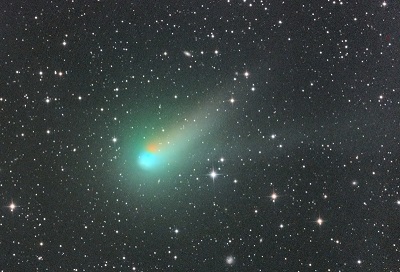
As it heads towards a November 15, 2015 perihelion date, Catalina is likely to brighten enough to be visible to the naked eye. Current predictions put the peak magnitude at about 4. However, comets are notoriously unpredictable and it may just fizzle out or brighter spectacularly so keep watching as you never quite know! Even taking the worst-case scenario its likely Catalina will be visible through binoculars for a few weeks to come.
Catalina Sky Survey
Comet Catalina was discovered by R. A. Kowalski of the Catalina Sky Survey on October 31, 2013. The Catalina Sky Survey (CSS) is a project based at the University of Arizona that searches for potentially hazardous asteroids that could impact the Earth. It utilizes 3 large telescopes to image the sky almost every clear night, except around full Moon, in the hunt for near-Earth objects (NEOs). To date the project had discovered hundreds of asteroids and comets.
Location and star chart
During September and October, Catalina is visible towards the west after sunset as soon as it's dark enough from southern locations. On September 22nd, it's positioned 5 degrees north of α Lup (mag. +2.3) in the constellation of Lupus. To the northeast of Catalina are stars ο Lup (mag .+4.3) and β Lup (mag. +2.7). At magnitude +6.1 it will be more than 20 times fainter than the α and β stars. Catalina then continues on a north-westerly path passing into Centaurus on September 24th where it remains until October 20th. It spends the last days of October cutting through the largest constellation of all Hydra.

From temperate northern latitudes, Catalina is not visible until November. It then finally crosses the celestial equator on December 17th becoming a true Northern Hemisphere object. On its journey through the inner Solar System the comet makes two passes of Earth. The first occurred during its inbound journey on August 14th and the second will happen on January 17, 2016 on its outward journey. On the second flyby, Northern Hemisphere observers will get their best chance to spot the comet when it approaches to within 0.72 AU or 108 million kilometres (67 million miles). At this time it could still be around 6th magnitude as it passes through one of the most famous of all constellations, Ursa Major the Great Bear or as it's commonly known the Big Dipper or Plough.
The finder charts below show the positions of the comet from August 31st to November 1st, 2015.


C/2013 US10 (Catalina) Data (at epoch November 15, 2014)
| Name | C/2013 US10 (Catalina) |
|---|---|
| Type | Comet |
| Discoverer | Catalina Sky Survey |
| Discovery date | October 31, 2013 |
| Perihelion (AU) | 0.82290 |
| Eccentricity | 1.00040 |
| Orbital period (years) | unknown |
| Inclination (degrees) | 148.8733 |
| Longitude of ascending node (degrees) | 186.1371 |
| Perihelion | November 15th, 2015 |
(C2013/US10) Catalina Data Table
| Date | Right Ascension | Declination | Mag. | Distance from Earth (AU) | Constellation |
|---|---|---|---|---|---|
| 01-Sep-2015 | 15h 32m 41s | -60d 39m 17s | 6.3 | 1.203 | Triangulum Australe |
| 02-Sep-2015 | 15h 27m 60s | -59d 40m 60s | 6.3 | 1.215 | Circinus |
| 03-Sep-2015 | 15h 23m 43s | -58d 43m 27s | 6.3 | 1.227 | Circinus |
| 04-Sep-2015 | 15h 19m 50s | -57d 46m 47s | 6.3 | 1.239 | Circinus |
| 05-Sep-2015 | 15h 16m 16s | -56d 51m 03s | 6.2 | 1.252 | Circinus |
| 06-Sep-2015 | 15h 12m 60s | -55d 56m 19s | 6.2 | 1.265 | Circinus |
| 07-Sep-2015 | 15h 09m 60s | -55d 02m 38s | 6.2 | 1.278 | Lupus |
| 08-Sep-2015 | 15h 07m 15s | -54d 10m 02s | 6.2 | 1.291 | Lupus |
| 09-Sep-2015 | 15h 04m 43s | -53d 18m 33s | 6.2 | 1.305 | Lupus |
| 10-Sep-2015 | 15h 02m 22s | -52d 28m 10s | 6.2 | 1.319 | Lupus |
| 11-Sep-2015 | 15h 00m 13s | -51d 38m 56s | 6.2 | 1.333 | Lupus |
| 12-Sep-2015 | 14h 58m 13s | -50d 50m 48s | 6.2 | 1.347 | Lupus |
| 13-Sep-2015 | 14h 56m 22s | -50d 03m 47s | 6.2 | 1.361 | Lupus |
| 14-Sep-2015 | 14h 54m 39s | -49d 17m 52s | 6.2 | 1.375 | Lupus |
| 15-Sep-2015 | 14h 53m 04s | -48d 33m 02s | 6.2 | 1.389 | Lupus |
| 16-Sep-2015 | 14h 51m 35s | -47d 49m 15s | 6.2 | 1.403 | Lupus |
| 17-Sep-2015 | 14h 50m 12s | -47d 06m 31s | 6.2 | 1.418 | Lupus |
| 18-Sep-2015 | 14h 48m 54s | -46d 24m 47s | 6.2 | 1.432 | Lupus |
| 19-Sep-2015 | 14h 47m 42s | -45d 44m 02s | 6.2 | 1.446 | Lupus |
| 20-Sep-2015 | 14h 46m 35s | -45d 04m 15s | 6.2 | 1.460 | Lupus |
| 21-Sep-2015 | 14h 45m 31s | -44d 25m 23s | 6.1 | 1.474 | Lupus |
| 22-Sep-2015 | 14h 44m 32s | -43d 47m 24s | 6.1 | 1.489 | Lupus |
| 23-Sep-2015 | 14h 43m 36s | -43d 10m 17s | 6.1 | 1.502 | Lupus |
| 24-Sep-2015 | 14h 42m 44s | -42d 34m 00s | 6.1 | 1.516 | Lupus |
| 25-Sep-2015 | 14h 41m 55s | -41d 58m 31s | 6.1 | 1.530 | Centaurus |
| 26-Sep-2015 | 14h 41m 08s | -41d 23m 48s | 6.1 | 1.544 | Centaurus |
| 27-Sep-2015 | 14h 40m 24s | -40d 49m 49s | 6.1 | 1.557 | Centaurus |
| 28-Sep-2015 | 14h 39m 43s | -40d 16m 32s | 6.1 | 1.570 | Centaurus |
| 29-Sep-2015 | 14h 39m 03s | -39d 43m 56s | 6.1 | 1.583 | Centaurus |
| 30-Sep-2015 | 14h 38m 26s | -39d 11m 58s | 6.0 | 1.596 | Centaurus |
| 01-Oct-2015 | 14h 37m 50s | -38d 40m 37s | 6.0 | 1.609 | Centaurus |
| 02-Oct-2015 | 14h 37m 16s | -38d 09m 52s | 6.0 | 1.621 | Centaurus |
| 03-Oct-2015 | 14h 36m 44s | -37d 39m 40s | 6.0 | 1.633 | Centaurus |
| 04-Oct-2015 | 14h 36m 13s | -37d 09m 60s | 6.0 | 1.645 | Centaurus |
| 05-Oct-2015 | 14h 35m 43s | -36d 40m 50s | 6.0 | 1.657 | Centaurus |
| 06-Oct-2015 | 14h 35m 15s | -36d 12m 08s | 5.9 | 1.668 | Centaurus |
| 07-Oct-2015 | 14h 34m 48s | -35d 43m 54s | 5.9 | 1.679 | Centaurus |
| 08-Oct-2015 | 14h 34m 22s | -35d 16m 05s | 5.9 | 1.690 | Centaurus |
| 09-Oct-2015 | 14h 33m 56s | -34d 48m 41s | 5.9 | 1.700 | Centaurus |
| 10-Oct-2015 | 14h 33m 32s | -34d 21m 38s | 5.9 | 1.710 | Centaurus |
| 11-Oct-2015 | 14h 33m 08s | -33d 54m 57s | 5.8 | 1.720 | Centaurus |
| 12-Oct-2015 | 14h 32m 45s | -33d 28m 36s | 5.8 | 1.729 | Centaurus |
| 13-Oct-2015 | 14h 32m 23s | -33d 02m 33s | 5.8 | 1.738 | Centaurus |
| 14-Oct-2015 | 14h 32m 01s | -32d 36m 47s | 5.8 | 1.747 | Centaurus |
| 15-Oct-2015 | 14h 31m 40s | -32d 11m 16s | 5.8 | 1.755 | Centaurus |
| 16-Oct-2015 | 14h 31m 19s | -31d 45m 60s | 5.7 | 1.763 | Centaurus |
| 17-Oct-2015 | 14h 30m 58s | -31d 20m 56s | 5.7 | 1.770 | Centaurus |
| 18-Oct-2015 | 14h 30m 38s | -30d 56m 04s | 5.7 | 1.777 | Centaurus |
| 19-Oct-2015 | 14h 30m 18s | -30d 31m 23s | 5.7 | 1.783 | Centaurus |
| 20-Oct-2015 | 14h 29m 58s | -30d 06m 51s | 5.7 | 1.789 | Centaurus |
| 21-Oct-2015 | 14h 29m 39s | -29d 42m 26s | 5.6 | 1.795 | Hydra |
| 22-Oct-2015 | 14h 29m 19s | -29d 18m 09s | 5.6 | 1.800 | Hydra |
| 23-Oct-2015 | 14h 28m 60s | -28d 53m 57s | 5.6 | 1.804 | Hydra |
| 24-Oct-2015 | 14h 28m 41s | -28d 29m 50s | 5.6 | 1.808 | Hydra |
| 25-Oct-2015 | 14h 28m 22s | -28d 05m 46s | 5.5 | 1.812 | Hydra |
| 26-Oct-2015 | 14h 28m 03s | -27d 41m 45s | 5.5 | 1.815 | Hydra |
| 27-Oct-2015 | 14h 27m 44s | -27d 17m 45s | 5.5 | 1.817 | Hydra |
| 28-Oct-2015 | 14h 27m 26s | -26d 53m 45s | 5.5 | 1.819 | Hydra |
| 29-Oct-2015 | 14h 27m 07s | -26d 29m 45s | 5.4 | 1.821 | Hydra |
| 30-Oct-2015 | 14h 26m 49s | -26d 05m 43s | 5.4 | 1.821 | Hydra |
| 31-Oct-2015 | 14h 26m 30s | -25d 41m 39s | 5.4 | 1.822 | Hydra |
| 01-Nov-2015 | 14h 26m 12s | -25d 17m 31s | 5.4 | 1.821 | Hydra |
| 02-Nov-2015 | 14h 25m 54s | -24d 53m 19s | 5.4 | 1.820 | Libra |
| 03-Nov-2015 | 14h 25m 36s | -24d 29m 01s | 5.3 | 1.819 | Libra |
| 04-Nov-2015 | 14h 25m 18s | -24d 04m 38s | 5.3 | 1.817 | Libra |
| 05-Nov-2015 | 14h 24m 60s | -23d 40m 07s | 5.3 | 1.814 | Libra |
| 06-Nov-2015 | 14h 24m 42s | -23d 15m 29s | 5.3 | 1.811 | Libra |
| 07-Nov-2015 | 14h 24m 25s | -22d 50m 41s | 5.3 | 1.807 | Libra |
| 08-Nov-2015 | 14h 24m 07s | -22d 25m 44s | 5.2 | 1.802 | Libra |
| 09-Nov-2015 | 14h 23m 50s | -22d 00m 37s | 5.2 | 1.797 | Libra |
| 10-Nov-2015 | 14h 23m 33s | -21d 35m 17s | 5.2 | 1.791 | Libra |
| 11-Nov-2015 | 14h 23m 16s | -21d 09m 46s | 5.2 | 1.785 | Libra |
| 12-Nov-2015 | 14h 22m 60s | -20d 44m 01s | 5.2 | 1.778 | Libra |
| 13-Nov-2015 | 14h 22m 44s | -20d 18m 03s | 5.2 | 1.770 | Libra |
| 14-Nov-2015 | 14h 22m 28s | -19d 51m 49s | 5.1 | 1.762 | Libra |
| 15-Nov-2015 | 14h 22m 12s | -19d 25m 19s | 5.1 | 1.753 | Libra |
| 16-Nov-2015 | 14h 21m 57s | -18d 58m 31s | 5.1 | 1.743 | Virgo |
| 17-Nov-2015 | 14h 21m 42s | -18d 31m 26s | 5.1 | 1.733 | Virgo |
| 18-Nov-2015 | 14h 21m 28s | -18d 04m 01s | 5.1 | 1.723 | Virgo |
| 19-Nov-2015 | 14h 21m 14s | -17d 36m 16s | 5.1 | 1.711 | Virgo |
| 20-Nov-2015 | 14h 21m 00s | -17d 08m 10s | 5.1 | 1.700 | Virgo |
| 21-Nov-2015 | 14h 20m 47s | -16d 39m 40s | 5.1 | 1.687 | Virgo |
| 22-Nov-2015 | 14h 20m 34s | -16d 10m 46s | 5.1 | 1.674 | Virgo |
| 23-Nov-2015 | 14h 20m 22s | -15d 41m 27s | 5.1 | 1.661 | Virgo |
| 24-Nov-2015 | 14h 20m 10s | -15d 11m 40s | 5.0 | 1.647 | Virgo |
| 25-Nov-2015 | 14h 19m 59s | -14d 41m 25s | 5.0 | 1.632 | Virgo |
| 26-Nov-2015 | 14h 19m 48s | -14d 10m 40s | 5.0 | 1.617 | Virgo |
| 27-Nov-2015 | 14h 19m 38s | -13d 39m 22s | 5.0 | 1.601 | Virgo |
| 28-Nov-2015 | 14h 19m 28s | -13d 07m 30s | 5.0 | 1.585 | Virgo |
| 29-Nov-2015 | 14h 19m 19s | -12d 35m 02s | 5.0 | 1.569 | Virgo |
| 30-Nov-2015 | 14h 19m 10s | -12d 01m 56s | 5.0 | 1.552 | Virgo |
See also
Comet Catalina (C/2013 US10) moves past Kemble's Cascade during the last week of February 2016. Visible with binoculars and small telescopes from northern and tropical latitudes.
Comet Catalina (C/2013 US10) now fading as it recedes from Earth. Currently moving through the far northern constellations. Remains visible with binoculars and small telescopes.
Comet Catalina (C/2013 US10) remains visible with binoculars and small telescopes at it moves northwards. This month offers the last good chance to catch a glimpse before it fades significantly.
Comet Catalina (C/2013 US10) moves past Arcturus as it heads north during January. Remains visible with binoculars and small telescopes.
Comet Catalina (C/2013 US10) an early morning binocular and small telescope object
Catalina (C/2013 US10) an early morning binocular and small telescope comet
Comet Catalina (C/2013 US10) remains visible in the evening from Southern and Equatorial Latitudes during September 2015
Comet Catalina (C/2013 US10) now visible with binoculars from Southern and Equatorial Latitudes